


Dailymaverick logo

Maverick News

Maverick News

62% white. 73% male. When will SA's top management jobs move beyond the pale?

Despite decades of transformation policy, South Africa’s corporate leadership remains overwhelmingly white and male. As the ANC and DA clash in court over the Employment Equity Act, the deeper question remains: why is real change still so elusive?
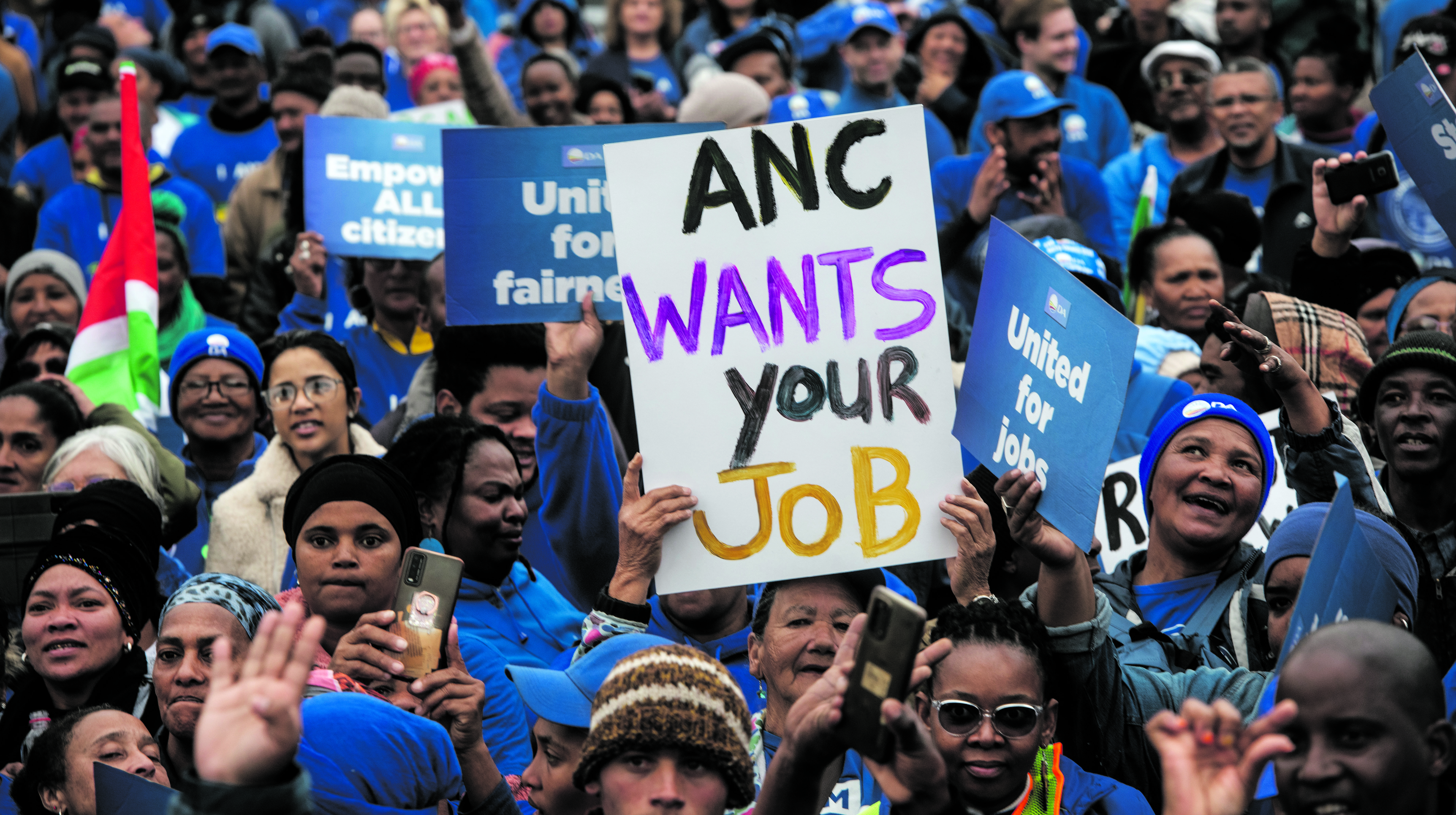
62% white. 73% male. When will SA's top management jobs move beyond the pale? At the dawn of democracy, economic power in South Africa remained firmly in white hands, despite the fall of apartheid. The ruling ANC adopted black economic empowerment (BEE) as a policy to change that.  Initially focused on ownership, often via high-stakes equity deals in established companies, the early BEE framework faced criticism for favouring a politically connected elite and often collapsing under financial stress.  The path to BEE was shaped by significant ideological shifts in the ANC. Although the Freedom Charter had called for sharing the nation’s wealth, some perspectives suggest that BEE ultimately emerged as a “consolation prize” for the ANC’s abandonment of more radical socialist policies such as nationalisation.  These shifts followed Nelson Mandela’s pivotal 1992 visit to the World Economic Forum annual meeting in Davos, where the future South African leadership was exposed to market-oriented global economic thinking, and warned to avoid the fate of isolated economies such as Cuba and North Korea. Oddly, while the policy is maligned by business now, BEE has its roots in corporate South Africa, with Anglo American pioneering early empowerment deals. These initiatives later evolved into a cornerstone policy instrument, initially focused on “deracialising business ownership and control”, as outlined in the ANC’s Reconstruction and Development Programme.  The early iterations primarily targeted increasing black ownership stakes in established white-owned companies through equity transactions, often using complex, leveraged financing structures that proved vulnerable during financial downturns. [caption id="attachment_2706457" align="alignnone" width="720"] More than 1,000 DA supporters march to Parliament to protest against the Employment Equity Act Draft Regulations on 26 July 2023. (Photo: Brenton Geach / Gallo Images)[/caption]

A long and winding road

By 2003, the government had introduced the Broad-Based Black Economic Empowerment (B-BBEE) Act. The shift from narrow BEE (focused on ownership deals) to broad-based BEE aligned with Thabo Mbeki’s economic policy agenda, which was shaped by market-friendly, growth-oriented reforms, with the accompanying B-BBEE scorecard adding dimensions such as employment equity, skills development and preferential procurement. Despite these frameworks, progress in transforming South Africa’s labour market has been uneven. Although overall employment rose significantly from 1994 to 2024, with black South Africans accounting for the largest increase in total employment (from about 63% in 1994 to about 73% in 2014), their advancement into higher-skill occupations has been “frustratingly limited”. Their representation in skilled occupations increased only marginally from 15% in 1994 to 18% by 2014, while skilled employment among white and Indian/Asian groups expanded significantly – a 26% increase – during the same period.  This trend continued into the 2023 data, where the Indian population group’s representation in skilled occupations and top or senior management exceeded their proportion of the economically active population (EAP), which is 2.6%. They have disproportionate representation in top management (11.6%) and senior management (12.4%). [caption id="attachment_2711277" align="alignnone" width="720"] Source: 24th Commission for Employment Equity (CEE) Annual Report (2023-2024); Illustration: Vecteezy[/caption] The public sector has been a beacon of the potential effectiveness of aggressively enforced BEE policies with more than 80% of public sector employees, including senior management, being black. The private sector has lagged behind significantly, suggesting that without strong enforcement mechanisms and clear incentives, transformation remains superficial – a pattern that has persisted during the 26 years since the Employment Equity Act was put into effect.

Sharper teeth and harder targets

The Employment Equity Amendment Act of 2022, which came into effect with accompanying regulations on 15 April 2025, is the ANC government’s latest attempt to accelerate this stalled transformation.  The amendments empower the Minister of Employment and Labour to set numerical targets for equitable representation of designated groups across all occupational levels after consulting relevant sectors and with advice from the Commission for Employment Equity. Lara Jansen van Rensburg, partner at Eversheds Sutherland, explained: “The Employment Equity Amendment Act is designed to drive meaningful transformation by enforcing sector-specific numerical targets. These quotas ensure that designated groups are adequately represented, moving beyond voluntary compliance.”  However, she warned that the conflicting draft regulations filed in May 2023 and February 2024 have created uncertainty and that “businesses must remain flexible in their employment equity planning”. This uncertainty was addressed in the final regulations, but the early confusion did reduce confidence.

Slow transformation

Despite decades of employment equity ef­forts, the 24th annual report of the Commission for Employment Equity revealed that transformation in corporate South Africa remains slow, and white men still dominate top management.  The data shows that 62.1% of these management roles are occupied by white individuals, despite them making up a much smaller proportion of the EAP (7.7% of all working-age South Africans). Additionally, 73.1% of top management positions are held by men, which points to persistent gender imbalance in leadership.  Although there has been some progress in increasing representation of designated groups, the pace remains slow in the private sector. To remedy this, the Employment Equity Regulations, 2025, which replaced the 2014 regulations, introduce what analysts describe as “a significantly more prescriptive and compliance-driven framework” for designated employers – those with 50 or more employees. Central to these reforms is the accompanying sectoral numerical targets, which introduce prescriptive goals for 18 key sectors over the next five years. “The new Employment Equity Regulations ... introduce sector-specific numerical targets for designated groups in South Africa, including the construction sector,” Thembeka Mnisi, president of South African Women in Construction, explained to Daily Maverick.  “These targets aim to increase the representation of black people, women and individuals with disabilities in the workforce, particularly in upper occupational levels.” One major shift is the elevation of targets for people with disabilities from 2% to 3%.  In construction, the goal is that 65.2% of professionally qualified employees will be African by 2030.  Designated employers will have to align their employment equity (EE) plans with these sectoral targets or face potential fines, compliance orders and exclusion from doing business with the state. Importantly, the legislation insists these are not rigid quotas. “Designated employers can set their own targets in their EE plans and justify failure to meet them on reasonable grounds,” said Nomakhosazana Meth, the minister of employment and labour. 

Technical skills, not degrees

The implementation of these policies continues to face substantial challenges. Deep structural inequalities, economic sluggishness and deficiencies in the education system sustain a difficult environment for meaningful transformation. Despite the increased overall employment of black South Africans, their movement into higher-skilled occupations remains limited, and the private sector is particularly resistant to change compared with the public sector. High youth unemployment, especially among young black South Africans, persists as a significant concern. [caption id="attachment_2713037" align="alignnone" width="720"] Stats SA graphic of unemployment according to population groups[/caption] Transformation, though, is not only a numbers game – and in the real economy, skills shortages may matter more than demographics. “Degrees alone won’t save South Africa’s economy,” warned Yershen Pillay, CEO of the Chemical Industries Education and Training Authority (Chieta). “Skills will.” Pillay laments the “mismatch between the skills our economy needs and the qualifications we continue to produce”.  In a nation hurtling into a future defined by artificial intelligence, green energy and advanced manufacturing, technical competence is the missing link.  Chieta’s model, which includes decentralised trade test sites and Smart Skills Centres, is trying to close the gap. “We are preparing South Africa’s youth for the industries of tomorrow,” Pillay said, advocating a national pivot towards artisanship and innovation over outdated academic credentials. While industry leaders call for agility, the DA is challenging the new framework in court, arguing that the targets constitute rigid quotas and threaten both fairness and constitutional order. The DA’s lawyer, Ismail Jamie, described the regulations as “totalitarian” and creating “an absolute barrier” to employment based on birth. The party maintains that the previous version of the act was preferable: employer-­led, context-sensitive and explicitly against quotas. [caption id="attachment_2713008" align="alignnone" width="720"] Source: 24th Commission for Employment Equity (CEE) Annual Report (2023-2024)[/caption]

Quotas by another name?

There is a critical mismatch between the skills the economy needs and the qualifications being produced, highlighting the urgent need for investment in skills development aligned with market requirements.  The regulatory framework has also raised concerns among businesses about compliance burdens, although smaller companies employing fewer than 50 people were ultimately excluded from reporting requirements, in the wake of opposition. Critics have also pointed to instances where BEE implementation has facilitated “elite capture” rather than broad-based empowerment, with practices such as “fronting” and “tenderpreneurship” undermining genuine transformation and fostering public cynicism. A key element of the DA’s challenge focuses on the potential impact of applying national targets at the provincial level.  The party’s federal executive chair, Helen Zille, has argued that imposing national demographic targets without considering provincial variations would be “manifestly unfair” to minority groups, citing examples such as Indians in KwaZulu-Natal and coloured people in the Western Cape, who might face reduced access to employment. There is also an insistence that the legislation should have followed the Section 76 process of the Constitution, which is designed to safeguard provincial interests. In response, advocate Fana Nalane, representing the minister, has countered that the court’s focus should be on whether Section 15A of the act itself is constitutional, not on hypothetical implementation scenarios or the potential impact on individuals moving between provinces. The minister also rebuffed these claims in a statement given to Daily Maverick: “The DA’s challenge seeks to disrupt efforts aimed at achieving equitable representation and maintaining the inherently unfair status quo,” said Meth.  “By opposing these amendments, the DA is actively sabotaging the transformation goals that have been pursued since the end of the apartheid era, effectively hindering progress towards equality and fairness in the workplace.  “This stance is not only anti-transformation, but also a step backward in the fight for equality and fairness in the workplace.” Meth defended her authority to set numerical targets, emphasising that this power is exercised only after consulting relevant sectors and the Commission for Employment Equity, ensuring she does not act arbitrarily and remains within the act’s framework. [caption id="attachment_2321052" align="alignnone" width="720"] Youth representatives during the Youth Jobs Imbizo Summit at the Metro Centre on June 23, 2023 in Johannesburg, South Africa.(Photo by Gallo Images/Luba Lesolle)[/caption]

A dose of reality

What emerges from this policy clash is a tension between two competing visions of fairness: one grounded in redress for historical injustice, the other in procedural equity and individual rights.  But even beyond the ideological divide, transformation is slowed by deeper challenges – a sluggish economy, a broken education system and systemic in­equa­lity. What remains clear is that despite three decades of policy interventions, the transformation of South Africa’s economic landscape remains incomplete. For advocates of the new rules, the hope is that clear targets – if implemented flexibly and fairly – can finally break the inertia.  For opponents, the fear is that rigid state intervention may simply replace one injustice with another. In the meantime, young South Africans wait – many unemployed, most under-skilled, all looking for something the law alone can’t deliver: a future that works. As the legal challenge moves through the courts, policymakers and business leaders alike face the challenge of better integrating B-BBEE policy with broader economic stra- tegies to ensure truly inclusive, broad-based economic growth. It’s a goal that remains as urgent today as it was at the dawn of South Africa’s democracy. DM This story first appeared in our weekly DM168 newspaper, available countrywide for R35.

At the dawn of democracy, economic power in South Africa remained firmly in white hands, despite the fall of apartheid. The ruling ANC adopted black economic empowerment (BEE) as a policy to change that. 

Initially focused on ownership, often via high-stakes equity deals in established companies, the early BEE framework faced criticism for favouring a politically connected elite and often collapsing under financial stress. 

The path to BEE was shaped by significant ideological shifts in the ANC. Although the Freedom Charter had called for sharing the nation’s wealth, some perspectives suggest that BEE ultimately emerged as a “consolation prize” for the ANC’s abandonment of more radical socialist policies such as nationalisation. 

These shifts followed Nelson Mandela’s pivotal 1992 visit to the World Economic Forum annual meeting in Davos, where the future South African leadership was exposed to market-oriented global economic thinking, and warned to avoid the fate of isolated economies such as Cuba and North Korea.

Oddly, while the policy is maligned by business now, BEE has its roots in corporate South Africa, with Anglo American pioneering early empowerment deals. These initiatives later evolved into a cornerstone policy instrument, initially focused on “deracialising business ownership and control”, as outlined in the ANC’s Reconstruction and Development Programme. 

The early iterations primarily targeted increasing black ownership stakes in established white-owned companies through equity transactions, often using complex, leveraged financing structures that proved vulnerable during financial downturns.

More than 1,000 DA supporters march to Parliament to protest against the Employment Equity Act Draft Regulations on 26 July 2023. (Photo: Brenton Geach / Gallo Images)


A long and winding road


By 2003, the government had introduced the Broad-Based Black Economic Empowerment (B-BBEE) Act. The shift from narrow BEE (focused on ownership deals) to broad-based BEE aligned with Thabo Mbeki’s economic policy agenda, which was shaped by market-friendly, growth-oriented reforms, with the accompanying B-BBEE scorecard adding dimensions such as employment equity, skills development and preferential procurement.

Despite these frameworks, progress in transforming South Africa’s labour market has been uneven. Although overall employment rose significantly from 1994 to 2024, with black South Africans accounting for the largest increase in total employment (from about 63% in 1994 to about 73% in 2014), their advancement into higher-skill occupations has been “frustratingly limited”.

Their representation in skilled occupations increased only marginally from 15% in 1994 to 18% by 2014, while skilled employment among white and Indian/Asian groups expanded significantly – a 26% increase – during the same period. 

This trend continued into the 2023 data, where the Indian population group’s representation in skilled occupations and top or senior management exceeded their proportion of the economically active population (EAP), which is 2.6%. They have disproportionate representation in top management (11.6%) and senior management (12.4%).

Source: 24th Commission for Employment Equity (CEE) Annual Report (2023-2024); Illustration: Vecteezy


The public sector has been a beacon of the potential effectiveness of aggressively enforced BEE policies with more than 80% of public sector employees, including senior management, being black. The private sector has lagged behind significantly, suggesting that without strong enforcement mechanisms and clear incentives, transformation remains superficial – a pattern that has persisted during the 26 years since the Employment Equity Act was put into effect.

Sharper teeth and harder targets


The Employment Equity Amendment Act of 2022, which came into effect with accompanying regulations on 15 April 2025, is the ANC government’s latest attempt to accelerate this stalled transformation. 

The amendments empower the Minister of Employment and Labour to set numerical targets for equitable representation of designated groups across all occupational levels after consulting relevant sectors and with advice from the Commission for Employment Equity.

Lara Jansen van Rensburg, partner at Eversheds Sutherland, explained: “The Employment Equity Amendment Act is designed to drive meaningful transformation by enforcing sector-specific numerical targets. These quotas ensure that designated groups are adequately represented, moving beyond voluntary compliance.” 

However, she warned that the conflicting draft regulations filed in May 2023 and February 2024 have created uncertainty and that “businesses must remain flexible in their employment equity planning”. This uncertainty was addressed in the final regulations, but the early confusion did reduce confidence.

Slow transformation


Despite decades of employment equity ef­forts, the 24th annual report of the Commission for Employment Equity revealed that transformation in corporate South Africa remains slow, and white men still dominate top management. 

The data shows that 62.1% of these management roles are occupied by white individuals, despite them making up a much smaller proportion of the EAP (7.7% of all working-age South Africans). Additionally, 73.1% of top management positions are held by men, which points to persistent gender imbalance in leadership. 

Although there has been some progress in increasing representation of designated groups, the pace remains slow in the private sector.

To remedy this, the Employment Equity Regulations, 2025, which replaced the 2014 regulations, introduce what analysts describe as “a significantly more prescriptive and compliance-driven framework” for designated employers – those with 50 or more employees.

Central to these reforms is the accompanying sectoral numerical targets, which introduce prescriptive goals for 18 key sectors over the next five years.

“The new Employment Equity Regulations ... introduce sector-specific numerical targets for designated groups in South Africa, including the construction sector,” Thembeka Mnisi, president of South African Women in Construction, explained to Daily Maverick. 

“These targets aim to increase the representation of black people, women and individuals with disabilities in the workforce, particularly in upper occupational levels.”

One major shift is the elevation of targets for people with disabilities from 2% to 3%. 

In construction, the goal is that 65.2% of professionally qualified employees will be African by 2030. 

Designated employers will have to align their employment equity (EE) plans with these sectoral targets or face potential fines, compliance orders and exclusion from doing business with the state.

Importantly, the legislation insists these are not rigid quotas. “Designated employers can set their own targets in their EE plans and justify failure to meet them on reasonable grounds,” said Nomakhosazana Meth, the minister of employment and labour. 

Technical skills, not degrees


The implementation of these policies continues to face substantial challenges. Deep structural inequalities, economic sluggishness and deficiencies in the education system sustain a difficult environment for meaningful transformation.

Despite the increased overall employment of black South Africans, their movement into higher-skilled occupations remains limited, and the private sector is particularly resistant to change compared with the public sector. High youth unemployment, especially among young black South Africans, persists as a significant concern.

Stats SA graphic of unemployment according to population groups


Transformation, though, is not only a numbers game – and in the real economy, skills shortages may matter more than demographics.

“Degrees alone won’t save South Africa’s economy,” warned Yershen Pillay, CEO of the Chemical Industries Education and Training Authority (Chieta). “Skills will.”

Pillay laments the “mismatch between the skills our economy needs and the qualifications we continue to produce”. 

In a nation hurtling into a future defined by artificial intelligence, green energy and advanced manufacturing, technical competence is the missing link. 

Chieta’s model, which includes decentralised trade test sites and Smart Skills Centres, is trying to close the gap.

“We are preparing South Africa’s youth for the industries of tomorrow,” Pillay said, advocating a national pivot towards artisanship and innovation over outdated academic credentials.

While industry leaders call for agility, the DA is challenging the new framework in court, arguing that the targets constitute rigid quotas and threaten both fairness and constitutional order.

The DA’s lawyer, Ismail Jamie, described the regulations as “totalitarian” and creating “an absolute barrier” to employment based on birth. The party maintains that the previous version of the act was preferable: employer-­led, context-sensitive and explicitly against quotas.

Source: 24th Commission for Employment Equity (CEE) Annual Report (2023-2024)


Quotas by another name?


There is a critical mismatch between the skills the economy needs and the qualifications being produced, highlighting the urgent need for investment in skills development aligned with market requirements. 

The regulatory framework has also raised concerns among businesses about compliance burdens, although smaller companies employing fewer than 50 people were ultimately excluded from reporting requirements, in the wake of opposition.

Critics have also pointed to instances where BEE implementation has facilitated “elite capture” rather than broad-based empowerment, with practices such as “fronting” and “tenderpreneurship” undermining genuine transformation and fostering public cynicism.

A key element of the DA’s challenge focuses on the potential impact of applying national targets at the provincial level. 

The party’s federal executive chair, Helen Zille, has argued that imposing national demographic targets without considering provincial variations would be “manifestly unfair” to minority groups, citing examples such as Indians in KwaZulu-Natal and coloured people in the Western Cape, who might face reduced access to employment.

There is also an insistence that the legislation should have followed the Section 76 process of the Constitution, which is designed to safeguard provincial interests.

In response, advocate Fana Nalane, representing the minister, has countered that the court’s focus should be on whether Section 15A of the act itself is constitutional, not on hypothetical implementation scenarios or the potential impact on individuals moving between provinces.

The minister also rebuffed these claims in a statement given to Daily Maverick: “The DA’s challenge seeks to disrupt efforts aimed at achieving equitable representation and maintaining the inherently unfair status quo,” said Meth. 

“By opposing these amendments, the DA is actively sabotaging the transformation goals that have been pursued since the end of the apartheid era, effectively hindering progress towards equality and fairness in
the workplace. 

“This stance is not only anti-transformation, but also a step backward in the fight for equality and fairness in the workplace.”

Meth defended her authority to set numerical targets, emphasising that this power is exercised only after consulting relevant sectors and the Commission for Employment Equity, ensuring she does not act arbitrarily and remains within the act’s framework.

Youth representatives during the Youth Jobs Imbizo Summit at the Metro Centre on June 23, 2023 in Johannesburg, South Africa.(Photo by Gallo Images/Luba Lesolle)


A dose of reality


What emerges from this policy clash is a tension between two competing visions of fairness: one grounded in redress for historical injustice, the other in procedural equity and individual rights. 

But even beyond the ideological divide, transformation is slowed by deeper challenges – a sluggish economy, a broken education system and systemic in­equa­lity.

What remains clear is that despite three decades of policy interventions, the transformation of South Africa’s economic landscape remains incomplete.

For advocates of the new rules, the hope is that clear targets – if implemented flexibly and fairly – can finally break the inertia. 

For opponents, the fear is that rigid state intervention may simply replace one injustice with another.

In the meantime, young South Africans wait – many unemployed, most under-skilled, all looking for something the law alone can’t deliver: a future that works.

As the legal challenge moves through the courts, policymakers and business leaders alike face the challenge of better integrating B-BBEE policy with broader economic stra-
tegies to ensure truly inclusive, broad-based economic growth. It’s a goal that remains as urgent today as it was at the dawn of South Africa’s democracy. DM

This story first appeared in our weekly DM168 newspaper, available countrywide for R35.

Comments

Fanie Rajesh Ngabiso May 10, 2025, 01:53 AM

When our education system works for all. The issue is not race as is nearly always implied, it is equitable access to quality education. There is no free lunch here. ANC, educate our people or get out of the way and allow the DA to do it.

William Stucke May 10, 2025, 12:32 PM

Well said, Fanie. While more kids are going to school, in far too many cases they are learning little to nothing. The ANC crows about an increased matric pass rate, while ignoring the reduction in standards and pass rates. The crux of the issue is the appalling deterioration of education in South Africa. To quote IOL: "Political analysts and unions in the education sector say the state of education in black communities has deteriorated since the advent of democracy in 1994."

megapode May 10, 2025, 03:52 PM

I think social networks, what they call "the old school tie" in the UK, still plays a part. But yes, the stats show that white folks still have better access to education. And they earn more per head, so they can better afford good schooling and to send kids to university. There's no getting away from the role that colour still plays in this country. We might argue that it's not what we want, and we may be right, but the divide is still undeniably there.

Fanie Rajesh Ngabiso May 10, 2025, 11:02 PM

Equal education for all is the first and biggest requirement by a country mile. We need to focus on what is most important. The rest will follow.

Peter Doble May 12, 2025, 07:30 AM

Connections will always play a part in every sphere of any society. But the labour market, and certainly managers/executives, must be decided on merit not law. Race, colour, creed, physical disability or gender should not be promoted nor discriminated. Skills and relevant experience are the only factors.

Francois Smith May 12, 2025, 09:54 AM

Indeed, what a shallow article by the journalist! It is about equality of opportunity and not equality of outcome. Strange that the journalist does not elaborate on say Eskom where equality of outcome prevailed in the composition of the work force. Look what that resulted in!

R S May 12, 2025, 09:29 AM

My parents aren't white and worked themselves to the bone to get my siblings and I into private schools. Times were very tough. We sometimes didn't have money for food. But they prioritised education and it paid off for all of us.

Jubilee 1516 May 10, 2025, 07:44 AM

Rather than a witch hunt against white males, start by asking how many new businesses, companies etc. are formed by black males, females and other much more preferred demographics mentioned in the article.

megapode May 10, 2025, 03:55 PM

What's a "business"? A spaza shop in a township? Owning a taxi? A garden service? Tailors? I deal with a black-owned, black-run lawnmower servicing business in my 'hood. All my tailoring/clothes repair is done by black people in a black-owned business. My DSTV was installed by a black-owned small business.

Jubilee 1516 May 11, 2025, 10:33 AM

A business to which this bizarre ideology can be applied to enable piggybacking. Registered with CIPC in most cases, and with SARS etc. One where there is growth and levels of management and directorships. A few of which a few have the potential to list on the JSE in years to come. A new idea registered at OAPI or ARIPO with the intention to expand into Africa. Not the spaza shops selling poisonous food to children and the ANC cannot manage to register at the municipality for a trading licence.

Jubilee 1516 May 10, 2025, 07:50 AM

How far back will we redress "historical injustices". Will we return to 1652? How equal were we back then?

megapode May 10, 2025, 03:58 PM

Well in terms of land claims, the cut off in law has been 1913. That's because that was the first time we had a unitary South Africa with laws taking land from non-white citizens.

Jubilee 1516 May 11, 2025, 05:46 PM

OK, so let us redress so we all return to our different levels of development as at 1913.

Fanie Rajesh Ngabiso May 12, 2025, 08:51 AM

I just don't get your point/s Bob. We all know that the past was wrong. However the simple fact remains that South Africans cannot be made competitive via legislation. Education is the only sure route.

megapode May 12, 2025, 10:25 AM

I was providing some sort of answer to the question of how far back redress should go. Land redress is a good example. It doesn't go back past the institution of a unitary SA. That seems a good starting point.

Fanie Rajesh Ngabiso May 12, 2025, 04:07 PM

Expropriation is crazily complicated. A question might be: "Is expropriating land today from people who have purchased it using their own savings any better than expropriating it from people back in the early 1900s?" My feeling is absolutely "No; 2 wrongs will never make a right." But more importantly, uplifting our people in the form of education will allow active and productive participation in the global economy. Those empowered can purchase land, cars, houses.... Educate! I say.

Martin Neethling May 10, 2025, 07:54 AM

BEE targets have been driven through most of the public sector, but no ‘potential beacon’ of success has emerged in 3 decades. In fact quite the opposite! The numbers reverse in the private sector, as do the results. It boils down to competence, a function of hard yards and skills. Businesses in SA fall over themselves to secure talented black managers, but the pool is shallow. They aren’t in the Public Sector, so a small group recycle between competitors. This is our reality.

Wilhelm van Rooyen May 10, 2025, 02:11 PM

True in my experience too - the few qualified and experienced Black professionals keep jumping between employers, don't add much long term value, and keep on raising personnel cost. In more technical positions, we often had to resort to contracting retired professionals to get the job done. Management's KPIs include BBEE targets, but shareholders (of all colours) prefer ROC

Mike Lawrie May 10, 2025, 08:09 AM

Look at the success and failures of the entities that are dominated by black management, and then judge if it is a good idea to force the pace of transformation. Eskom, Prasa, VBS bank, Post Office, SAA, the Public Service, Denel, and many more. It is only the favoured few who are benefitting from BEE. The priority should be to have the country run properly.

Johan Buys May 10, 2025, 08:21 AM

Appointing staff based on race / sex is a VERY stupid business decision. If there are businesses that select white males because they are white male, instead of the best applicant, will not do as well as a competitor that selects the best candidate. Those that did do that will in any event not change because of the EE act. Racism is baked into their DNA. I think the last people to try this kind of social engineering were the Nazis in the 1930’s.

megapode May 10, 2025, 04:01 PM

How long have you lived in South Africa? Whites were hugely advantaged in the job market, especially government departments well in to the 80s. OK, they got in black men to clean out the toilets but clerical work, skilled work, management, whites got a head start.

Johan Buys May 11, 2025, 10:35 AM

You appear to miss my point : selecting staff now because they are black/female is as stupid as the racists are/were that select staff because they are white/male. Or, perhaps you think selecting top staff on race/sex basis is clever?

megapode May 12, 2025, 10:32 AM

What I was responding to was the claim that the last bunch who tried this kind of appointing on the basis of color or gender was Nazi Germany in the 30s. Which was your point, and that's what I responded to. In fact there are other cases since the 30s. Rhodesia an obvious one. There are softer cases too where these sorts of selections happened but were not overt government policy.

Jubilee 1516 May 11, 2025, 05:44 PM

How far back do you know our job market's history? who introduced it, grew it, as well as mining, industry, manufacturing etc? The advantage wa natural.

Johan Buys May 10, 2025, 08:21 AM

Appointing staff based on race / sex is a VERY stupid business decision. If there are businesses that select white males because they are white male, instead of the best applicant, will not do as well as a competitor that selects the best candidate. Those that did do that will in any event not change because of the EE act. Racism is baked into their DNA. I think the last people to try this kind of social engineering were the Nazis in the 1930’s.

megapode May 12, 2025, 10:28 AM

That sort of social engineering went on in SA at least into the 1980s. That's what apartheid was and did.

Richard Bryant May 10, 2025, 08:36 AM

Ironically, the longer term impact of most social programs is likely have the opposite effect. Or at least unintended consequences. For anyone who is given a job because of who they are and not because of skill or experience is likely to be lazy and possibly obstructive for fear of showing up deficiencies. Meanwhile my children who have no hope of getting anywhere here are working overseas. Getting stronger. Gaining experience. Becoming worldly. Earning way more they can earn here.

Wilhelm van Rooyen May 10, 2025, 02:13 PM

Mine too, and probably never coming back. Lost forever to this country

Freda Brodie May 11, 2025, 04:35 PM

My son & family moved to Canada, not for job opportunities, but for their kids safety and better education. My son was self employed. His skills are lost to this country, and our family lives have changed forever.

A Rosebank Ratepayer May 10, 2025, 08:58 AM

Article quiet on real issue except quote from Yershen Pillay re need for skills. 1000s of years ago King Canute tried to illustrate futility of thinking decrees will change anything. Only being able to do the job will. In our own experience Government departments themselves wouldn’t accept work from BEE interns because of insufficient polish. They only accepted work prepared by experienced white professionals, not because they were white but because of quality.

A Rosebank Ratepayer May 10, 2025, 09:05 AM

Government is criminal in their dumbing down of education, training, apprenticeships etc. Continuing to call for BEE and AA in the face of this criminal neglect suggests they are complicit in knowing these programs are no more than money transfer mechanisms for their cronies. It’s the same reason they were so reluctant to look at cost reduction instead of increasing revenue with the VAT increase. Just devices to spoon more funds into trough for elites.

Jon Quirk May 10, 2025, 09:59 AM

Demographics plays a large part; blacks make up over 95% of children and youth, and throughout the age bands a disproportionate number of unskilled and semi-skilled. These are the realities - and we actually have a scarcity of many of the high skills, knowledge and experience, with many incumbents reaching retirement age - skilled surgeons and specialised doctors, for example.

Jan Pierewit May 10, 2025, 10:08 AM

Transformation has become an empty signifier. It's merely political jargon. What counts is capacity. And it seems bizarre that this race-based issue persists a full three decades post-apartheid. Nations have rebuilt themselves out of the ashes of total war in less than half that time. First upgrade secondary education in SA and then, after a decade or two, notice the results.

Bryan Shepstone May 10, 2025, 12:19 PM

Restricting myself only to the gender debate, I have to ask a question relating to this statement: "73.1% of top management positions are held by men, which points to persistent gender imbalance in leadership." Surely this is only relevant if we can confirm that equal numbers of men and women want to be in top management?

megapode May 10, 2025, 04:05 PM

My work experience is very different from other commenters here. This is private sector. I see BEE policies in place, yes, but the young black people getting jobs are trained (tertiary education/business experience), and they are well aware that there are lots of unemployed young black people who will snap up even a lesser position. So they are motivated to work hard. Now, in time, all being equal, those youngsters should start climbing the ladder to senior positions.

Jubilee 1516 May 11, 2025, 05:48 PM

I am an internationally qualified professional, and see very little of that in SA.

Jubilee 1516 May 10, 2025, 06:32 PM

Minorities continuously decline as percentage of the total population, while the percentage made up by black citizens and illegal foreigners continuously grows. Will we annually see misleading statistics like these, effectively telling us we should have more children to "get back in contention"? Come on man.

Pieter van de Venter May 11, 2025, 08:32 AM

The source of the stats is really in doubt. Is the public sector (that must be dominated by ANC members) included in the stats. It is impossible that more than 60% of senior positions in the country to be occupied by white men. It is like the stats on land ownership. Like Churchill said - "there are lies, damn lies and statistics"

Peter Cheshire May 12, 2025, 11:51 AM

Yes my thought exactly, sound like these stats are based on private enterprise, add in the public sector and the picture will be very different!

Johan Herholdt May 11, 2025, 10:36 AM

It is true that the ANC was in a hurry to get rid of white, brown and Indian persons employed by the State (also in SOE's) and to replace them with black people. The results speak for themselves. Persisting with a bad idea makes our economy and employment worse - it will never make it better. Especially if government's pay scales outpace similar jobs in the private sector.

Janie Rorke May 11, 2025, 12:35 PM

Difficult to get a useful qualification on a 30 % pass rate with none of the sciences. And the ridiculous concept of being too clever to be a blue collar worker. Change of skill set, change of attitude, will help.

David McCormick May 11, 2025, 01:55 PM

For 31 years as a white male, BEE has been bandied about by politicians and liberals. This has been a constant threat to my career. In five years time (hopefully) I retire. It is unlikely that my children (boys) will live in South Africa, despite receiving a good education here. Nobody should bear 40 years of BEE stress during their career - especially when disasterous BEE outcomes are visible daily in almost every Public Sector enterprise.

michele35 May 11, 2025, 04:51 PM

You reap the harvest of the seeds you sow: 30% STEM pass rate will never suffice for the majority of management & senior management positions. Not being able to correspond meaningfully in English the worldwide business language is another issue. A dose of realism is required. Start from preschool where the foundation of maths is taught and learnt. The Constitutional Court will ultimately decide whether the targets set in the latest EE Act are lawful or not so not worth the stress until then.

Mariella Norman May 11, 2025, 06:00 PM

‘The public sector has been a beacon of the potential effectiveness of aggressively enforced BEE policies with more than 80% of public sector employees, including senior management, being black.’ And where do we find the most incompetence, corruption, failed service delivery, and collapsing institutions?

Ceo86 May 12, 2025, 07:54 AM

The low proportion of previously disadvantaged people in management is due to the extremely poor economic growth that the government has achieved by its racial policies. If business was free to grow without restriction and consequent economic growth was high, even though it would have inititally been driven mainly by exisiting white management, there is no way that the number of new management jobs created could have been filled by whites given the basic demographis of the country.

D'Esprit Dan May 12, 2025, 08:46 AM

A quick Google (open to challenges on numbers) shows that there are 457 national government agencies in SA, 296 Provincial agencies, roughly 2,800 local govenrment ones and over 700 SOEs. That's a total of 4253 'corporates' that are, according to the figures above, roughly 80% black African managed. Given that salaries in government are often higher than in the private sector, is it any wonder that black professionals gravitate towards state employment?

Dragon Slayer May 12, 2025, 08:48 AM

Moving from numerical stats to outcome effectiveness then the public sector more specifically local government where outcomes are most measurable, should, after 30 years of nearly 100% BEE equity, be beacon of achievement and benchmark of transformation and BEE top management functionality which it clearly is not?

R S May 12, 2025, 08:57 AM

Education is the main issue. Not race. The communities that make huge sacrifices for good education succeed.

Andrew Mckenzie May 12, 2025, 09:18 AM

As with any process the quality of feedstock is vital. Get the education process right and the rest will come in time and with experience.

sampsonj May 12, 2025, 09:57 AM

The statistics are no doubt correct, but they should be accompanied by the following information: How many businesses (farming, mining, engineering, technology, banking, insurance etc. etc.) are started and built by males compared to females, by white compared to black persons. I do not think it would be a surprise to learn that there would be many more men than women starting businesses and likely most of the large businesses would be originated by white people.

Steuart Pennington May 12, 2025, 11:26 AM

This can't be just a numbers game, for two reasons; the first is the match between education and relevant skills required in the changing world of work, well articulated here. Bust the second is risk; the management of risk, understanding risk and taking risk. None of our labour related laws, LRA, Equity, BBBEE take this into account as the essential ingredient of entrepreneurial endeavour. It invariably takes a 1000 days to justify the viability of the start-up risk taken. Factor that in!

Douglas Hammond May 12, 2025, 11:41 AM

For at least 20 years, there has been debate around the composition of management in companies. White/Black/Brown/female, and no doubt transgender is waiting in the wings. Over the years, the SA economy has faltered, and in my opinion, this is largely due to incompetence and corruption by the black component in management. There, it has been said! Unfortunately, those educated and applying their learning get drawn into the mix. The author should study the latest moves by the British re migrants.

Rod MacLeod May 12, 2025, 12:01 PM

"You want 6 pretty white spots on each side of the dice, you want it all to be equal but you need to throw twice" [apologies to Chris Rea] and when you don't get what you want you need to throw three times, four times ... in fact, n+1 times where "n" is the total number of throws already made. Come on, 35 years of discrimination in the work place and all you have to show for it is an elite bunch of Johnny Walker gulpers with over-large ladies on their arms.

moults2008 May 12, 2025, 12:34 PM

The past informs the future but should not control it. Jobs need to go to competent people be it in government or private business. At the moment the lack of attention the government has given to ensuring good education and facilities for all is profoundly disappointing. The ANC also must accept that the government is there to create a fair and rewarding framework that is attractive to entrepreneurs and established businesses. The USSR economics that many adsorbed is not going to do the job.

popetrevorjo May 12, 2025, 02:34 PM

To add, the ANC still hasn't got past the fall of the Berlin wall and the collapse of the Soviet Empire. 30 years later, the Germans are still sorting out the mess the communists left in former East Germany. And that mess is what our apparatchiks are aspiring to emulate!

Ivan van Heerden May 12, 2025, 01:37 PM

None of the insane race based social engineering will work as long as our economy is growing at less than a percentage point per yer and our brettheren are doubling their population every 10 years. If the economy was growing at 5% and people weren't breeding like flies there would be enough jobs to go around but instead the ANC focuses on instant wealth for comrades! One needs to look no further than the SOE's to see the catastrophic effects of race based business practice

Miles Japhet May 12, 2025, 02:01 PM

This fanciful notion of equality is foolish. Assuming Apartheid is the only reason that skills and other attributes would have been evenly spread across different racial groupings is nonsensical. The focus is not who is in leadership but only that they are best placed to create jobs and grow the economy. BEE is a harmful political sideshow that benefits the few and that has fuelled widespread corruption and mismanagement. Doubling down on it with quotas is pure madness.

Hidden Name May 12, 2025, 02:17 PM

Jordan Peterson for once has a reasonable argument on this, as opposed to the usual sanctimonious but entertaining drivel he spouts - its a mistake to try and assign quotas to outcomes (talent and capability dont necessarily follow neat statistical distributions by race group or gender). Its more sensible to push for equality of opportunity. To get there means improving the job market and actually producing capable graduates. The obsession with race is highly detrimental. 30 YEARS now. THINK!

Jas May 12, 2025, 02:57 PM

The new BEE quotas effectively require companies to not hire whites. So whites open their own businesses. And hence most business owners (managers) end up being white. BEE is working exactly as expected, it's creating a competitive platform for whites to survive and get ahead out of necessity. That's what competition does, it makes you strong.

Rohan Holmes May 14, 2025, 02:00 PM

Very well said. I have a business that deals with other businesses and most of them are white owned. The only way for this country to correct itself is to get rid of the marxist government and open up the economy for the business people to grow their businesses without the government interfering.

Get off my lawn May 13, 2025, 11:58 AM

You are more likely to land a top management job if you come from a middle-class or well-off family and had access to a good education. Give the relatively-newly-established black middle-class a chance to grow and the stats will normalise organically. Trying to force this change as quickly as possible using fixed quotas is exactly why we have 1% economic growth, crumbling public service and SOE's that are falling apart. How's a kid that can't read for meaning in matric going to run an enterprise? How is she focusing in class when she's starving? Meaningful change requires proper education, infrastructure and time, not changing the colours and calling it done.

Get off my lawn May 13, 2025, 12:54 PM

Instead of focusing on the colour spectrum for top-management, why not spend all those resources on creating enough jobs to get unemployment to 3% or less? Why benefit the elite few when you could dramatically change the lives of so many, especially those who have been left furthest behind? Succeeding at that would significantly boost economic growth, enable us to provide a social safety net that's above the poverty line, reduce crime and free up much-needed funds for education, healthcare, safety and infrastructure. A lofty goal and easier said than done, but in my opinion it is the only way to ensure proper redress and make SA the country it deserves to be.

A Concerned Citizen May 13, 2025, 03:14 PM

These quotas are akin to the ones in sport. Rather than trying to achieve transformation on paper, give everyone a fair shot by developing them at grassroots level and giving those who deserve an extra helping hand to get to the same equity of opportunity. Then, let the individuals determine what they want and how hard they will work for it. Fix ECD, education, nutrition, housing and watch the cream rise to the top naturally.

Gregory Scott May 13, 2025, 05:27 PM

Spot on Fanie. Private business has to appoint the best person for the job to remain competitive, that is, the most competent person, male or female. For a state run entity the same should apply to ensure that the taxpayer gets bang for every buck. Regretfully, in South Africa, cadre deployment is the yard stick. The bottom line: The ANC has failed the youth of South Africa in particular by not making the highest level of education a priority.

Johan Greyling May 15, 2025, 03:19 PM

Don't try and punish those that achieve. You will kill the economy as well as create more and more unemployment. It will put SA back in the dark Ages. Creating jobs must be the priority not social engineering. Think of the many with no future at all with starving children sleeping in the cold.