



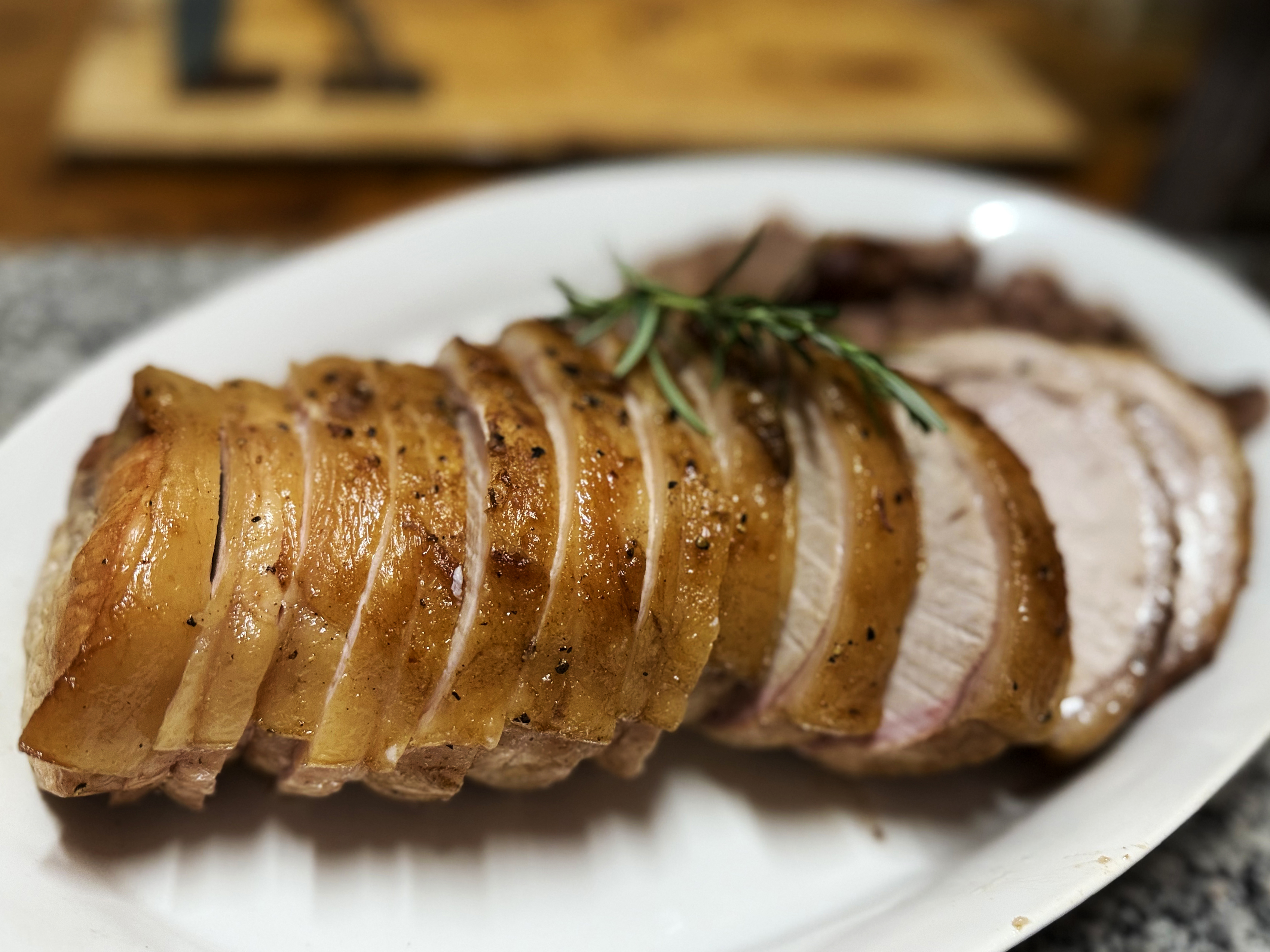

It was tempting to unroll this deboned pork saddle, give it a stuffing of something, and roll it up again. But the butcher had rolled and tied it so neatly that I didn’t have the heart to mess it up, as I inevitably would have when trying to do it in my clumsy, over-hasty Aries way.
So I would need to bring my imagination to bear on how to season and perhaps glaze it instead. This was not a cut with any potential crackling, as that has to be removed in order to roll it up.
This was the second roast of my 70th birthday carvery dinner party. The first was the all-day leg of mutton with kapokbos butter that I published yesterday. There were all the trimmings: roast potatoes, Yorkshire puddings, cauliflower cheese, and courgettes with feta. We started the dinner party with individual portions of my parmesan gem squash.
For my birthday, I’d been given two (no less) bottles of proper Canadian maple syrup. Both are Grade A, signifying pure maple syrup, and both are amber, indicating a rich flavour. Other colour and flavour profiles (all grade A) are gold (delicate flavour), dark (robust) and very dark (strong in flavour). The colour and flavour intensify as the harvesting season progresses, but one grade is not necessarily of a higher calibre; more a matter of preference for the consumer, and a guide to choosing what you like best.
I decided to make a maple syrup glaze, adding an equal quantity of another fine ingredient I have come to prize: Rozendal lavender fynbos vinegar. These two made for a winning flavour, nicely balanced for sweetness and delicate acidity. I only added a little salt and a fairly generous amount of black pepper.
Tony’s deboned saddle of pork with a maple syrup glaze
 … and sliced. (Photo: Tony Jackman)
(Serves 10)
Ingredients
1 x 1.8kg pork saddle, deboned, rolled and tied with kitchen string (ask your butcher to do this)
4 Tbsp Canadian pure maple syrup
4 Tbsp Rozendal lavender fynbos vinegar
Salt and black pepper to taste
3 Tbsp cooking oil
Method
Preheat the oven to 200°C.
Rub salt into the fat of the pork. (The rind will have been removed, so that the outside of the rolled joint shows its layer of fat.) Season with black pepper as well.
Pour a little oil into a roasting pan. Add the rolled pork and move it around in the oil to be sure the side touching the pan is coated.
Place in the preheated oven — with no maple baste at this stage — and roast it for 15 to 20 minutes at 200°C.
Turn the heat down to 180°C and continue roasting for an hour.
In a bowl, mix the maple syrup and fynbos vinegar together.
Remove from the oven, baste it with half of the maple-lavender vinegar mixture and return to the oven. Season with a little more salt and pepper to offset any loss of seasoning during the brushing.
Roast for another 45 minutes, then baste with the remaining glaze, and return it to the oven for half an hour more or until the glaze has turned golden. If needed, turn the oven heat up to 200°C for the last half hour.
Let the meat rest in the oven with the door ajar for 15 minutes before carving and serving. I like to serve pork with shredded cabbage and apple pan fried in butter, with a light seasoning of salt and white pepper. DM
Tony Jackman is twice winner of the Galliova Food Writer of the year award, in 2021 and 2023
Order Tony’s book, foodSTUFF, here.
Follow Tony Jackman on Instagram @tony_jackman_cooks.
This dish is photographed on a plate by Mervyn Gers Ceramics.