


Dailymaverick logo

World

World

As Trump dismantles US norms and institutions, Afrikaner refugee process remains unclear

The Trump administration continues making news for all the wrong reasons both at home and abroad. And it seems to be gaining momentum in tearing up conventions on governance, foreign policy and human decency.
As Trump dismantles US norms and institutions, Afrikaner refugee process remains unclear

The latest Trump rampages 

For now, the following are some comments about the ongoing, piecemeal decapitation of the government by the Trump administration. The continuing chaos is being caused by Donald Trump appointees in government jobs, in tandem with the depredations of Elon Musk’s kiddie-techie brigade as they wreak havoc on US government agencies, programmes, employees and the country’s international reputation. These actions include cancelling whole programmes and firing or driving out employees including inspectors general and military Judge Advocate General officers. All this, at least theoretically, has been at the behest of the president. Many of these actions are now or will soon be entangled in ongoing court challenges pursued by groups of affected employees and grant recipients, as well as the contractors who perform much of the government’s activities. Still, so far, beyond exceptions such as Connecticut Senator Chris Murphy, the Democratic Party’s members in Congress do not – yet – appear able to articulate a cogent, effective response to the Musk/Trump transgressions.  [caption id="attachment_2606360" align="alignnone" width="2560"]trump ukraine As US and Russian officials met to discuss the future of Ukraine, activists with Munich against Hate and other global organisations called for unity and democracy on Thursday, 20 February, in Berlin, Germany. (Photo: EPA-EFE / Munich against Hate / Handout)[/caption] New York Times commentator David Brooks was right on the money when he labelled the Musktrumpians as energetic nihilists, with no coherent ideological theory of government, besides being giddy destroyers. He compared them to the way F Scott Fitzgerald had described his characters, Tom and Daisy Buchanan, in The Great Gatsby, saying they were the kind of rich people who broke things and then just moved on. Nevertheless, some Republican members of Congress are already getting an earful from disgruntled constituents – even in dyed-in-the-wool, red districts – who are concerned that this assault on government is already affecting services to farmers, the elderly and others.  Then, too, the news is filled by Trump’s shifting promises – or threats – of a soon-to-be-imposed regimen of tariffs on a whole range of products, perhaps to offset VAT charges on items imported from the US in many other nations. These American tariffs would include semiconductor chips, pharmaceuticals, steel and aluminium, among other items. 

A volte-face on Ukraine

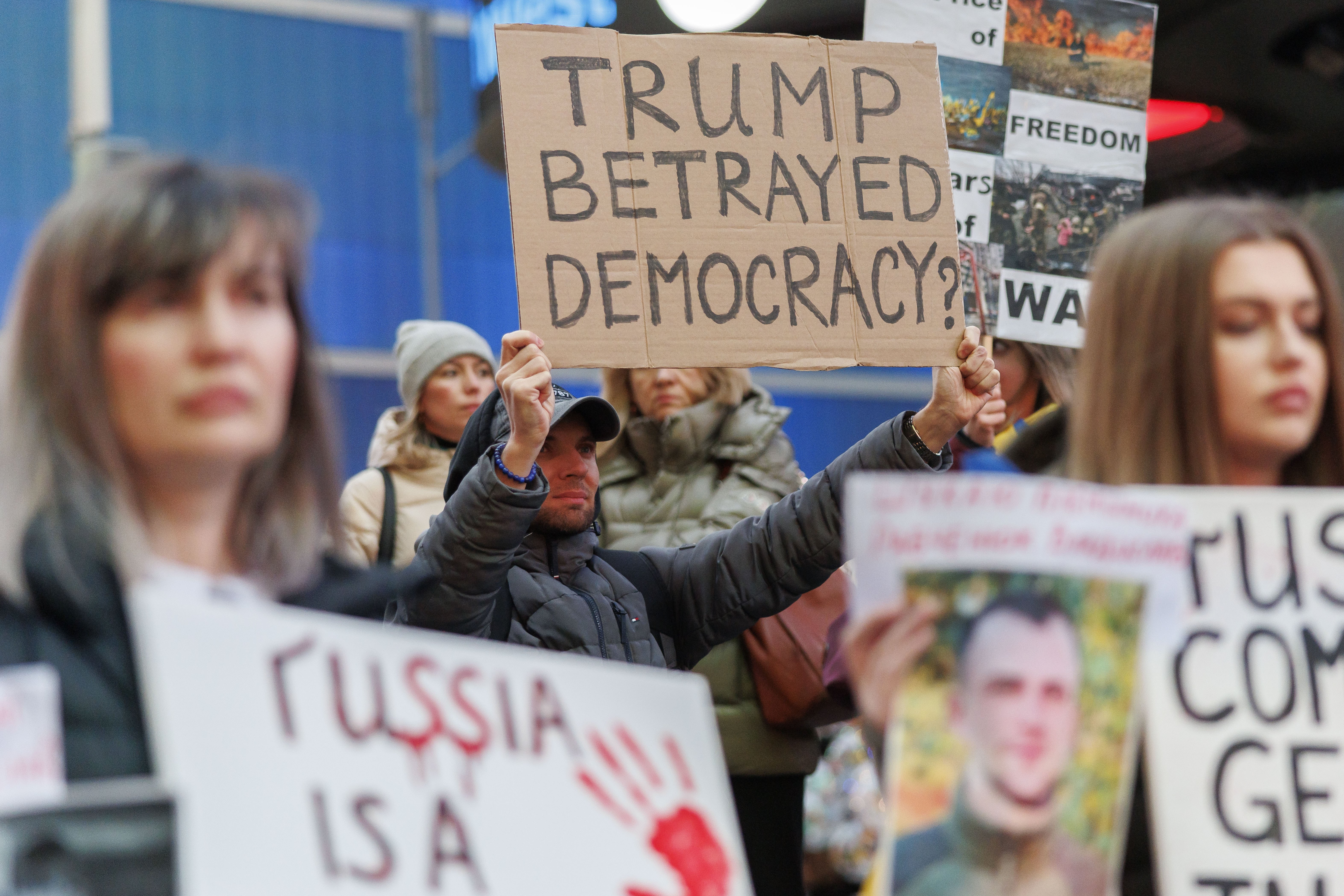
Most astonishingly, there is an ongoing effort by Trump to call into being what is effectively Vladimir Putin’s version of a severely lopsided peace deal (or even an outright Ukrainian surrender) as a result of Russia’s invasion of its neighbour and its continuing bombardment of Ukraine by missiles and drones. The quickly convened US-Russia meeting in Saudi Arabia excluded any representatives from Ukraine, the EU or any other Nato nation beyond America.  This was despite the obvious expectation that the aggrieved party – Ukraine – should be party to any negotiations about its future, in addition to the interests of other European nations, given their defence and economic support for Ukraine. Commentators have been reminding audiences of another meeting where the Nazi German leader met his French and British counterparts to decide the fate of Czechoslovakia, also without that nation in the room. The US president has now let his pro-Putin visage fully appear from beneath his American presidential mask. Flying in the face of the evidence in plain sight, Donald Trump has accused Ukraine’s president of somehow starting the Russia-Ukraine conflict and petulantly declining to cede a fifth of their country to the invader to make Donald Trump and Vladimir Putin happy. Then, to get any further US aid (and to pay for the aid that has already been given), the Trump team has demanded a 50% share of some key Ukrainian mineral resources. Most egregiously, Trump said the Ukrainian president was a dictator without popular support and he had better get with Trump’s programme – or else he could soon end up without a country. Trump, of course, made no mention of Vladimir Putin’s credentials in the dictator sweepstakes. Trump’s latest attack on Volodymyr Zelensky and Ukraine, like many of the US president’s earlier criticisms, virtually duplicates those of Vladimir Putin in justifying the invasion. The US president remains resentful that Zelensky had declined to help Trump’s electoral chances by manufacturing evidence against Joe Biden or his son.

Attacks on America’s allies

Meanwhile, Pete Hegseth, Trump’s secretary of defense, said in Brussels that in any future settlement of the conflict, the question may become whether Ukraine remains an independent nation – or once again part of Russia. Piling on, Vice-President JD Vance –  in Munich, nogal, at the annual European Security Conference – insisted that the real crisis was how European nations were persecuting ultra-far-right political movements and purveyors of hate speech and misinformation. It was these sins, rather than the threat to Europe posed by the ongoing Russian military operations against Ukraine, that mattered the most. In a remarkable performance in Germany, Vance met the leader of the far-right, pro-Putin, Alternative for Germany (AfD) party, just before the German election. Considering all this, the Financial Times summed up Trump’s negotiation strategy as one of: “Advantage Putin.”  Then, for the newest mind-boggle, on Monday, 24 February, the US aligned itself with Russia and others such as Belarus and North Korea in a vote on a resolution in the UN General Assembly that condemned Russia’s invasion of Ukraine on the third anniversary of that event. Read more: UN resolution highlights diplomatic shift as South Africa votes for Ukraine amid US retreat Fortunately, in that German election, the AfD did not score higher than the Christian Democrats, although they did capture almost a fifth of the vote, in spite of Musk’s very visible championing of them. Presumptive new German chancellor Friedrick Merz publicly chastised those interventions in German electoral politics. Based on the election results, the Christian Democrats will be the core of a new coalition government and will be staunchly supportive of Ukrainian independence and freedom.

Impresario Trump?

In a sad distraction from all the other wrecking ball activity, there was the tragicomic takeover of the Kennedy Center for the Performing Arts in Washington (the city’s official monument to the late president Kennedy and its premier cultural centre). Donald Trump fired the board chair, appointed himself to replace the former chair, and then removed the members of the board to replace them with Trump lackeys. As a result of this particular mayhem, a growing roster of A-list performers and the centre’s advisory committee artists are cancelling performances in protest or severing their association with the centre. A cynic might wonder if there will be unremitting performances by Lee Greenwood and group singalongs of “YMCA,” rather than a schedule of first-tier performances by the world’s best performing artists and groups.

Mixed messaging on refugees

But put those Musktrumpian machinations aside and shift attention to the topic of immigration. Here, the Trump administration has two contradictory impulses. On the one hand, there is its ongoing round-up of thousands of undocumented aliens already in the US and sending many of them back to their countries of origin, often on military air transport. In addition, Trump has ordered the US military to prepare its Guantanamo Naval Base in Cuba to house thousands more, and has dispatched US troops to the country’s southern border to back up border officers.  This latter move is despite the fact that illegal entry via the Rio Grande River or Southwestern desert crossings is at its lowest point in years. The Trump administration is effectively blocking further immigration more generally and this is consistent with the winning formula of immigrant bashing that helped propel Trump into the White House.  [caption id="attachment_2595693" align="alignnone" width="2560"]trump afrikaners South African Trump supporters gather at the US Embassy in Pretoria on 15 February 2025. (Photo: Gallo Images / Rapport / Elizabeth Sejake)[/caption]

America as a refuge for SA’s ‘persecuted’

But then, in a counter-narrative, the Trump administration announced plans to offer a home in America to South Africa’s Afrikaner population. This came in response to those acting on behalf of that community, pressing the case of an imagined ethnic persecution of being driven off their farms, making them homeless, and after the passage of a South African law clarifying procedures for the expropriation of property – a measure that had been under debate for years. This White House announcement made concrete Trump’s earlier embrace of that narrative back in 2018. Such charges had been made on the Tucker Carlson Show on Fox News TV, years before the South African expropriation Bill was law. (Trump is an obsessive consumer of that network.)  Trump’s decision should be read as a broad extension of his public embrace of the discontents of white, working-class people everywhere, including the US, from threats by dangerous, darker-hued “others”. For Trump, his “America First” mantra means foreign policy decisions contain a component of domestic rabble-rousing and so the view of Afrikaners as a desperate refugee population in need of a new home fits perfectly with that. We shall come back to that measure after some more personal observations.

Origins of  executive order on SA

As for South Africa, right at the beginning of the second Trump administration, the new president embraced the long-running pressure campaign calling for a US government effort on behalf of the presumed plight of Afrikaner farmers. While some claim this presidential decision had been specifically designed to punish South Africa for its efforts at the International Court of Justice over Israel’s military operations in Gaza, and while that may have had some impact, the interpretation that this was the primary cause of the order ignores the much broader anger in Republican circles that had been growing for years about South Africa’s growing embrace of Russia, China and Iran in international fora and explicitly mentioned in the executive order. Read more: Donald Trump and South Africa – this is just the beginning This was now joined to the claim of Afrikaner persecution that had been first raised more than half a decade earlier. (One must wonder how concerns about Russian ties will now square with the Trump administration’s new embrace of Russia over the Ukraine conflict, the president’s adoration of Russia’s president, and in making deals about Ukraine’s future and US-Russia business ties.) There has also been pressure among some Republican members of the US Congress to remove South Africa’s eligibility under the African Growth and Opportunity Act (Agoa), a law allowing duty-free entry for African products into the American market. Cancelling eligibility would be punishment for those Russia/China/Iran ties, per letters from congressmen to the president, as well an assertion that the country was already a middle-income country and thus undeserving of Agoa benefits.  Some Republican members of Congress are even hoping Agoa will not be renewed at all by Congress, an outcome that would affect Africa generally, once the current law expires later this year. Given the ongoing chaos in the US government as a result of Musk and his Doge team’s erratic interventions into government structures, it is possible a replacement Agoa measure may not even be introduced in the new Congress. Read more: Afrikaner group makes a sho’t right to Europe to campaign for more support against ‘SA race laws’

Strands all come together

For Trump’s second term of office, these strands have come together with one additional, crucial element. This was Trump and Musk’s animus towards the global apparatus of American foreign assistance. They have moved quickly to attempt to dismantle or freeze the entirety of foreign assistance worldwide, including the Pepfar anti-HIV/Aids programme. That has been the majority of American foreign aid in South Africa for years.  While Pepfar may now be protected somewhat by changes in the president’s policy and court rulings, the on-off nature over aid staffing, budgets and programmes has rendered much of the country’s foreign assistance virtually inoperable. The net effect in South Africa has been dismay or anger directed against the US – and virtually all of those are opposed to the idea that Afrikaners should gain some kind of expeditious entry into the US because of an illusory persecution.

The way of refuge status

Despite that loud buzz about the announcement over this refugee status and the halting of aid programmes, the real challenge is that there are no protocols in place for the easy processing of would-be Afrikaners as refugees. Refugee (or asylum) requests are governed by complex laws and regulations and the flip of a switch from an executive order does not instantly change things.  Read more: Trump’s Afrikaner refugees could be in for a long wait – if previous US policies apply

What’s next?

Presumably, the application of the executive order will not offer asylum, but some form of refugee status. Regarding refugee and asylum status, Amnesty International notes, “A refugee is a person who has fled their own country and is unable or unwilling to return because they have a well-founded fear of persecution based on one of five reasons: their race; religion; nationality; membership of a particular social group; or political opinion. Persecution means a threat to life, freedom and other serious violations of human rights.” By comparison, a “…‘person seeking asylum’ refers to someone who has fled their country and applied for protection as a refugee, but hasn’t yet been legally recognised as a refugee and is waiting to receive a decision on their asylum claim”. The usa.gov website notes that for would-be refugees into America, “To seek refugee status, you must be outside the US and believe you will be persecuted in your country.” The US Citizenship and Immigration Services adds, “Under United States law, a refugee is someone who: is located outside of the United States, is of special humanitarian concern to the United States, demonstrates that they were persecuted or fear persecution due to race, religion, nationality, political opinion, or membership in a particular social group, is not firmly resettled in another country, [and] is admissible to the United States.” In addition, a person seeking to be a refugee “must receive a referral to the U.S. Refugee Admissions Program (USRAP) for consideration as a refugee…” (While a person applies for asylum when they are already in the US, rather than from some far distant corner of the world, special exceptions have been made for Vietnamese and Cubans seeking refuge in the US, but there is no indication, so far, such a provision would also apply in the local context.)  In the language of the executive order, it is made clear that the primary justification for it speaks to the expropriation and the presumed persecution of Afrikaners. While South Africa’s ICJ effort and other South African government positions such as close ties with Iran are noted, it is clear from the original order’s text that the central issue is that, “In shocking disregard of its citizens’ rights, the Republic of South Africa (South Africa) recently enacted Expropriation Act 13 of 2024 (Act), to enable the government of South Africa to seize ethnic minority Afrikaners’ agricultural property without compensation. This Act follows countless government policies designed to dismantle equal opportunity in employment, education, and business, and hateful rhetoric and government actions fueling disproportionate violence against racially disfavored landowners.” The executive order goes on to state, “The Secretary of State and the Secretary of Homeland Security shall take appropriate steps, consistent with law, to prioritize humanitarian relief, including admission and resettlement through the United States Refugee Admissions Program, for Afrikaners in South Africa who are victims of unjust racial discrimination.”  At least so far, no definitive instructions have been promulgated and so there is no point for anybody interested in this promise to camp out in front of the US Consulate General in South Africa, just yet. Read more: Local Trump supporters gather at the US Embassy in Pretoria, and more from around the world

Turning the executive order into actual practice

CBS News reported, “It’s unclear how and when that plan would be enacted, since refugee arrivals were brought to a halt by Mr. Trump. In an executive order he signed on Jan. 20, the president argued refugees were a strain on receiving communities and said he would only restart the refugee program if he concluded that doing so would serve the interests of the U.S.  “Mr. Trump’s order does, however, allow officials to make case-by-case exemptions to the freeze in refugee arrivals. The U.S. refugee program is designed to offer a safe haven to people abroad fleeing persecution based on their race, religion, political views or other factors. Typically, refugees are referred to the U.S. by United Nations officials and spend months or years in third countries undergoing interviews, as well as security and medical checks, before being allowed into the U.S.”

Conundrums of any refugee process

But let’s assume all the bureaucratic issues are sorted out and the visa window is opened for such would-be refugees. This writer is straining to imagine the kinds of screenings for eligibility. Would approval be on the basis of self-identification or demonstrated linguistic proficiency? Or on surnames? What about someone with the surname of Smith or Jones, or someone whose linguistic skills veered more towards English than Afrikaans, but who has a family tree stretching back for hundreds of years, back to the Great Trek and a commercial farm? And how will the procedures respond to darker-hued South Africans whose home language is also Afrikaans? Or, what about a person who identifies as an Afrikaans-speaking Khoi or San individual? Surely that individual could proffer a claim of the persecution of their ancestors, stretching back centuries? Read more: Steenhuisen yet to meet a single farmer who wants to leave South Africa Although the South African Chamber of Commerce in America has said it has received thousands of inquiries from South Africa regarding this plan, my guess is the most likely actual applicants might be software engineers from trendy Cape Town neighbourhoods, eager for new professional opportunities, but who just happen to own a share in a game farm. But would a successful applicant be required to show a title deed for a working farm or agricultural smallholding, or would they – even more bizarrely – need to offer some kind of genetic testing? And finally, how would any new regulations deal with interracial families – of whom there are growing numbers – or would the US embassy and consulates, along with the Department of Homeland Security (which has the final say on visas) be forced to consider a kind of stereotyping to decide visas? What a mess that would become. Such moves conceivably could return America to a time of racial or ethnic preferences over those who would be allowed to enter the country (such as the Chinese Exclusion Act of 1884), or expressing a preference, as Donald Trump once did, for more immigrants from places like Norway – versus the rest of the planet. DM

The latest Trump rampages 


For now, the following are some comments about the ongoing, piecemeal decapitation of the government by the Trump administration. The continuing chaos is being caused by Donald Trump appointees in government jobs, in tandem with the depredations of Elon Musk’s kiddie-techie brigade as they wreak havoc on US government agencies, programmes, employees and the country’s international reputation.

These actions include cancelling whole programmes and firing or driving out employees including inspectors general and military Judge Advocate General officers. All this, at least theoretically, has been at the behest of the president.

Many of these actions are now or will soon be entangled in ongoing court challenges pursued by groups of affected employees and grant recipients, as well as the contractors who perform much of the government’s activities.

Still, so far, beyond exceptions such as Connecticut Senator Chris Murphy, the Democratic Party’s members in Congress do not – yet – appear able to articulate a cogent, effective response to the Musk/Trump transgressions. 

trump ukraine As US and Russian officials met to discuss the future of Ukraine, activists with Munich against Hate and other global organisations called for unity and democracy on Thursday, 20 February, in Berlin, Germany. (Photo: EPA-EFE / Munich against Hate / Handout)


New York Times commentator David Brooks was right on the money when he labelled the Musktrumpians as energetic nihilists, with no coherent ideological theory of government, besides being giddy destroyers. He compared them to the way F Scott Fitzgerald had described his characters, Tom and Daisy Buchanan, in The Great Gatsby, saying they were the kind of rich people who broke things and then just moved on.

Nevertheless, some Republican members of Congress are already getting an earful from disgruntled constituents – even in dyed-in-the-wool, red districts – who are concerned that this assault on government is already affecting services to farmers, the elderly and others. 

Then, too, the news is filled by Trump’s shifting promises – or threats – of a soon-to-be-imposed regimen of tariffs on a whole range of products, perhaps to offset VAT charges on items imported from the US in many other nations. These American tariffs would include semiconductor chips, pharmaceuticals, steel and aluminium, among other items. 

A volte-face on Ukraine


Most astonishingly, there is an ongoing effort by Trump to call into being what is effectively Vladimir Putin’s version of a severely lopsided peace deal (or even an outright Ukrainian surrender) as a result of Russia’s invasion of its neighbour and its continuing bombardment of Ukraine by missiles and drones. The quickly convened US-Russia meeting in Saudi Arabia excluded any representatives from Ukraine, the EU or any other Nato nation beyond America. 

This was despite the obvious expectation that the aggrieved party – Ukraine – should be party to any negotiations about its future, in addition to the interests of other European nations, given their defence and economic support for Ukraine. Commentators have been reminding audiences of another meeting where the Nazi German leader met his French and British counterparts to decide the fate of Czechoslovakia, also without that nation in the room.

The US president has now let his pro-Putin visage fully appear from beneath his American presidential mask. Flying in the face of the evidence in plain sight, Donald Trump has accused Ukraine’s president of somehow starting the Russia-Ukraine conflict and petulantly declining to cede a fifth of their country to the invader to make Donald Trump and Vladimir Putin happy. Then, to get any further US aid (and to pay for the aid that has already been given), the Trump team has demanded a 50% share of some key Ukrainian mineral resources.

Most egregiously, Trump said the Ukrainian president was a dictator without popular support and he had better get with Trump’s programme – or else he could soon end up without a country. Trump, of course, made no mention of Vladimir Putin’s credentials in the dictator sweepstakes.

Trump’s latest attack on Volodymyr Zelensky and Ukraine, like many of the US president’s earlier criticisms, virtually duplicates those of Vladimir Putin in justifying the invasion. The US president remains resentful that Zelensky had declined to help Trump’s electoral chances by manufacturing evidence against Joe Biden or his son.

Attacks on America’s allies


Meanwhile, Pete Hegseth, Trump’s secretary of defense, said in Brussels that in any future settlement of the conflict, the question may become whether Ukraine remains an independent nation – or once again part of Russia. Piling on, Vice-President JD Vance –  in Munich, nogal, at the annual European Security Conference – insisted that the real crisis was how European nations were persecuting ultra-far-right political movements and purveyors of hate speech and misinformation.

It was these sins, rather than the threat to Europe posed by the ongoing Russian military operations against Ukraine, that mattered the most. In a remarkable performance in Germany, Vance met the leader of the far-right, pro-Putin, Alternative for Germany (AfD) party, just before the German election. Considering all this, the Financial Times summed up Trump’s negotiation strategy as one of: “Advantage Putin.” 

Then, for the newest mind-boggle, on Monday, 24 February, the US aligned itself with Russia and others such as Belarus and North Korea in a vote on a resolution in the UN General Assembly that condemned Russia’s invasion of Ukraine on the third anniversary of that event.

Read more: UN resolution highlights diplomatic shift as South Africa votes for Ukraine amid US retreat

Fortunately, in that German election, the AfD did not score higher than the Christian Democrats, although they did capture almost a fifth of the vote, in spite of Musk’s very visible championing of them. Presumptive new German chancellor Friedrick Merz publicly chastised those interventions in German electoral politics. Based on the election results, the Christian Democrats will be the core of a new coalition government and will be staunchly supportive of Ukrainian independence and freedom.

Impresario Trump?


In a sad distraction from all the other wrecking ball activity, there was the tragicomic takeover of the Kennedy Center for the Performing Arts in Washington (the city’s official monument to the late president Kennedy and its premier cultural centre). Donald Trump fired the board chair, appointed himself to replace the former chair, and then removed the members of the board to replace them with Trump lackeys.

As a result of this particular mayhem, a growing roster of A-list performers and the centre’s advisory committee artists are cancelling performances in protest or severing their association with the centre. A cynic might wonder if there will be unremitting performances by Lee Greenwood and group singalongs of “YMCA,” rather than a schedule of first-tier performances by the world’s best performing artists and groups.

Mixed messaging on refugees


But put those Musktrumpian machinations aside and shift attention to the topic of immigration. Here, the Trump administration has two contradictory impulses. On the one hand, there is its ongoing round-up of thousands of undocumented aliens already in the US and sending many of them back to their countries of origin, often on military air transport. In addition, Trump has ordered the US military to prepare its Guantanamo Naval Base in Cuba to house thousands more, and has dispatched US troops to the country’s southern border to back up border officers. 

This latter move is despite the fact that illegal entry via the Rio Grande River or Southwestern desert crossings is at its lowest point in years. The Trump administration is effectively blocking further immigration more generally and this is consistent with the winning formula of immigrant bashing that helped propel Trump into the White House. 

trump afrikaners South African Trump supporters gather at the US Embassy in Pretoria on 15 February 2025. (Photo: Gallo Images / Rapport / Elizabeth Sejake)


America as a refuge for SA’s ‘persecuted’


But then, in a counter-narrative, the Trump administration announced plans to offer a home in America to South Africa’s Afrikaner population. This came in response to those acting on behalf of that community, pressing the case of an imagined ethnic persecution of being driven off their farms, making them homeless, and after the passage of a South African law clarifying procedures for the expropriation of property – a measure that had been under debate for years.

This White House announcement made concrete Trump’s earlier embrace of that narrative back in 2018. Such charges had been made on the Tucker Carlson Show on Fox News TV, years before the South African expropriation Bill was law. (Trump is an obsessive consumer of that network.) 

Trump’s decision should be read as a broad extension of his public embrace of the discontents of white, working-class people everywhere, including the US, from threats by dangerous, darker-hued “others”. For Trump, his “America First” mantra means foreign policy decisions contain a component of domestic rabble-rousing and so the view of Afrikaners as a desperate refugee population in need of a new home fits perfectly with that. We shall come back to that measure after some more personal observations.

Origins of  executive order on SA


As for South Africa, right at the beginning of the second Trump administration, the new president embraced the long-running pressure campaign calling for a US government effort on behalf of the presumed plight of Afrikaner farmers.

While some claim this presidential decision had been specifically designed to punish South Africa for its efforts at the International Court of Justice over Israel’s military operations in Gaza, and while that may have had some impact, the interpretation that this was the primary cause of the order ignores the much broader anger in Republican circles that had been growing for years about South Africa’s growing embrace of Russia, China and Iran in international fora and explicitly mentioned in the executive order.

Read more: Donald Trump and South Africa – this is just the beginning

This was now joined to the claim of Afrikaner persecution that had been first raised more than half a decade earlier. (One must wonder how concerns about Russian ties will now square with the Trump administration’s new embrace of Russia over the Ukraine conflict, the president’s adoration of Russia’s president, and in making deals about Ukraine’s future and US-Russia business ties.)

There has also been pressure among some Republican members of the US Congress to remove South Africa’s eligibility under the African Growth and Opportunity Act (Agoa), a law allowing duty-free entry for African products into the American market. Cancelling eligibility would be punishment for those Russia/China/Iran ties, per letters from congressmen to the president, as well an assertion that the country was already a middle-income country and thus undeserving of Agoa benefits. 

Some Republican members of Congress are even hoping Agoa will not be renewed at all by Congress, an outcome that would affect Africa generally, once the current law expires later this year. Given the ongoing chaos in the US government as a result of Musk and his Doge team’s erratic interventions into government structures, it is possible a replacement Agoa measure may not even be introduced in the new Congress.

Read more: Afrikaner group makes a sho’t right to Europe to campaign for more support against ‘SA race laws’

Strands all come together


For Trump’s second term of office, these strands have come together with one additional, crucial element. This was Trump and Musk’s animus towards the global apparatus of American foreign assistance. They have moved quickly to attempt to dismantle or freeze the entirety of foreign assistance worldwide, including the Pepfar anti-HIV/Aids programme. That has been the majority of American foreign aid in South Africa for years. 

While Pepfar may now be protected somewhat by changes in the president’s policy and court rulings, the on-off nature over aid staffing, budgets and programmes has rendered much of the country’s foreign assistance virtually inoperable. The net effect in South Africa has been dismay or anger directed against the US – and virtually all of those are opposed to the idea that Afrikaners should gain some kind of expeditious entry into the US because of an illusory persecution.

The way of refuge status


Despite that loud buzz about the announcement over this refugee status and the halting of aid programmes, the real challenge is that there are no protocols in place for the easy processing of would-be Afrikaners as refugees. Refugee (or asylum) requests are governed by complex laws and regulations and the flip of a switch from an executive order does not instantly change things. 

Read more: Trump’s Afrikaner refugees could be in for a long wait – if previous US policies apply

What’s next?


Presumably, the application of the executive order will not offer asylum, but some form of refugee status. Regarding refugee and asylum status, Amnesty International notes, “A refugee is a person who has fled their own country and is unable or unwilling to return because they have a well-founded fear of persecution based on one of five reasons: their race; religion; nationality; membership of a particular social group; or political opinion. Persecution means a threat to life, freedom and other serious violations of human rights.”

By comparison, a “…‘person seeking asylum’ refers to someone who has fled their country and applied for protection as a refugee, but hasn’t yet been legally recognised as a refugee and is waiting to receive a decision on their asylum claim”.

The usa.gov website notes that for would-be refugees into America, “To seek refugee status, you must be outside the US and believe you will be persecuted in your country.”

The US Citizenship and Immigration Services adds, “Under United States law, a refugee is someone who: is located outside of the United States, is of special humanitarian concern to the United States, demonstrates that they were persecuted or fear persecution due to race, religion, nationality, political opinion, or membership in a particular social group, is not firmly resettled in another country, [and] is admissible to the United States.” In addition, a person seeking to be a refugee “must receive a referral to the U.S. Refugee Admissions Program (USRAP) for consideration as a refugee…”

(While a person applies for asylum when they are already in the US, rather than from some far distant corner of the world, special exceptions have been made for Vietnamese and Cubans seeking refuge in the US, but there is no indication, so far, such a provision would also apply in the local context.) 

In the language of the executive order, it is made clear that the primary justification for it speaks to the expropriation and the presumed persecution of Afrikaners.

While South Africa’s ICJ effort and other South African government positions such as close ties with Iran are noted, it is clear from the original order’s text that the central issue is that, “In shocking disregard of its citizens’ rights, the Republic of South Africa (South Africa) recently enacted Expropriation Act 13 of 2024 (Act), to enable the government of South Africa to seize ethnic minority Afrikaners’ agricultural property without compensation. This Act follows countless government policies designed to dismantle equal opportunity in employment, education, and business, and hateful rhetoric and government actions fueling disproportionate violence against racially disfavored landowners.”

The executive order goes on to state, “The Secretary of State and the Secretary of Homeland Security shall take appropriate steps, consistent with law, to prioritize humanitarian relief, including admission and resettlement through the United States Refugee Admissions Program, for Afrikaners in South Africa who are victims of unjust racial discrimination.” 

At least so far, no definitive instructions have been promulgated and so there is no point for anybody interested in this promise to camp out in front of the US Consulate General in South Africa, just yet.

Read more: Local Trump supporters gather at the US Embassy in Pretoria, and more from around the world

Turning the executive order into actual practice


CBS News reported, “It’s unclear how and when that plan would be enacted, since refugee arrivals were brought to a halt by Mr. Trump. In an executive order he signed on Jan. 20, the president argued refugees were a strain on receiving communities and said he would only restart the refugee program if he concluded that doing so would serve the interests of the U.S. 

“Mr. Trump’s order does, however, allow officials to make case-by-case exemptions to the freeze in refugee arrivals. The U.S. refugee program is designed to offer a safe haven to people abroad fleeing persecution based on their race, religion, political views or other factors. Typically, refugees are referred to the U.S. by United Nations officials and spend months or years in third countries undergoing interviews, as well as security and medical checks, before being allowed into the U.S.”

Conundrums of any refugee process


But let’s assume all the bureaucratic issues are sorted out and the visa window is opened for such would-be refugees. This writer is straining to imagine the kinds of screenings for eligibility.

Would approval be on the basis of self-identification or demonstrated linguistic proficiency? Or on surnames? What about someone with the surname of Smith or Jones, or someone whose linguistic skills veered more towards English than Afrikaans, but who has a family tree stretching back for hundreds of years, back to the Great Trek and a commercial farm?

And how will the procedures respond to darker-hued South Africans whose home language is also Afrikaans? Or, what about a person who identifies as an Afrikaans-speaking Khoi or San individual? Surely that individual could proffer a claim of the persecution of their ancestors, stretching back centuries?

Read more: Steenhuisen yet to meet a single farmer who wants to leave South Africa

Although the South African Chamber of Commerce in America has said it has received thousands of inquiries from South Africa regarding this plan, my guess is the most likely actual applicants might be software engineers from trendy Cape Town neighbourhoods, eager for new professional opportunities, but who just happen to own a share in a game farm. But would a successful applicant be required to show a title deed for a working farm or agricultural smallholding, or would they – even more bizarrely – need to offer some kind of genetic testing?

And finally, how would any new regulations deal with interracial families – of whom there are growing numbers – or would the US embassy and consulates, along with the Department of Homeland Security (which has the final say on visas) be forced to consider a kind of stereotyping to decide visas? What a mess that would become.

Such moves conceivably could return America to a time of racial or ethnic preferences over those who would be allowed to enter the country (such as the Chinese Exclusion Act of 1884), or expressing a preference, as Donald Trump once did, for more immigrants from places like Norway – versus the rest of the planet. DM

Comments

Martin Neethling Feb 26, 2025, 06:24 AM

For blue-leaning folk, one would think that the events of recent times - the clean sweep by the GOP in the US, the surge in support for Reforn in the UK, the AfD winning 20% in Germany - would prompt a pause to ask, why? Isn’t it just possible that the globalist Left’s agenda needs a reset?

Paul Mathias Feb 26, 2025, 04:17 PM

An interesting article but one that lets Americans off the hook for the chaos Trump is sowing. He is causing this damage in his capacity as their president elected by them on a pretty transparent platform. His election is not an anomaly it is the will of the people, these are America’s actions.