



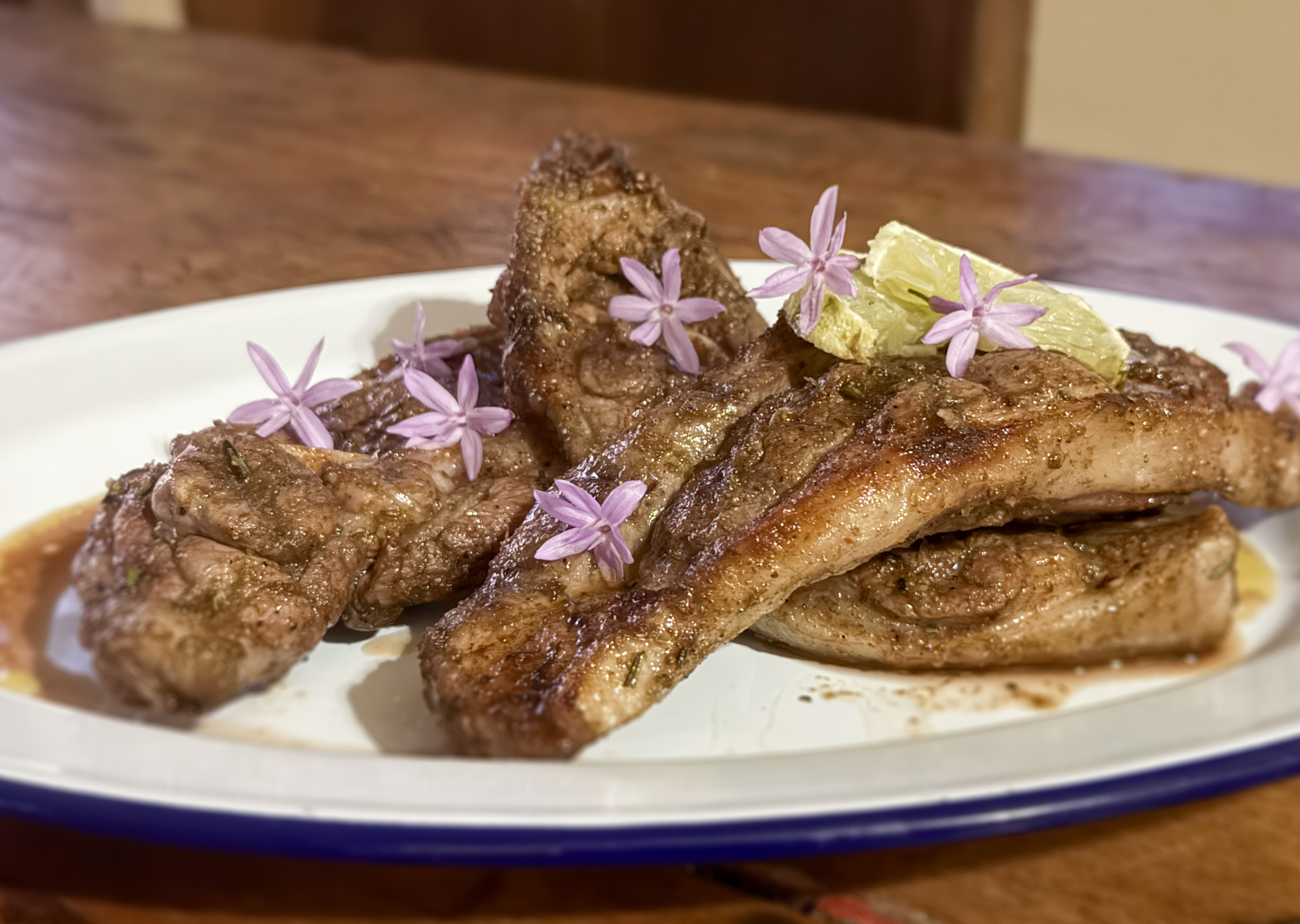

A lamb chop can go oh so right but can also go embarrassingly wrong. Just a few seconds, and what seemed on target to be That Chop — the most perfect tjoppie you’ve ever braaied — turned into, oh dear, that chop. The worst one you’ve ever cooked. The one turfed into the bin or thrown on the coals for instant incineration. I mean, it’s gone that far, it might as well be given a cremation.
It happens to every chop braaier. (It’s how we become better at it.) Yes, me too. Even after turning out perfect chops five or six times in a row, suddenly I’ll be distracted, turn back to the braai and… charred mayhem. Nobody wants that.
But let’s start with some rules about how not to braai a lamb chop. There are some simple rules when braaing a lamb chop, and the chief one for me, and one that has me shaking my head in disbelief whenever I see some oke doing it, is…
- Pouring your beer on to the flames.
That’s a Big Fat No from me. I mean, guys. Why? You want those flames to lick your chops. That’s how you get lovely crispy, crunchy fat. And we all know that the best part of a lamb is the… ?
Fat! So we need to cook that fat properly. And dousing your fire with beer does not help one bit. So rule number 2, as well as rule number 1, is…
- Don’t undercook the fat by pouring your blimmin’ beer on the coals.
Okay. I’m glad I’ve got that off my chest.
Moving on: rule number 3, as you’ll soon discover, is not far removed at all from rules number 1 and 2. Rule number 3 pertains to those coals. You need to have a fire going nearby with plenty of fuel on it (and I mean wood, not briquettes) so that you don’t have that awful situation where the chops aren’t done, or are not yet crispy, the fat is limp and white, and you just want to cry into what’s left of your beer and go to bed early. So the third rule is…
- Don’t run out of hot coals when you need them most.
Because if you do, you’ll undercook your chops without even having poured your beer on the coals. And all that beer will have been wasted and unfit for (unnecessary) purpose.
But how do you know your chop is done?...
- Don’t stick a meat thermometer in it to see if it’s reached its ‘correct internal temperature’.
Jirre, man. No self-respecting chopmeister ponces around with a meat thermometer going on and on about internal temperatures. We use our instincts, our eyes, the touch of a hand to the meat, to be sure it’s still soft and hasn’t gone too far. (If we foul it up, there’s a handy incinerator right there. But our self-respect will be intact. Sort of.)
This is primal. Meat thermometers are for wussies.
And finally, our fifth no-no…
- Don’t let your mates help you braai your chops.
This ought, in fact, to be rule number one. Every braaier worth his chops (sorry, I had to get that in somewhere) has had to contend with one of his mates turning the chops while he nips inside to grab a beer.
“Hope you don’t mind, the grid needed turning. Cheers!” Grrrrrrrr.
This is sacrilege. I have had friends who (I’m convinced, now, with hindsight) used to actually wait for me to leave the braai for a minute and would then rearrange the chops, turn the grid, add seasoning — essentially making the entire scene unrecognisable on my return scarcely a minute later.
Then, when the chop inevitably turns out not quite the way you intended them to be, remark with infuriating nonchalance that they “knew they were ready five minutes ago but were too polite to say”.
But not too polite to mess with another guy’s chops.
 OY! Hands off! (Image by Hai Nguyen Tien from Pixabay)
But there are some “do” rules for braaing tjoppies as well.
- Do braai the fatty edges of the chops first, by turning them on their sides.
There’s an easy way to achieve this. Use a pair of strong tongs with a long handle, grab the chops firmly with them, and hold them fat side down very near to super-hot coals. Swap hands if the first hand is getting too hot. Or, buy one of those racks that looks like a toaster, and wedge the chops in that.
What you need is for them to be so hot that the fat drips out on to the coals and — yes! — catches flame. That’s a good thing (see rules 1, 2 and 3 above).
So, yes, all of these rules somehow relate to the same thing.
- Remember not to forget that you’re cooking the chops.
Like the sentiments of the Bee Gees’ Don’t Forget to Remember Me, a spurned chop is not going to be very happy with you if you do this. Lamb chops like to be cooked perfectly, not ignored and allowed to turn tough and chewy so they have to be thrown to the dogs.
- Make enough baste to baste the chops at least once, preferably twice, during their cooking.
Also have enough baste to douse the cooked chops in it again just before serving, so that the baste becomes a sauce of a kind.
Also remember to season well but don’t get carried away. And that mate of yours who you know has a heavy hand with the salt — keep a sharp eye on him. He’ll be itching to get at that salt and throw it around like beach sand off his feet.
- When you start nibbling a chop because it’s a ‘braaier’s right’ (right?), don’t get too carried away.
Your mates will be watching. One will grab the next chop, and another the one next to that. You have given them an unwitting signal that the chops are ready. Within three minutes, you’ll be needing to go out and buy more chops.
So, to that end, the final rule…
- Don’t be stingy with your chop allocation.
This means always buying too many chops, without fail. I’ve often been told I “cook for an army”. That’s a good thing. Rather that than have the troops complaining about their rations.
Now let’s talk about timing. And here’s the truth: there is no exact recommended timing for cooking a chop. This is because some chops are thinner, some thicker. Coals might be hotter or cooler; and the chops might be closer to, or further away from, the coals.
Then you get different cuts of chop. Little loin or rib cutlets will be quicker (and of those two, the loin chop is likely to cook faster than a rib chop). A leg chop takes longer to cook and can be cooked more slowly, higher above the coals. Shoulder chops, meanwhile, are from a muscle that is used less by the animal, so they are best cooked quickly close to very hot coals.
To marinate or baste?
The inimitable Jan Braai, surely a national treasure, in a TV cooking series for Afternoon Express, braaied Frenched lamb rib chops he’d obtained from a source near to his Klein Karoo family farm. Jan does not like to marinate most meats, and simply seasoned these Klein Karoo lamb chops generously with coarse salt and black pepper.
This is something I agree with but, as I’m sure he finds too, when you have to come up with lamb chop recipes now and then, you can’t just churn out the same salt-and-pepper one every time. But yes: the point of Karoo lamb is that herbaceous wild diet the animal has, and any extra flavour we add to it can only mask that flavour. Having said that, the recipe I’m offering today does have a baste.
In the same video clip, he uses a baste — and in that baste are almost all of the ingredients in my own recipe. Rosemary, fresh garlic, lemon juice, chilli flakes, salt and black pepper. Olive oil too.
I’ve added one ingredient to all of those — cumin. This is one of my favourite flavours to match lamb. I don’t remember ever having added it to a baste that contains rosemary, lemon, garlic and chilli before, but my intention with this baste or marinade was to include all of the things that I like with lamb. So in went just a teaspoon of ground cumin.
I also used a hint of Worcestershire sauce, this being an aromatic that I like to use with braaied lamb ribs — a “staanrib” (standing rib) cooked side-on to the coals, slowly for a rather long time.
So, you have your hot coals. Six to seven minutes per side? Four minutes per side? It depends on who you ask. Don’t pour your beer on to the coals — pour it into yourself. Well, that’s a start. But what if the chop you’re throwing on the braai is very thick? Or very thin?
Jan Braai does them near hot coals for two minutes on each side without any basting, then tosses them in the baste and puts them back on for another two minutes. But they were rib chops, Frenched (a pity, I think, as you’ve lost some of the fat by trimming them) and seemed to be of fairly standard thickness. So his recommended timing is, as he says in the video, for that particular kind of chop.
The key to this method is very hot coals, and the meat being near them to catch that golden-crunchy sear that any lam tjoppie fan adores.
But there is also the reverse sear method of cooking a chop or, say, a tomahawk steak. This entails having the grid high above the coals to begin with, and cooking the lamb chops very slowly and gently. Then, you need to rake a load of fresh, very hot coals over, lower the grid so that they’re near those newly raked coals, and finish them off very quickly, just for them to attain that lovely char. A couple of minutes rest, and your tjoppies should give you that happy feeling all braaiers know.
Tony’s braaied shoulder chops
(Per 1 serving)
Ingredients
2 shoulder chops per serving
1 Tbsp rosemary needles, finely chopped
3 garlic cloves, finely chopped
2 Tbsp extra virgin olive oil
1 Tbsp Worcestershire sauce
Juice and zest of 2 limes
1 tsp ground cumin
½ tsp chilli powder or flakes
Salt to taste
Black pepper to taste
Method
Mix the baste ingredients together and brush over all the chops. Let them sit at room temperature while you prepare the coals, make a salad, wrap some potatoes in foil, or whatever you’re serving with the chops.
Braai for 2 to 3 minutes per side, depending on how close the chops are to the coals. Rest for 5 minutes. DM
Tony Jackman is twice winner of the Galliova Food Writer of the year award, in 2021 and 2023.
Order Tony’s book, foodSTUFF, here.
Follow Tony Jackman on Instagram @tony_jackman_cooks.