



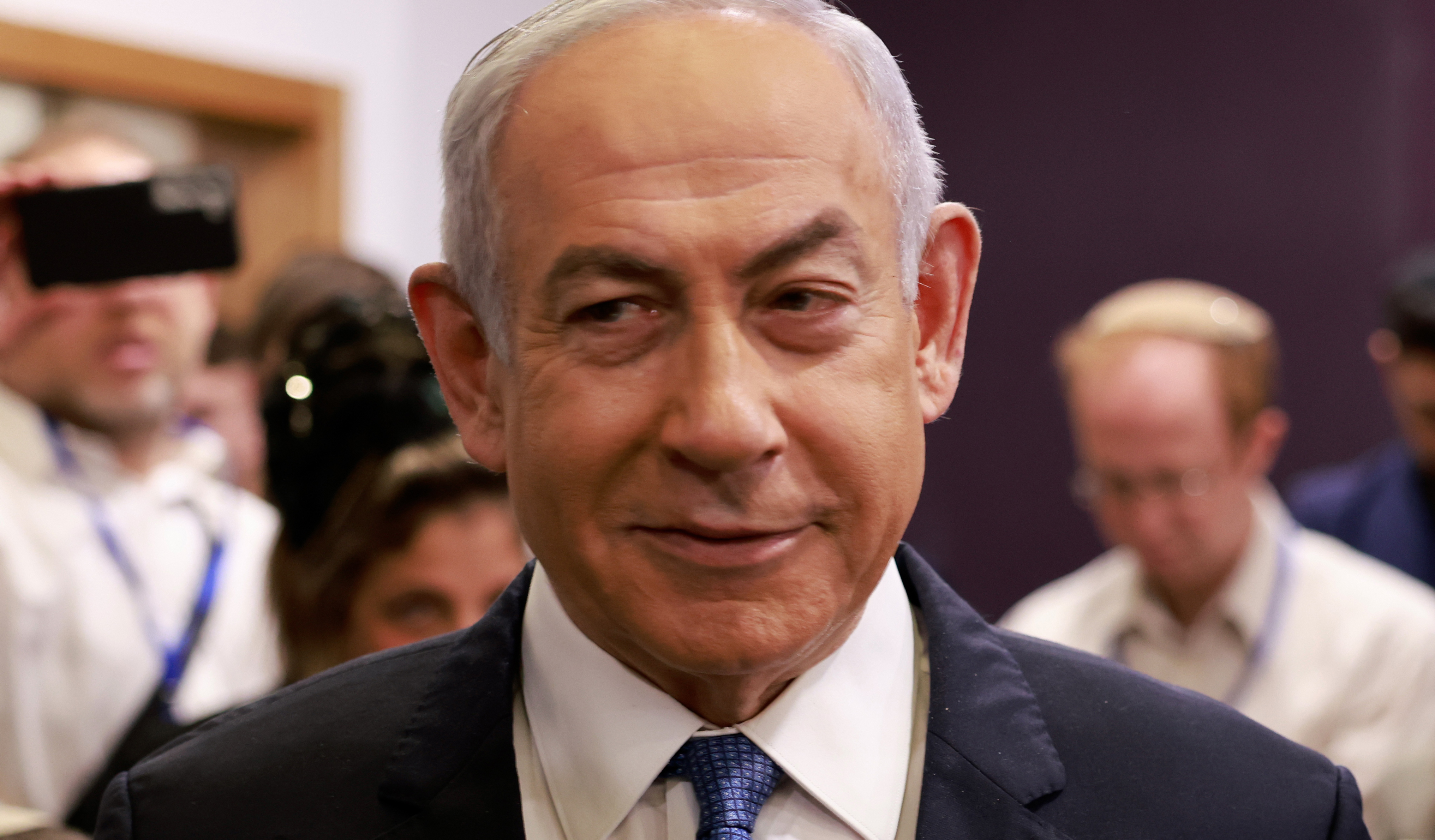

Israel had ordered its forces to create a “sterile defence zone” in southern Syria that would be enforced without a permanent Israeli presence as it tightened its hold along the line between Syria and the Israeli-occupied Golan Heights, said Defence Minister Israel Katz on Tuesday.
The Biden administration saw increased energy towards a Gaza ceasefire deal after hostilities were tamped down between Israel and Lebanon, said US Deputy National Security Advisor Jon Finer in an interview at the Reuters Next conference in New York on Tuesday.
Netanyahu assails media as he testifies for first time in his corruption trial
Israeli Prime Minister Benjamin Netanyahu took the witness stand for the first time on Tuesday in his long-running corruption trial, saying he was being hounded for his hawkish security policies.
Netanyahu (75) is Israel’s first sitting prime minister to be charged with a crime. He is testifying at the same time Israel is engaged in a war in Gaza and facing possible new threats posed by regional turmoil, including in Syria.
Last week judges ruled that Netanyahu, indicted in 2019, must testify three times a week, forcing the longtime Israeli leader to juggle between the courtroom and the war room at Israel’s Defence Ministry, minutes away from the courthouse.
He took the stand for about four hours and will resume testifying on Wednesday. Twice his military secretary handed him written messages, the first time requiring a recess and underscoring his having to do double duty as prime minister.
The leader of the right-wing Likud party, Netanyahu assailed the Israeli media for what he called its leftist stance and accused journalists of having hounded him for years because his policies did not align with a push for a Palestinian state.
“I have been waiting for eight years for this moment to tell the truth,” Netanyahu told the three-judge court. “But I am also a prime minister ... I am leading the country through a seven-front war. And I think the two can be done in parallel.”
Netanyahu was indicted in three cases involving gifts from millionaire friends and for allegedly seeking regulatory favours for media tycoons in return for favourable news coverage. He denies any wrongdoing and has pleaded not guilty.
“Had I wanted good coverage all I would have had to have done would be to signal toward a two-state solution. Had I moved two steps to the left I would have been hailed,” he said.
He stood rather than sat in the witness box while testifying. In lengthy replies, he portrayed himself as a staunch defender of Israel’s security, withstanding pressures from international powers and a hostile domestic media.
Netanyahu smiled confidently when he entered the Tel Aviv District Court. The trial was moved from Jerusalem for undisclosed security reasons and convened in an underground courtroom.
Before Netanyahu took the stand, his lawyer Amit Hadad laid out for the judges what the defence maintains are fundamental flaws in the investigation. Prosecutors, Hadad said, “weren’t investigating a crime, they were going after a person”.
A few dozen protesters gathered outdoors, some of them supporters and others demanding Netanyahu do more to negotiate the release of some 100 hostages still held by Hamas in Gaza.
Israel has been waging war in Gaza against the Palestinian militant group for more than a year, during which Netanyahu had been granted a delay for the start of his court appearances. Last Thursday, judges ruled that he must start testifying.
In the run-up to his court date, Netanyahu revived familiar pre-war rhetoric against law enforcement, describing investigations against him as a witch hunt.
Before the war, Netanyahu’s legal troubles bitterly divided Israelis and shook Israeli politics through five rounds of elections. His government’s bid last year to curb the powers of the judiciary further polarised Israelis.
The shock Hamas attack on Israel on 7 October 2023, and the ensuing Gaza war swept Netanyahu’s trial off the public agenda as Israelis came together in grief and trauma. But as the war dragged on, political unity crumbled.
In recent weeks, while fighting abated on one front after Israel reached a ceasefire with Hamas’ Lebanese ally Hezbollah, members of Netanyahu’s Cabinet, including his justice and police ministers, have clashed with the judiciary.
His domestic legal woes were compounded last month when the International Criminal Court issued an arrest warrant for him and his former defence chief Yoav Gallant along with a Hamas leader, for alleged war crimes in the Gaza conflict.
Israel to impose ‘sterile defence zone’ in southern Syria
Israel had ordered its forces to create a “sterile defence zone” in southern Syria that would be enforced without a permanent Israeli presence as it tightened its hold along the line between Syria and the Israeli-occupied Golan Heights, said Defence Minister Israel Katz on Tuesday.
He gave no details but said the zone, would “prevent the establishment and organisation of terror in Syria” after the collapse of the government of President Bashar al-Assad at the weekend ended more than five decades of his family’s rule.
“We will not allow this, we will not allow threats to the state of Israel,” said Katz following a visit to a naval base in the northern Israeli port of Haifa.
Earlier, a military spokesperson said Israeli troops remained in the demilitarised buffer zone in Syrian territory created after the 1973 Arab-Israeli war as well as “a few additional points” outside the separation area.
But he denied that forces had penetrated Syrian territory significantly beyond the zone, after Syrian sources said the incursion had extended to within 25km of the capital, Damascus.
“IDF forces are not advancing towards Damascus. This is not something we are doing or pursuing in any way,” Lieutenant Colonel Nadav Shoshani, the military spokesperson, told a briefing with reporters.
Israeli media reported that the air force had carried out as many as 250 sorties as warplanes struck a string of targets across Syria since the weekend. The operation, which appears to have been one of its biggest in years, aimed to ensure Syrian military equipment, including combat aircraft, missiles and chemical weapons, does not fall into rebel hands.
“We have no intention of interfering in Syria’s internal affairs, but we clearly intend to do what is necessary to ensure our security,” said Netanyahu.
“I authorised the air force to bomb strategic military capabilities left by the Syrian army, so that they would not fall into the hands of the jihadists.”
In addition to the airstrikes, Katz said Israeli missile ships had destroyed a Syrian military fleet in an operation on Monday night that British security firm Ambrey said targeted at least six vessels in the Syrian port of Latakia.
Following Assad’s flight on Sunday, Israeli troops moved into the demilitarised zone inside Syria, including the Syrian side of the strategic Mount Hermon that overlooks Damascus, where it took over an abandoned Syrian military post.
Israel, which has just agreed to a ceasefire in Lebanon following weeks of fighting the Iranian-backed Hezbollah movement, calls the incursion a limited and temporary measure to ensure border security.
But the move has been condemned by states including the United Arab Emirates and it remained unclear how far beyond the designated buffer zone its troops had stopped.
Three security sources said on Tuesday the Israelis had advanced beyond the demilitarised zone. One Syrian source said they had reached the town of Qatana, several kilometres to the east of the zone and just a short drive from Damascus airport.
Israel welcomed the fall of Assad, an ally of its main enemy Iran, but has reacted cautiously to the leading rebel faction, Hayat Tahrir al-Sham (HTS), which has roots in Islamist movements including al Qaeda and Islamic State though it has sought for years to moderate its image.
White House’s Finer sees more energy towards Gaza ceasefire deal
The Biden administration saw increased energy towards a Gaza ceasefire deal after hostilities were tamped down between Israel and Lebanon, said US Deputy National Security Advisor Jon Finer in an interview at the Reuters Next conference in New York on Tuesday.
US officials would be deployed to the region in the weeks ahead for focused conversations about bringing Israeli hostages home and ending fighting as well as managing the situation in Syria, he said.
Pope, growing critical of Israel, to meet Palestinian president
Pope Francis will meet Palestinian President Mahmoud Abbas on Thursday, said the Vatican, as the Catholic pontiff has become more vocal in his criticism of Israel’s military campaign in Gaza.
Abbas travels to Italy this week, where he is expected also to meet with Italian President Sergio Mattarella and Prime Minister Giorgia Meloni.
The Vatican announced the meeting with Abbas in a brief note on Tuesday, but did not offer further details.
In November, Francis suggested the global community should study whether Israel’s campaign in Gaza constituted a genocide of the Palestinian people. The comment, in a forthcoming book, drew a public rebuke from Israel’s ambassador to the Holy See.
Israel says accusations of genocide in Gaza are baseless and that it is solely hunting down Hamas and other armed groups.
Francis and Abbas have met several times, and are last known to have spoken on the phone in November 2023, a month into the Israel-Hamas conflict.
Israeli forces kill at least 34 people in Gaza, say rescue workers
Israeli strikes across the Gaza Strip killed at least 34 Palestinians overnight and on Tuesday, said medics, as Israeli tanks pushed into areas in central and southern parts of the enclave.
An Israeli airstrike killed at least 25 people in Beit Hanoun in northern Gaza, where Israeli forces have operated since October, and injured dozens of others in a multistorey building, said medics.
The Palestinian Civil Emergency said most of those killed were from the same family, including women and children. Images posted online, which Reuters couldn’t immediately verify, showed the bodies lined up in a single mass grave in the town.
Another airstrike on a house in the Nuseirat refugee camp in central Gaza killed at least seven people. It wounded several others, said medics and the Palestinian Civil Emergency Service, while another killed two people in Rafah south of the enclave.
In Deir Al-Balah near the coast, Israeli naval forces detained six Palestinian fishermen who tried to sail into the Mediterranean Sea earlier on Tuesday, according to residents.
Gunmen led by the Palestinian militant group Hamas killed some 1,200 people and took more than 250 hostages back to Gaza when they attacked Israel on 7 October 2023, according to Israeli tallies. More than 44,700 Palestinians have been killed in the 14-month-old Israeli military campaign on Gaza that has followed, say Gaza health authorities.
Ceasefire efforts by Arab mediators Egypt and Qatar, backed by the US, have failed to find agreement, but recent signs of optimism among Israeli and Palestinian officials have suggested a deal to end the war could be closer.
World Central Kitchen fires dozens of workers in Gaza
A US-based charity, the World Central Kitchen (WCK), fired dozens of Palestinians working for the charity in the Gaza Strip, at least three workers told Reuters, after Israel said at least 62 staff were linked to militant groups.
In a message to staff, WCK confirmed that it had “made changes” after Israel demanded an investigation into its hiring practices in Gaza.
“This should not be taken as a conclusion by WCK that the individuals are affiliated with any terror organisation,” it said, adding that Israel had not shared its intelligence and “we do not know the basis for Israel’s decision to flag these individuals”.
It said it had taken the step “to protect our team and our operations”. A WCK spokesperson confirmed that 62 people had been let go. DM
Read more: Middle East crisis news hub