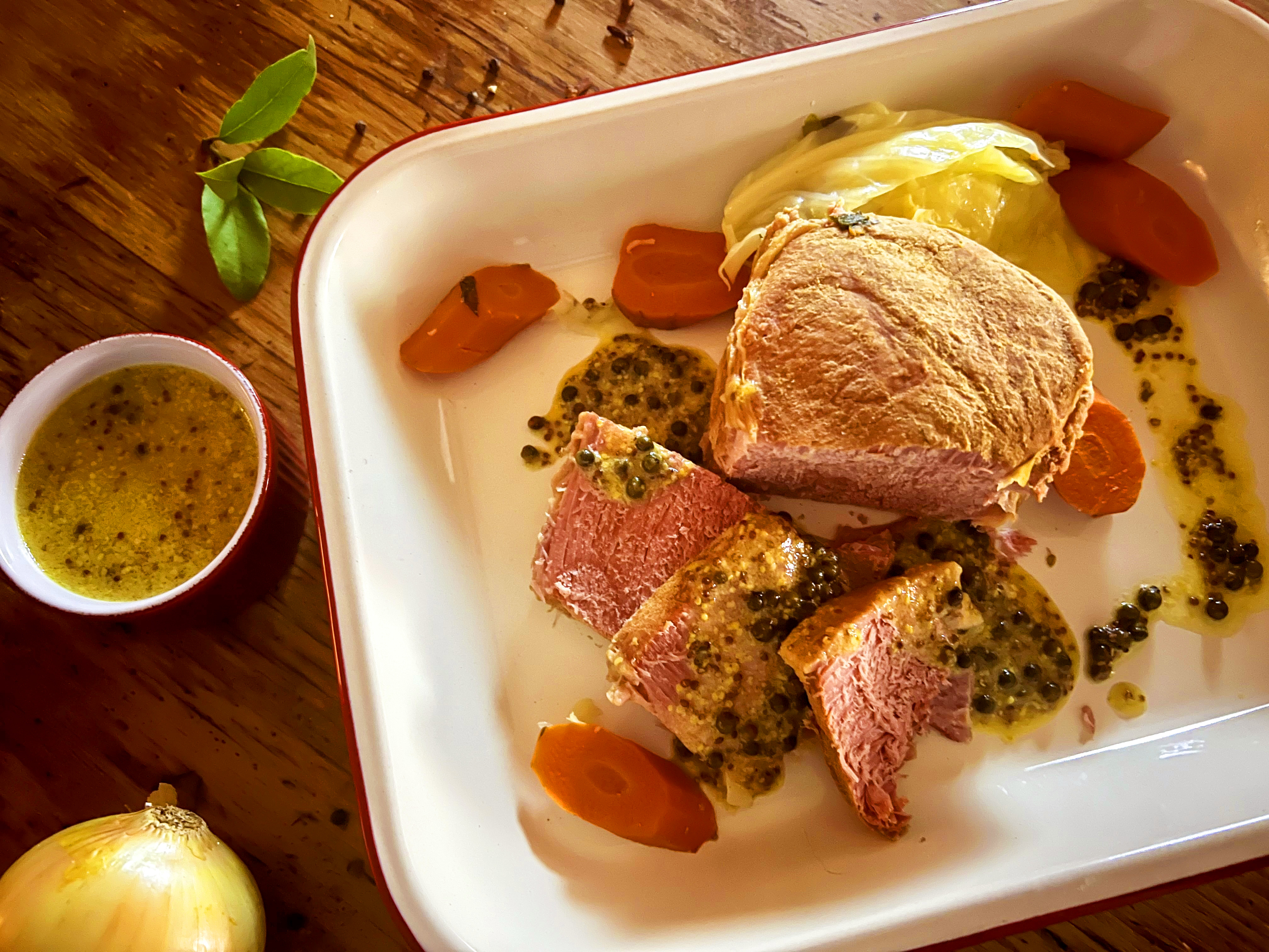




In parts of the Karoo, salt beef, also known as soutvleis, is as much a part of the Christmas table as turkey and gammon are elsewhere. My recipe below is an interpretation of the Karoo tradition, though in Cape Malay cuisine a different version involving many spices is also traditional.
Corned beef in Britain and certain other territories is almost always salt-cured brisket, but in South Africa and Australia, among others, silverside or brisket are most often used. In South Africa, silverside is also the favoured cut for biltong.
A canned variation, often called bully beef, supposedly a bastardisation of the French bouillon (beef stock), has long been a soldiers’ ration in the armed forces of many parts of the world.
On her Cape Malay Cooking and Other Delights website, Salwaa Smith explains that “corned beef served with homemade bread or homemade bread rolls are traditionally served on Eid mornings for breakfast. Very often this will be accompanied by pastei (a large minced meat or steak and kidney pie)”.
Her recipe for a typical homemade pickling spice for salt beef includes mustard seeds, allspice, coriander seeds, cloves, a bay leaf, a cinnamon stick, red pepper flakes and ground ginger. This gives the end product an altogether spicier flavour than the Karoo version.
Having been born into a British family who had emigrated to South Africa in the early 1950s, I grew up eating canned corned beef as a matter of course, even in sandwiches for a school lunch. But my parents had no tradition of corning the beef themselves. “Corned beef” is very much an English term, when applied to the canned version of minced and tightly packed salted beef; even in nearby Ireland, they call it salt beef, which is also its name in faraway Australia.
What does “corn” mean, in fact, in this context? Corning is to cure meat in “corns” of salt, which we’d be more likely to call rock salt today: little chunks of salt, rather than fine grains.
Elsewhere in the world, variations on the theme abound. Salt beef is the key ingredient of the famous Reuben sandwich, and corned beef hash is a popular American meal. In Irish-American culture, more so than in Ireland itself, corned beef is associated with St Patrick’s Day. Interestingly, my Yorkshire mother also used to make corned beef hash, and actually used that term. Variations of it also feature in various Far Eastern cuisines.
My expatriate South African friend in Chicago, Chris Pretorius, tells me that in America salt beef is considered to be an Irish tradition. Wikipedia observes that the American author Mark Kurlansky, in his book Salt, “states that the Irish produced a salted beef around the Middle Ages that was the ‘forerunner of what today is known as Irish corned beef’ and in the 17th century, the English named the Irish salted beef corned beef’.” Well, I’m wondering if it isn’t just a tad glib to claim that the English just took the name from the Irish, when the term corning actually has a specific meaning.
At this time of the year in the Karoo, salt beef (in other words, it has already been cured) is sold at supermarkets everywhere, ready for your administrations in a big pot at home.
Cabbage is a popular accompaniment to salt beef, and in my version I add chunks of cabbage to the pot not long before it is ready to eat. My approach is to boil the beef with plenty of onion, carrots and celery, along with a variety of hard aromatics.
Mustard is the perfect relish for salt beef. I took it a step further, making a cream sauce of wholegrain mustard and green peppercorns. Specifically, this refers to Madagascar green peppercorns in brine.
Ingredients
1 kg salt beef
1 large white onion, roughly chopped
4 carrots, peeled and roughly chopped
3 celery stalks, chopped
A handful of parsley, rinsed
6 cloves
10 black peppercorns
1 tsp fennel seeds
1 heaped tsp mustard powder
3 bay leaves
Cold water to cover
Half a medium cabbage, in chunks
2 Tbsp Madagascar green peppercorns
100 ml cream
2 Tbsp (heaped) wholegrain mustard
Method
Put the chopped vegetables at the bottom of a deep, heavy pot. Place the salt beef on top of them and add cold water to cover. Add the parsley, spices and bay leaves.
Bring to a boil, lower the heat to a steady simmer, and cook for two hours. You’ll see that a 1 kg piece of salt beef is light enough to float in the water, consequently there being no risk of it sticking to the bottom.
Twenty minutes before the end, add chunky wedges of cabbage and continue to cook.
Now let’s make the sauce. Put a sieve over a small saucepan or bowl. Using a ladle, spoon off about 500 ml of the cooking stock into the pan or bowl. Discard whatever the sieve catches.
Add 2 Tbsp of green peppercorns to the stock in this pot. Bring the stock to the boil and reduce by two-thirds.
Whisk in 2 Tbsp prepared wholegrain mustard and add 100 ml cream.
Simmer until the sauce thickens. Season with salt and white pepper.
Slice the beef and serve the carrots, bits of onion and cabbage alongside it, with the sauce. DM
Tony Jackman is Galliova Food Writer 2023, jointly with TGIFood columnist Anna Trapido.
Follow Tony Jackman on Instagram @tony_jackman_cooks.
TGIFood
Karoo Krismis: Salt beef with green peppercorn and mustard sauce
Add salt beef to your festive spread this year. It’s one of the things we’ll be taking home to the Mother City with us in the new year after a decade in the Eastern Cape. Some things need not be let go of.