


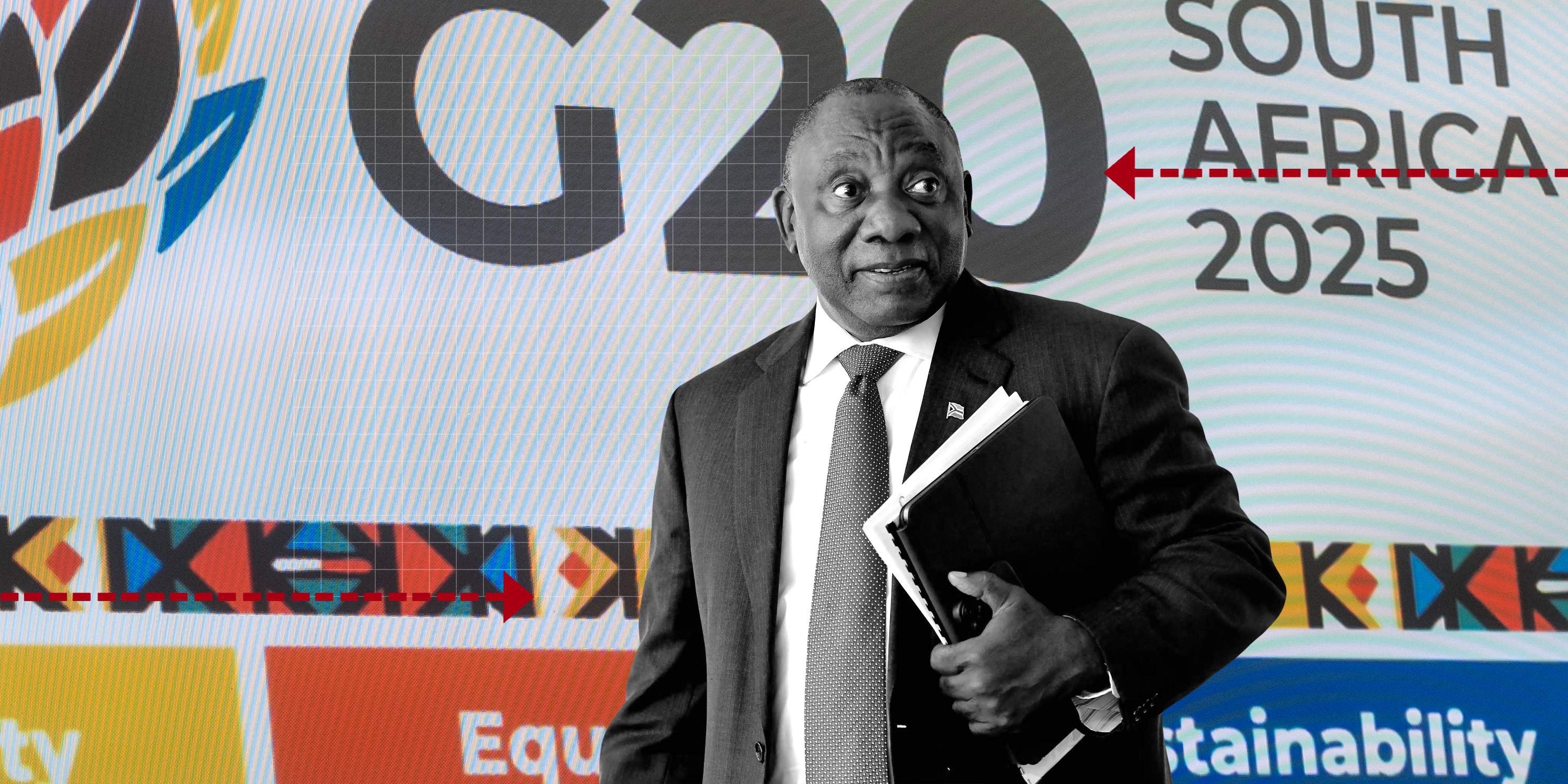
The recent appointment by President Cyril Ramaphosa of a high-powered 19-member team of economic advisers to bolster his G20 presidency points to a man on a mission.
In the same week, Ramaphosa acted on Daily Maverick and News 24 revelations in an investigation into his justice minister, Thembi Nkadimeng-Simelane, who is implicated in corruption, replacing her immediately with Mmamoloko Tryphosa Kubayi, the former Minister of Human Settlements.
Nkadimeng-Simelane has been placed in holding at human settlements while still facing serious allegations but these are less likely to do damage in this realm of governance (for now).
Further shuffles this week included Phumzile Mgcina, as Deputy Minister of Mineral and Petroleum Resources and Judith Nemadzinga-Tshabalala as Deputy Minister of Employment and Labour.
Read more: Ramaphosa axes Simelane as justice minister — but keeps her in the Cabinet
With regard to the G20 economic panel, members are drawn from business and the global academies and show a bias towards employment-linked growth strategies, as Ferial Haffajee and Righard Kapp have noted in Daily Maverick.
Addressing employment-linked gameplans, these advisers are all leading thinkers, head-hunted by Ramaphosa.
The intellectual umbrella they cast is far and wide across fields such as agriculture, state innovation and tackling inequality and structural unemployment.
Through the noise rising from Jacob Zuma’s uMkhonto Wesizwe (MK) party, in the opposition benches in Parliament and on the ground in KZN, and the ghost of Phala Phala nudging his flanks, Ramaphosa is getting on with it.
From the appointment of this panel of experts to the choice of ministries distributed to opposition parties in the coalition government and now the shuffling out of a dodgy minister of justice, Ramaphosa’s dogged path is one that might just leave a legacy.
Two streams pull the Government of National Unity (GNU) towards potential success, for South Africa and then ultimately the ANC led by Ramaphosa.
A cleaned-out ANC where the proverbial rats have jumped ship to the MK party, former president Zuma’s constitutional stealth bomber. His party is made up mostly of fugitives from the law or officials seriously implicated in State Capture and the R57-billion that vanished with the Guptas and their fixers.
What stands between them and jail time is the rule of law and its application.
An eye on the future
How to explain Wildebeest (GNU) to visiting Europeans whose epigenetic wartime trauma has been activated by rising nationalism and intolerance on that continent…
In Holland, Belgium, Italy, Slovakia, Hungary and Sweden the right wing is on the rise. War and migration have prompted a flood of displaced people attempting to find safety in democracies. Finding common ground, as South Africa appears to have done, is virtually impossible, say the visiting Europeans.
So what is this Government of National Unity we South Africans have fashioned? How does it work? And how come they are mostly all on the same page? How do we explain it to an outsider?
Let’s cast an eye on the future.
In five years, if South Africa’s coalition government has survived and proved a success, President Cyril Ramaphosa (and a twice-rinsed ANC) would be right to claim and share the victory.
He would be correct in pointing out: “Look what we did. Look how John Steenhuisen, our Minister of Agriculture, bowed and greeted Comrade President Xi Jinping. And he signed agreements as well! Well done!”
In real life Steenhuisen posted about the visit in September on Facebook: “I have also signed a memorandum of understanding to fight foot and mouth disease. These are game changers for South Africa’s agricultural sector and our economy.”
Proud moment.
Should the GNU fall apart, however, the blame can easily be shifted to opposition partners handed certain responsibilities. Make like a CEO, take the credit for the success and finger unstable markets or other people for failures.
Delegate, delegate, delegate
What Ramaphosa has achieved with the GNU is a shake-up of some of the most anaemic and useless departments, giving these to opposition party ministers eager to prove to their constituencies that they are capable.
The competition should be on, and in politics the election is always closer in the rearview mirror than you might think.
Simplified for the visitors, it was set out thus.
Imagine Ramaphosa is the CEO of RSA (Pty) Ltd and has outsourced (let’s say it for now) some of the most anaemic or damaged departments for a make-over by an opposition party member.
Basic Education (DA); Home Affairs (DA), Communications (DA); Forestry, Fisheries and Environment (DA); Sports, Arts and Culture (PA); Correctional Services (FF+); Cooperative Governance and Traditional Affairs (IFP); Agriculture (DA); Public Service and Administration (IFP); Public Works and Infrastructure (DA); Tourism (Good); and Land Reform and Rural Development (PAC).
Read more: Ramaphosa – ‘Judge the GNU on its work, not the parties involved’
To please the grease, you keep some biggies and some money guzzlers – Finance; Minerals; Electricity and Energy; Defence and Military Veterans; Police; Higher Education; Science Technology and Innovation; Employment and Labour; Health and Human Settlements; and crucially, Social Development.
What binds them all on the same path, regardless of ideological differences, is that we know what needs to be fixed in South Africa: the awful unemployment statistics; the scourge of gender-based violence; fraud in the private and public sector; and poverty and homelessness.
It’s the how-to now.
When it comes to the judiciary, the NPA or SARS or the Hawks or any ministry or department, Ramaphosa lets them get on with their work, unlike Zuma whose prints were all over the place.
It is the mark of a good leader when he or she can think around political corners. The Zuma Zombies are always going to be there, many still inside Ramaphosa’s ANC.
Go Wildebeest, go. DM