



Dailymaverick logo

Maverick Citizen

This article is more than a year old

Maverick Citizen

Banned insecticide found in spazas as inspectors home in on what killed 6 kids

The investigation by a multidisciplinary team points to the widespread and persistent problem of banned forms of pest control being used in the township’s spaza shops and households.
Banned insecticide found in spazas as inspectors home in on what killed 6 kids Authorities are one step closer to uncovering what caused the deaths of the six children in the township south of Johannesburg, police revealed on Thursday (24 October).  Monica Sebetwana (6), Ida Maama (7), Isago Mabote (8), Karabo Rampou (9) and Njabulo Msimanga (7) died on Sunday, 6 October after eating chips from a local spaza shop that authorities determined were contaminated by a chemical agent. The last surviving child, Katlego Olifant (7), died on Sunday, 13 October after a week-long battle in intensive care. The investigation – what Health Minister Aaron Motsoaledi has called a systematic search for the cause of the tragedy – has uncovered traces of a chemical used to kill insects in two spaza shops in the area, Gauteng police commissioner Tommy Mthombeni told the media on Thursday. “We have results from the forensic labs which clearly indicate that the cause is carbamates. It is a bait that kills insects,” Mthombeni said. [caption id="attachment_2424654" align="alignnone" width="1806"]Naledi poison insecticide An inspector holds a packed of banned insecticide found inside a spaza shop in Naledi, Soweto. (Photo: Lerato Mutsila)[/caption] While the commissioner did not say whether the spaza shops that were tested were directly linked to the children’s deaths, the use of chemical agents to kill pests, particularly ones that are banned in South Africa, is a trend that persists in many of the nation’s townships and informal settlements. Read more: Deaths of five children in Naledi underscore need for urgent action on food safety Read more: Five Naledi children honoured as community weeps amid suspected food poisoning cases spike Daily Maverick witnessed this when the publication joined the team of 80 health inspectors in a multidisciplinary assessment of spaza shops on Wednesday. They were joined by officials from the National Institute For Communicable Diseases, the Border Management Authority and the departments of Health and Agriculture. When they visited a spaza shop in Naledi extension 1, the owner initially tried to flee. After following the Mozambican down the road and instructing her to return and open the shop, the inspectors asked whether she used any banned pesticides in the shop. [caption id="attachment_2424652" align="alignnone" width="1833"] A crime protection warden outside a closed spaza shop where six children allegedly bought snacks that may have led to their deaths. (Photo: Lerato Mutsila)[/caption] [caption id="attachment_2424655" align="alignnone" width="1870"] Gauteng police commissioner Tommy Mthombeni briefs the media on his first 100 days in office at Tshwane Metro Police Department headquarters in Pretoria on 13 June 2024. (Photo: Gallo Images / Frennie Shivambu)[/caption] The woman denied this but an inspection of the shop uncovered a packet of a banned insecticide that appeared to be from China. It was confiscated and the woman was instructed to close her shop. It will be tested before it is destroyed, as per procedure. Speaking to Daily Maverick in the field, deputy director of environmental health at the Health Department Belinda Makhafola said these highly poisonous and banned forms of pest control are not only used in spaza shops but in households as well. However, the department did not have the capacity to inspect every household in the province.  “Communities prefer these banned pesticides because they are very effective compared to the normal ones that are sold on the shelves. When we ask them where they get the substances, they all have different stories. Once we are able to track the supplier and charge them for illegally selling a banned substance then we will be able to deal with access to the community,” Makhafola said. DM

Authorities are one step closer to uncovering what caused the deaths of the six children in the township south of Johannesburg, police revealed on Thursday (24 October). 

Monica Sebetwana (6), Ida Maama (7), Isago Mabote (8), Karabo Rampou (9) and Njabulo Msimanga (7) died on Sunday, 6 October after eating chips from a local spaza shop that authorities determined were contaminated by a chemical agent. The last surviving child, Katlego Olifant (7), died on Sunday, 13 October after a week-long battle in intensive care.

The investigation – what Health Minister Aaron Motsoaledi has called a systematic search for the cause of the tragedy – has uncovered traces of a chemical used to kill insects in two spaza shops in the area, Gauteng police commissioner Tommy Mthombeni told the media on Thursday.

“We have results from the forensic labs which clearly indicate that the cause is carbamates. It is a bait that kills insects,” Mthombeni said.

Naledi poison insecticide An inspector holds a packed of banned insecticide found inside a spaza shop in Naledi, Soweto. (Photo: Lerato Mutsila)


While the commissioner did not say whether the spaza shops that were tested were directly linked to the children’s deaths, the use of chemical agents to kill pests, particularly ones that are banned in South Africa, is a trend that persists in many of the nation’s townships and informal settlements.

Read more: Deaths of five children in Naledi underscore need for urgent action on food safety

Read more: Five Naledi children honoured as community weeps amid suspected food poisoning cases spike

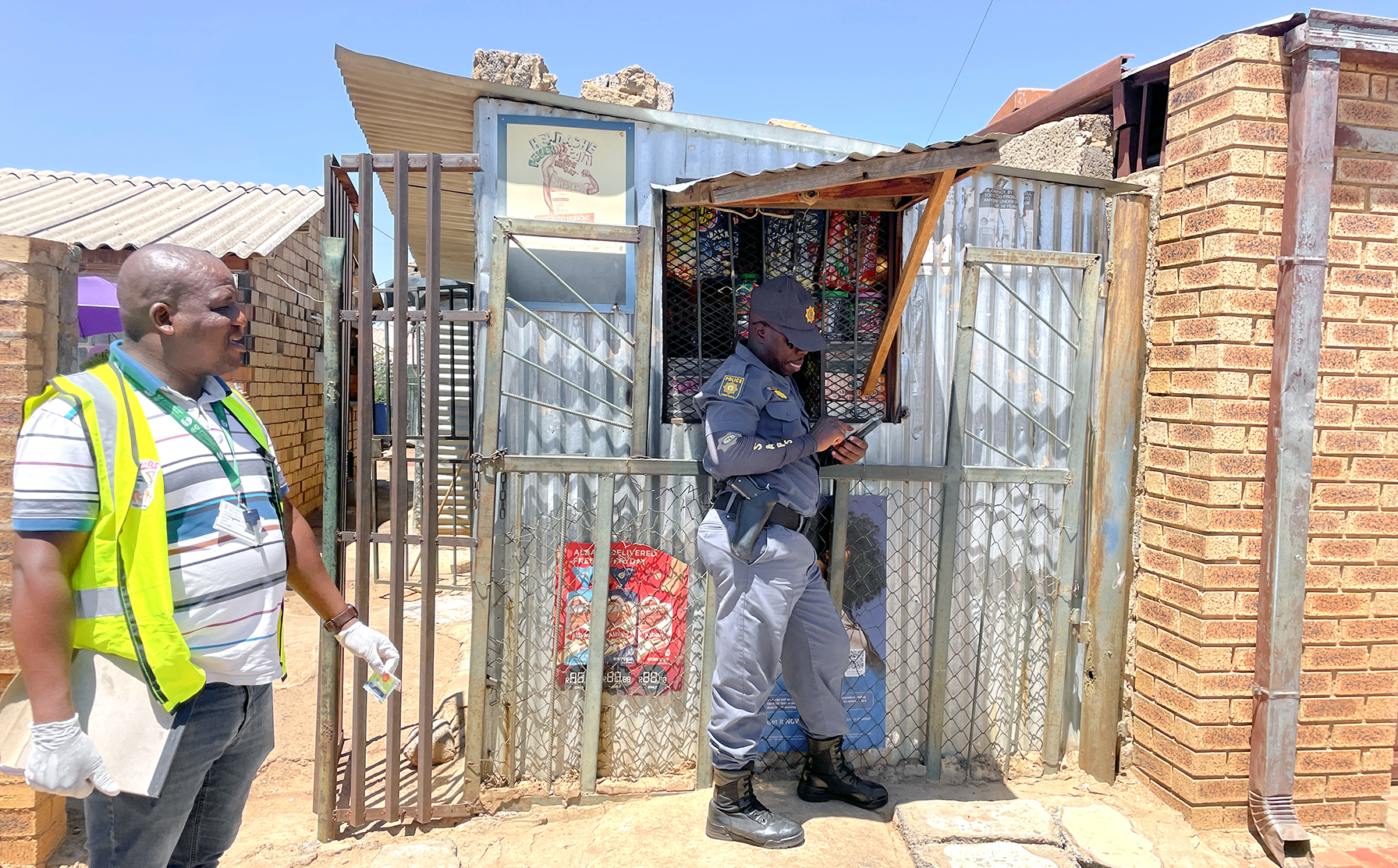
Daily Maverick witnessed this when the publication joined the team of 80 health inspectors in a multidisciplinary assessment of spaza shops on Wednesday. They were joined by officials from the National Institute For Communicable Diseases, the Border Management Authority and the departments of Health and Agriculture.

When they visited a spaza shop in Naledi extension 1, the owner initially tried to flee. After following the Mozambican down the road and instructing her to return and open the shop, the inspectors asked whether she used any banned pesticides in the shop.

A crime protection warden outside a closed spaza shop where six children allegedly bought snacks that may have led to their deaths. (Photo: Lerato Mutsila)


Gauteng police commissioner Tommy Mthombeni briefs the media on his first 100 days in office at Tshwane Metro Police Department headquarters in Pretoria on 13 June 2024. (Photo: Gallo Images / Frennie Shivambu)


The woman denied this but an inspection of the shop uncovered a packet of a banned insecticide that appeared to be from China. It was confiscated and the woman was instructed to close her shop. It will be tested before it is destroyed, as per procedure.

Speaking to Daily Maverick in the field, deputy director of environmental health at the Health Department Belinda Makhafola said these highly poisonous and banned forms of pest control are not only used in spaza shops but in households as well. However, the department did not have the capacity to inspect every household in the province. 

“Communities prefer these banned pesticides because they are very effective compared to the normal ones that are sold on the shelves. When we ask them where they get the substances, they all have different stories. Once we are able to track the supplier and charge them for illegally selling a banned substance then we will be able to deal with access to the community,” Makhafola said. DM

Comments

MaverickMe Oct 24, 2024, 04:03 PM

Reap what you sow. If you sow litter you will reap rodents. Between the inefficient municipal waste departments and the residents who think it is their right to litter this problem will never stop. Only the innocent suffer.

luke17 Oct 24, 2024, 04:21 PM

Along with Aldecarb, commonly known as Two-Step, it is freely available at taxi ranks and used for poisoning dogs at houses earmarked for robberies. It is also often brought in from neighboring countries by passengers on minibus taxis. The authorities have known about this for decades.

Deanne Plunkett Oct 24, 2024, 07:29 PM

I've bought a similar product from a China market shop, to kill cockroaches. Warning is that is highly poisonous. So are other insecticides, herbicides which are legal in this country. This still doesn't solve the problem of children being poisoned: how, why and by whom??

Antonio Tonin Oct 24, 2024, 10:57 PM

Why did you buy it?

Mike Pragmatist Oct 26, 2024, 07:54 PM

He told you - to kill cockroaches. Why buy it is not poisonous and not going to kill them.

Mike Pragmatist Oct 25, 2024, 02:09 PM

It is easy to find a "culprit" and charge that culprit with noting but circumstantial evidence. A "tick box exercise"

noahtsholo. Oct 25, 2024, 08:17 AM

This does not answer the question on who poisoned the children and how. Remember the toxicology report found no trace of the said poison or pesticide. We need answers not speculations. I smell a dead rat here. Someone is trying to cover-up something.

jim Oct 25, 2024, 09:06 AM

This is the sort of thing that China brings to Africa. The only things the Russians have ever brought to Africa is millions of AK47s. The west brings investment and business, lots of it. Yet, the government and the RET have only got eyes for the former. Thinking with the heart, not the brain...

ashleyhaywood4 Oct 25, 2024, 10:21 AM

Yet here we are the most unequal country in the world. Thank you,West! (of course your rebuttal will be ANC corruption bla bla). But it is the West with its Neo-liberalism policies guised as "investment and business".

Earl Grey Oct 25, 2024, 10:07 AM

If the insecticide is found in numerous households in the area, what was different about it being found in the spaza shop? Was it in the snacks that were taken for testing? If not, this doesn't seem like a breakthrough.

George.grimse Oct 26, 2024, 12:27 PM

The Poison is stored between the goods to kill the insects thereby contaminating all the products aound it ,,the children eat and then luck their fingers and so they ingest the poison , it is not rocket science ,it is common sense.

Dempstere Oct 27, 2024, 07:12 AM

Correct. I fail to see how a block of insect bait gets into food, particularly wrapped sweets.

Carolize Jansen Oct 25, 2024, 10:27 AM

All carbamates are not banned in South Africa. Snail poison, widely sold in supermarkets, are carbamates. However, if this was the notorious Two-Step (active ingredient: aldicarb) they found: it is also a carbamate, pretty awful and banned (but apparently traded on the black market).

johnbpatson Oct 25, 2024, 10:40 AM

But China is South Africa's great mate. Look how the leaders love each other at the BRICS summit. Surely it would not export deadly cockroach killer poisons, banned in all civilised countries, to kill the kids in South Africa...

gerstnek Oct 25, 2024, 12:11 PM

"home in on"?? COME ON DAILY MAVERICK. This article is pretty much unreadable now.

Carolyn Cramer Oct 25, 2024, 03:09 PM

Looked odd to me too, but if you google it, it seems that home in is correct... makes sense when you thinking of a homing device

Mike Pragmatist Oct 25, 2024, 02:07 PM

When you poison the fruit of the vine, do not claim to have found the problem and point elsewhere

Mike Pragmatist Oct 26, 2024, 07:52 PM

Well, maybe. Sounds like a typical detective novel - find a possible suspect, no alibi, and circumstantial evidence that this could be the killer. Arrest and convict, close the case (yay - looks good, everyone happy) Let's hope the investigation goes deeper than "this poison is illegal.

Stanislav Zimela Nkosi kaMthembu Oct 26, 2024, 08:33 PM

The finger must be pointed directly at the illegal foreigners, all these other sub-events are incidental. Deport all illegals.

malherbec5 Oct 26, 2024, 09:15 PM

Carbamates are readily available, two examples would be tick control on your dog and fly bait. Both available at your local agri shop. I suspect Temik is the problem at hand, and that is a very very very dangerous member of the carbamate family.

Is there hope South Africa? Oct 27, 2024, 02:46 PM

But how did this poison get into the chips and sweets the children ate? Can someone explain that?