


Dailymaverick logo

TGIFood

This article is more than a year old

TGIFood

Throwback Thursday: The highly desirable charms of the lamb lap

Let’s talk about the boneless edge of a lamb or sheep’s rib. Yes, that’s the fatty top under which you find all the bones. At the braai-side, this is a traditional delicacy. Not everybody knows about it, so let’s keep it to ourselves. Shhhh…
Throwback Thursday: The highly desirable charms of the lamb lap I did some Afrikaans googling (I hesitate to ask how that word is pronounced in Afrikaans) to find out more about a “lieslap”. I knew what it was, had already cooked it a few times, and had quickly come to love it as a braai-side snack. But I knew little about it other than that. But the whole point of this journey in food is to find out about what I don’t yet know, so down another rabbit hole I went. I’d had difficulty trying to explain exactly what it was. Sort of lamb or mutton flank, without the bones. But did this mean you removed the bones from a whole flank and called it a lieslap? Was it the whole deboned rib, or just the edge of it, i.e. the fatty part without the meat? And what did you call it in English? Foreign online sources told me that in certain territories at least, it is called a “lamb lap”. And since I can find no tradition of calling it anything in English in this country, and my Afrikaans mates call it a “lieslap”, it seemed pretty clear that this is what it is: the outer edge of the flank, above the rib bones, as a cut in its own right, and beloved of generations of those in the know as a singular treat, especially for those who are not afraid of fatty meat. Or who even relish it. Cook&Enjoy, the SJA de Villers classic, has a recipe for “rolled mutton rib” which is deboned and immersed in wine or vinegar with sliced onions and marinated in the fridge for three days. It is then covered in an unnamed stuffing (the ingredients just say “stuffing”), rolled and tied, and roasted until tender. I imagine you could turn the cutaway meat from the rib into a filling with some slow cooking and aromatics. But the above appears to be the entire deboned rib (the rib with its bones removed), which is considerably more substantial than the “lieslap”. De Villiers refers to the cutaway meat without bones as a “brisket”, which I had thought applied only to beef. (She is correct; I checked.)  Jan Scannell (aka Braai) has a recipe for a lamb rib roll in his excellent new book Atmosfire (Penguin), which are rolled into rounds, skewered and braaied. They look lovely. But they appear to be the whole rib (hence him calling them lamb rib roll, rather than lamb or mutton “lap” or whatever the going South African term might be. Please do enlighten me if you have insight into this.)

Tony Jackman’s weekly newsletter is packed with bright food ideas and delicious stories about food and life. Sign up to Tony’s weekly newsletter here. It’s free, and in your inbox every Friday afternoon. If it goes to promotions or spam at first, please drag it into your inbox.

Both of these recipes are for the whole rib without the bones, so they are not precisely what we are dealing with here. And, once the bones have gone, we find the references to it in both English and Afrikaans as “lieslap” or “lamb lap”. And therein lies enough evidence for us to make a call: it sort of resembles a cloth, and can even be folded like one to a degree. So this explains both the Afrikaans and English (in some parts of the world) names for it. Exploring what best to do with it, I took further advice. One sage of the old kitchens and braais told me that her family used to cut it into thin strips, roll each strip up, skewer them, douse them in lemon juice, Worcestershire sauce, salt and pepper and braai them slowly high above the coals. This mimics the method of cooking a whole mutton or lamb flank (bones and all) clamped into a grid side-on the coals. It takes a long time and finally becomes tender, and then you quickly crisp the fat on hot coals. Here’s how I do that. [caption id="attachment_2410559" align="alignnone" width="2362"] The ‘lieslap’ being crisped on the braai. (Photo: Tony Jackman)[/caption] A few weeks ago, I made a baste of Worcestershire sauce, fynbos vinegar, salt and black pepper, basted a whole lamb lap (lieslap), and braaied it slowly over moderate coals. It was very good but a tad chewy for my liking. I wanted it to be more tender.  I decided I would give it a slow oven braise, cool it down, and only finish it quickly on very hot coals before slicing it up as a snack for my friends. This worked very well, but it’s important to remove the cooked “laps” from their braising stock to dry out at room temperature before grilling them to crisp them up. Once you’ve done this once, don’t be surprised if you’ll be badgering your butcher before long to cut you another “lap”, and later another, and another. It’s devilishly moreish, but do leave some space for what you’re cooking as the main event. This recipe is for three of them, but you can just do one if there are only three or four to enjoy them.

Tony’s lamb ‘lap’, twice-cooked

(Serves a small crowd as a braai side nibble)

Ingredients

3 lamb laps (deboned flank) For the braise: Lamb stock to cover ⅓ cup Worcestershire sauce ⅓ cup sherry vinegar 1 Tbsp Hot English Mustard 1 Tbsp crushed coriander seeds Ground black pepper Salt For the baste: Worcestershire sauce Rozendal fynbos vinegar Maldon smoked sea salt Black pepper

Method

Preheat an oven to 170°C. In a deep oven pan, mix 1 litre (or more) of lamb stock with the Worcestershire sauce, sherry vinegar and Hot English Mustard and stir in the crushed coriander seeds, black pepper and salt. On the hob, bring the contents of the pan to a boil. Put the pan in the oven and braise for 2 to 3 hours or until the lamb flanks are tender. Remove and leave to cool to room temperature. They will be finished on the braai later. When you have hot coals, your mates are sitting out back with a glass of wine or a beer, and it’s time to cook this delicious braai-side nibble, remove the flanks from their braising stock and let them dry out a little at room temperature. (If you’re cooking another lamb or mutton dish as the main course, turn the braising stock into a sauce by spooning off fat and then reducing it down.) Mix the Worcestershire sauce and Rozendal fynbos vinegar in a little jug and baste both sides of the flanks with it. Season both sides with smoked Maldon salt and black pepper. Grill over hot coals until nice and crisp, especially the fatty side. Cut into strips and serve. DM Tony Jackman is Galliova Food Writer 2023, jointly with TGIFood columnist Anna Trapido.  Order Tony’s book, foodSTUFF, here. Follow Tony Jackman on Instagram @tony_jackman_cooks. This dish is photographed on a plate by Mervyn Gers Ceramics.

I did some Afrikaans googling (I hesitate to ask how that word is pronounced in Afrikaans) to find out more about a “lieslap”. I knew what it was, had already cooked it a few times, and had quickly come to love it as a braai-side snack. But I knew little about it other than that.

But the whole point of this journey in food is to find out about what I don’t yet know, so down another rabbit hole I went.

I’d had difficulty trying to explain exactly what it was. Sort of lamb or mutton flank, without the bones. But did this mean you removed the bones from a whole flank and called it a lieslap? Was it the whole deboned rib, or just the edge of it, i.e. the fatty part without the meat? And what did you call it in English?

Foreign online sources told me that in certain territories at least, it is called a “lamb lap”. And since I can find no tradition of calling it anything in English in this country, and my Afrikaans mates call it a “lieslap”, it seemed pretty clear that this is what it is: the outer edge of the flank, above the rib bones, as a cut in its own right, and beloved of generations of those in the know as a singular treat, especially for those who are not afraid of fatty meat. Or who even relish it.

Cook&Enjoy, the SJA de Villers classic, has a recipe for “rolled mutton rib” which is deboned and immersed in wine or vinegar with sliced onions and marinated in the fridge for three days. It is then covered in an unnamed stuffing (the ingredients just say “stuffing”), rolled and tied, and roasted until tender. I imagine you could turn the cutaway meat from the rib into a filling with some slow cooking and aromatics.

But the above appears to be the entire deboned rib (the rib with its bones removed), which is considerably more substantial than the “lieslap”. De Villiers refers to the cutaway meat without bones as a “brisket”, which I had thought applied only to beef. (She is correct; I checked.) 

Jan Scannell (aka Braai) has a recipe for a lamb rib roll in his excellent new book Atmosfire (Penguin), which are rolled into rounds, skewered and braaied. They look lovely. But they appear to be the whole rib (hence him calling them lamb rib roll, rather than lamb or mutton “lap” or whatever the going South African term might be. Please do enlighten me if you have insight into this.)

Tony Jackman’s weekly newsletter is packed with bright food ideas and delicious stories about food and life. Sign up to Tony’s weekly newsletter here. It’s free, and in your inbox every Friday afternoon. If it goes to promotions or spam at first, please drag it into your inbox.


Both of these recipes are for the whole rib without the bones, so they are not precisely what we are dealing with here. And, once the bones have gone, we find the references to it in both English and Afrikaans as “lieslap” or “lamb lap”. And therein lies enough evidence for us to make a call: it sort of resembles a cloth, and can even be folded like one to a degree. So this explains both the Afrikaans and English (in some parts of the world) names for it.

Exploring what best to do with it, I took further advice. One sage of the old kitchens and braais told me that her family used to cut it into thin strips, roll each strip up, skewer them, douse them in lemon juice, Worcestershire sauce, salt and pepper and braai them slowly high above the coals. This mimics the method of cooking a whole mutton or lamb flank (bones and all) clamped into a grid side-on the coals. It takes a long time and finally becomes tender, and then you quickly crisp the fat on hot coals. Here’s how I do that.

The ‘lieslap’ being crisped on the braai. (Photo: Tony Jackman)


A few weeks ago, I made a baste of Worcestershire sauce, fynbos vinegar, salt and black pepper, basted a whole lamb lap (lieslap), and braaied it slowly over moderate coals. It was very good but a tad chewy for my liking. I wanted it to be more tender. 

I decided I would give it a slow oven braise, cool it down, and only finish it quickly on very hot coals before slicing it up as a snack for my friends.

This worked very well, but it’s important to remove the cooked “laps” from their braising stock to dry out at room temperature before grilling them to crisp them up.

Once you’ve done this once, don’t be surprised if you’ll be badgering your butcher before long to cut you another “lap”, and later another, and another.

It’s devilishly moreish, but do leave some space for what you’re cooking as the main event.

This recipe is for three of them, but you can just do one if there are only three or four to enjoy them.

Tony’s lamb ‘lap’, twice-cooked


(Serves a small crowd as a braai side nibble)

Ingredients


3 lamb laps (deboned flank)

For the braise:

Lamb stock to cover

⅓ cup Worcestershire sauce

⅓ cup sherry vinegar

1 Tbsp Hot English Mustard

1 Tbsp crushed coriander seeds

Ground black pepper

Salt

For the baste:

Worcestershire sauce

Rozendal fynbos vinegar

Maldon smoked sea salt

Black pepper

Method


Preheat an oven to 170°C.

In a deep oven pan, mix 1 litre (or more) of lamb stock with the Worcestershire sauce, sherry vinegar and Hot English Mustard and stir in the crushed coriander seeds, black pepper and salt.

On the hob, bring the contents of the pan to a boil.

Put the pan in the oven and braise for 2 to 3 hours or until the lamb flanks are tender. Remove and leave to cool to room temperature. They will be finished on the braai later.

When you have hot coals, your mates are sitting out back with a glass of wine or a beer, and it’s time to cook this delicious braai-side nibble, remove the flanks from their braising stock and let them dry out a little at room temperature. (If you’re cooking another lamb or mutton dish as the main course, turn the braising stock into a sauce by spooning off fat and then reducing it down.)

Mix the Worcestershire sauce and Rozendal fynbos vinegar in a little jug and baste both sides of the flanks with it. Season both sides with smoked Maldon salt and black pepper.

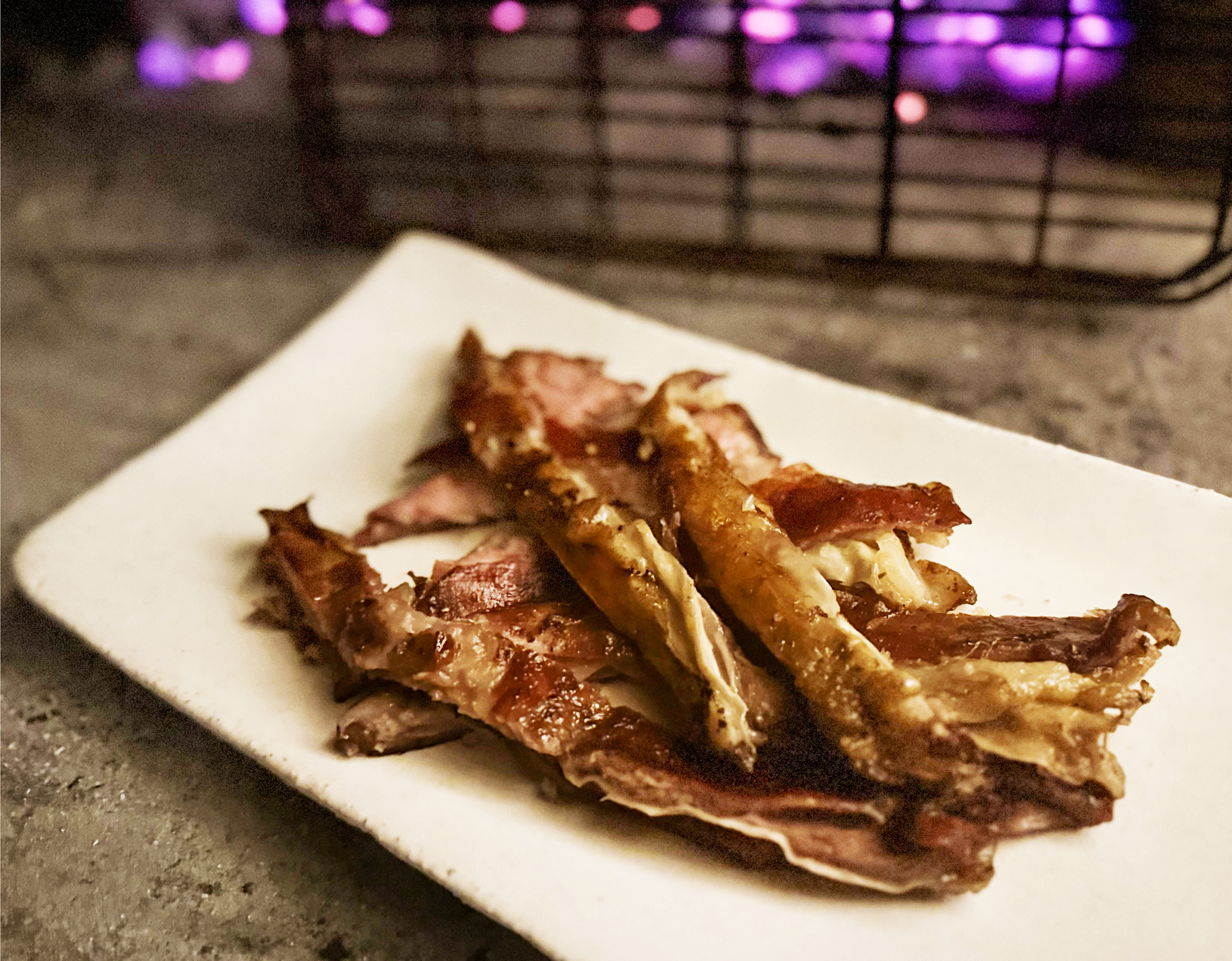
Grill over hot coals until nice and crisp, especially the fatty side. Cut into strips and serve. DM

Tony Jackman is Galliova Food Writer 2023, jointly with TGIFood columnist Anna Trapido. 

Order Tony’s book, foodSTUFF, here.

Follow Tony Jackman on Instagram @tony_jackman_cooks.

This dish is photographed on a plate by Mervyn Gers Ceramics.

Comments

ttshililo2 Oct 17, 2024, 05:19 PM

Man, Tito Mboweni’s cooking was still more creative and better executed than yours- I can’t believe this is masquerading as service journalism.

André van Niekerk Oct 17, 2024, 08:46 PM

Not sure how this is a relevant comment? Anyway, I would love to hear how Mr Mboweni cooked (I know he cooked well); does he have a "lieslap" recipe? Please share.