





‘This is painful. It is painful to look at your child, knowing you are just waiting for the call that he has died. Every day, I just had to wait, knowing that there was nothing that I could do for him. It is very painful. You will never understand the pain. His brain was damaged, and at the end, the only way my child could eat was through a tube.”
 A poster protesting against the ordeal of Oratile Diloane. (Supplied)
These were the heart-wrenching words of Refiloe Dilaone as she shared the news that her child, Oratile Diloane, had tragically died over the weekend, eight years after falling into a pit latrine.
In May 2016, when Oratile was only five years old, he was playing with his friends at school when he fell into a pit toilet, Diloane told Daily Maverick. When the incident happened, the anxious mother was told nothing; a young Oratile was just dropped off at her house as if nothing had happened.
In reality, after falling into the uncovered toilet, Oralite was rescued from the pit by a maintenance worker who used a rope to pull the small child out of the latrine. The then five-year-old was scolded by school officials, who, instead of informing his mother about what had happened, washed his clothes to conceal the evidence and sent him home.
The only evidence of what had happened to Oratile was the smell of faeces, which lingered on his skin and in his breath. As a result of his fall, Oratile sustained severe head injuries, resulting in hypoxia and hydrocephalus, which ultimately resulted in his death over the weekend at the young age of 13.
“There was nothing we could do for him. We tried to take him to the hospital, but we didn’t get much help. My child was always healthy, he didn’t have any problems, but by the time he died, his brain wasn’t working properly, and he was paralysed. All we could do was wait for god to take him,” Dilaone said.
Read more: New MPs in drive to fast-track overdue eradication of dangerous school toilets
The blight of pit latrine toilets
“Oratile’s death is a tragic happening, and it is a stark reminder that there is a cost when the government doesn’t fulfil its obligation and not meet the constitutional promise. This is a child who has suffered the most gross indignity, having been injured,” Motheo Brodie, a candidate attorney at SECTION27, said.
The civil society organisation had been helping the Diloane family with access to care from the public health system, in addition to placement in a school that caters to learners with special needs.
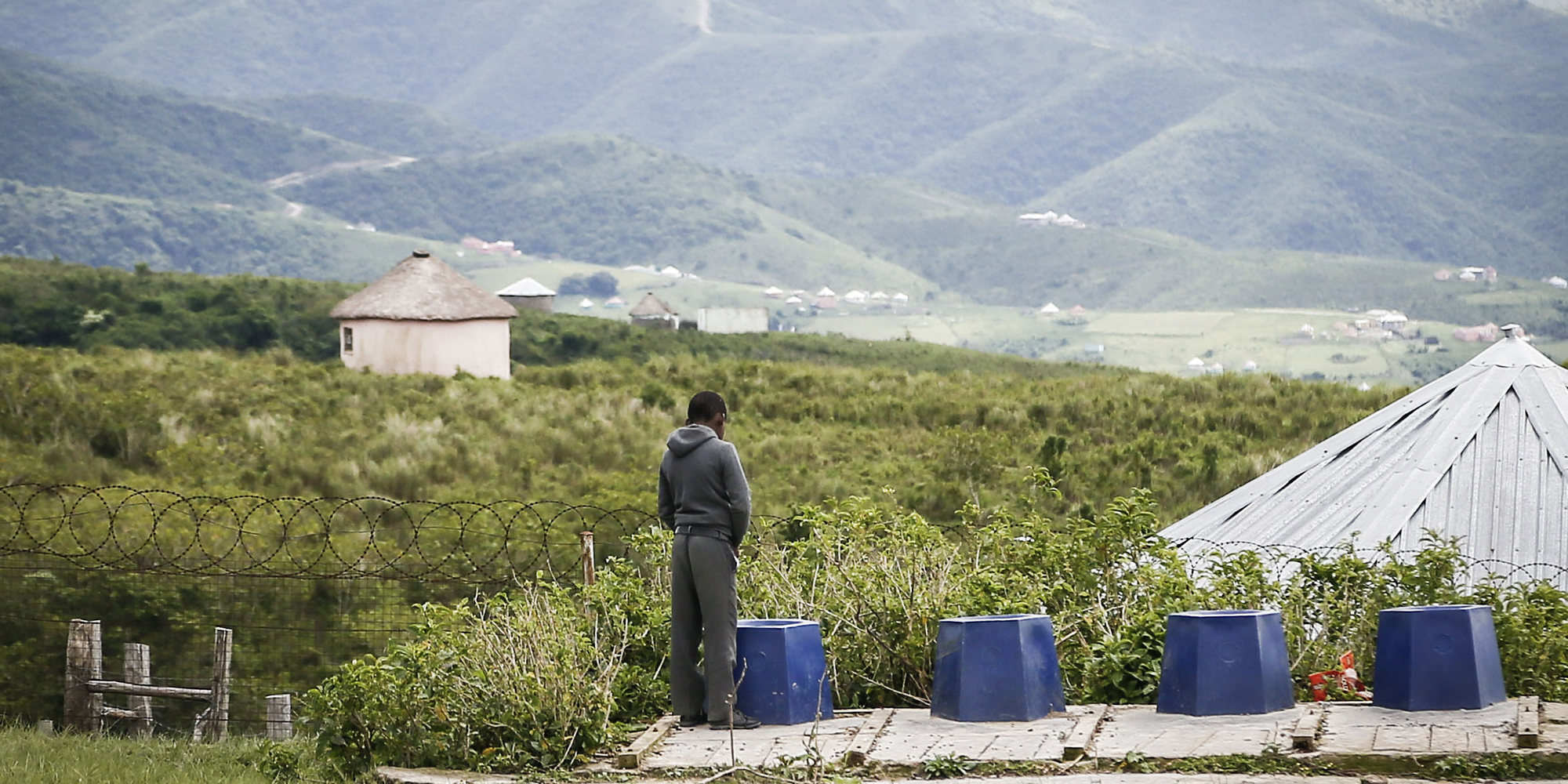 A pupil at Vulingcobo Junior Secondary School uses an old pit latrine at the Sibanye-Stillwater mine in Xhora, near Elliotdale in the Eastern Cape. (Photo: Felix Dlangamandla / Daily Maverick)
“Before his death, the family was struggling to get Oratile placement in a special needs school in North West, so he was also out of school for a very long time. That is the crux of the tragedy. One, it is the injury he endured and two, it’s the amount of suffering he endured and the failures of the healthcare system and the basic education system to actually assist him.”
SECTION27 has been campaigning for safe school sanitation and infrastructure following the tragic and preventable death of Michael Komape, who drowned in a pit toilet at a Limpopo school in 2014.
The civil society organisation, representing Michael’s parents, won an order from the Limpopo High Court in 2018, directing the provincial education department to eradicate all pit latrine toilets in schools. The Limpopo Department of Basic Education again fell short of its deadline in April 2024.
Read more: In the mission to eradicate pit toilets, this new progress monitor democratises data for Limpopo schools
The bid to eradicate pit toilets from government schools also resulted in the Sanitation Appropriate for Education (SAFE) programme, which President Cyril Ramaphosa announced in 2019. The purpose of the SAFE was to provide sufficient sanitation facilities to schools in South Africa.
“What is also disturbing us is the revised norms and standards published by the Department of Basic Education, which removed deadlines by which provinces ought to have eradicated pit toilets. Now there is less accountability, and one could say that it is actually a regression because previously you could track the department’s progress, but now there are no accountability measures,” Brodie said.
 Pit toilets at schools have not been eradicated. (Photo: Gallo Images / Sowetan / Sandile Ndlovu)
“So, really, we don’t know how much longer this is going to continue. How many other Oratiles are there going to be? So it really is heartbreaking and one hopes that the government realises what the cost of their failure really means.”
The Department of Basic Education’s Terence Khala told Daily Maverick that the department determined that 3,375 schools across the country needed intervention in safe sanitation.
“Ninety-two percent of SAFE schools have been provided with appropriate sanitation facilities; 2,045 of SAFE schools have been provided with appropriate sanitation facilities through Schools Infrastructure Backlog Grant (SIBG); 124 of SAFE schools have been provided with appropriate sanitation facilities through Donor funding; 927 of SAFE schools have been provided with appropriate sanitation facilities through the Education Infrastructure Grant (EIG). The remaining 279 are planned to be completed by 31 March 2025,” the department said.
When asked about Oratile’s death, the following response was given: “We will get more information from the province about that. We need to retrieve records of that incident before making any comment of any type whatsoever.”
Diloane said: “Ever since the day Oratile fell into the pit toilet he was never the same. After years of trying to get help from the hospital, he finally had operations on his brain. But after that day nothing has been going properly. his muscles stopped working, and he was even paralysed. The government failed me. They didn’t even come to ask us what had happened, even till today.” DM