


Dailymaverick logo

Maverick Life

This article is more than a year old

Maverick Life

Formidable France — Paris Olympic Games 2024 opening, a ceremony like never before

France can be messy, chaotic and unruly. Despite its proclamations, it isn’t always welcoming and inclusive of other cultures, languages and differences. But the Paris Olympics opening ceremony showed that maybe the ideals of liberty, equality and togetherness can triumph over nationalism and obscurity.
Formidable France — Paris Olympic Games 2024 opening, a ceremony like never before “The history of France is this: a story that clashes, is rebuilt, then deconstructed,” Thomas Jolly, a French actor, director and the creative mind behind the Paris Olympic ceremony, said in a recent interview with The New York Times On the night of 26 July, history indeed clashed, deconstructed and rebuilt itself. Jolly, along with his team that included journalist/TV presenter Daphné Bürki (the ceremony’s stylist), actor and author Damien Gabriac (costume director), choreographer/dancer Maud Le Pladec and historian/author/professor at the Collège de France, Patrick Boucheron, created 12 scenes built around 12 words:  
  1. “Enchanted”;
  2. “Synchronicity”;
  3. “Liberty”;
  4. “Equality”;
  5. “Brotherhood”;
  6. “Sisterhood”;
  7. “Sportiness”;
  8. “Festivity”;
  9. “Obscurity”;
  10. “Solidarity”;
  11. “Solemnity”; and
  12. “Eternity”.
Fashioning a ceremony around a selection of words already presented a challenge.  In a country attached to its republican values and the Constitution’s First Amendment, which proclaims that “France shall be an indivisible, secular, democratic and social Republic”, words are often fiercely debated.  The bedrock of a societal “model”, the word “secularity” — the separation of church and state, a concept that was made into law in 1905 — is repeatedly debated in tense and polarising discussions Like the Turritopsis dohrnii, it returns, proud and immense, reminding us that words can — and should — change, evolve and reshape to reflect our ever-changing world. Words don’t lose their power as they grow; they don’t lose their beauty when dissected, broken down or multiplied. But they certainly lose their lustre if they remain stuck in the past. The 2024 Olympic Games opening ceremony clashed with, deconstructed and rebuilt words and ideas against the walls of Paris’ most famous monuments.  And what a feast this was!  The ceremony followed the “Bateaux Mouches”, a fleet of barges that took athletes from around the world down the River Seine, over 6km, starting at the Austerlitz bridge and going all the way to the Trocadéro, across the river from the Eiffel Tower.  Each “scene” opened with different historic buildings as a backdrop, rethinking and reinterpreting history with one message at its core: our common humanity and inclusivity.  Using movement, dance, language, music, costumes and pyrotechnics, it revolutionised window frames, marched over paved bridges, nudged at classical statues, circled venerable columns, swung down ancient staircases, flew over rooftops and hustled the Republic with fabulous joie de vivre (and yes, giving a delicious middle finger to the far right, which came once again so close to victory at the recent national elections). But the ceremony wasn’t done in response to France’s snap elections. According to Bürki, it took the team two years to write the scenario, weaving together the history and values of the Olympic Games and those of a complex, nuanced and layered city.  It took two years, with teams split across France, 3,000 artists rehearsing in secrecy, and more than 3,000 costumes made of upcycled and recycled material, to bring to life what many called a historic event [caption id="attachment_2294203" align="alignnone" width="2560"] Smoke clouds in the tricolours of the France flag are seen at Pont d'Austerlitz during the Opening Ceremony of the Olympic Games Paris 2024 on 26 July 2024 in Paris, France. (Photo: Ann Wang - Pool / Getty Images)[/caption] In an interview with the French radio channel France Inter, the morning after the opening, Bürki explained that they tried to work with the “grey colours of Paris’ sky” and that they hoped “for everyone to feel represented … and to show the richness of French society”.  Even if the ceremony wasn’t a direct response to the elections, it lyrically challenged conservative and traditionalist ideas and addressed the notion that history must either be destroyed and erased to be reinvented or left untouched to be preserved. Art is by default political. It exists to help us see things differently and think about the world in ways we might not have otherwise, caught as we are in the business of our daily lives. In all its often uncomfortable or unusual beauty, art breaks the speed of everythingness to make us stop and contemplate.  And so, for more than three hours, art exploded in front of our eyes, outside of the confines of what can usually be intimidating and elitist spaces: galleries, museums, monuments, stadiums.  For more than three hours, art burst into colours and sounds, bouncing off towering brick walls (a parallel with the May ’68 barricades?) reminding us that history can be all at once celebrated, honoured, challenged and reinvented.   [caption id="attachment_2294206" align="alignnone" width="1908"] Aya Nakamura performs during the Opening Ceremony of the Olympic Games Paris 2024 on 26 July 2024 in Paris, France. (Photo: Esa Alexander-Pool / Getty Images)[/caption] There is nothing more empowering than French-Malian Aya Nakamura dressed in metallic gold (a medal!) performing a medley of her hits Pookie and Djadja and Charles Aznavour’s For Me Formidable with the orchestra of the French Republican Guard right in front of the Académie Française.  Officially created in 1635, the Académie is “the principal French council for matters pertaining to the French language”. The academy refused in October 2017 to make the French language, which is gendered, more inclusive. And just last year, President Emmanuel Macron “opposed gender-inclusive spelling” like the use of “they” as a gender-neutral pronoun, at the inauguration of the French language museum.  Nakamura is continually attacked by the far right, with racist, sexist and vicious comments posted and voiced about her work, her person and the slang she uses in her songs. What better way then, to gracefully and joyfully shake up the institution than with Nakamura exiting that very monument of “Frenchness” singing songs that stretch and rethink the French language with the Republican Guard tailing her? A Guard dressed in traditional costumes, made by exclusive ateliers that preserve and safeguard centuries of craftsmanship. There it was: history recognised, remembered, challenged and awakened.    It wasn’t the only place, of course — just before, the heavy metal band Gojira and opera singer Marina Viotti performed at La Conciergerie. There again, people gasped at the sight of what looked like a guillotined Marie Antoinette, her dangling head singing: “Ah ça ira, ça ira, les aristocrates on les pendra!”, “It’ll be fine, it’ll be fine, the aristocrats we will hang them”, a French revolutionary song first heard in May 1790. [caption id="attachment_2294204" align="alignnone" width="2560"] Smoke billows near windows as performers participate during the Opening Ceremony of the Olympic Games Paris 2024 on 26 July 2024 in Paris, France. (Photo: Bernat Armangue - Pool / Getty Images)[/caption] [caption id="attachment_2294205" align="alignnone" width="2560"] Heavy Metal band Gojira performs during the opening ceremony of the Olympic Games Paris 2024 on 26 July 2024 in Paris, France. (Photo: Zhang Yuwei-Pool / Getty Images)[/caption] [caption id="attachment_2294213" align="alignnone" width="2560"] French heavy metal band Gojira performs during the opening ceremony of the Olympic Games Paris 2024 on 26 July 2024 in Paris, France. (Photo: Buda Mendes / Getty Images)[/caption] On France Inter, Gabriac explained, “We wrote the ceremony following the fleet of athletes [on the Seine], passing the Conciergerie where Marie Antoinette was imprisoned before being guillotined.  “We thought, we have to talk about the French Revolution. We are known worldwide for this historical event… We wanted it to be filled with energy, the energy of the French Revolution, and so Gojira, a heavy metal band, along with guillotined heads … it was also a snub to London and the queen of England and James Bond!” Gabriac said with a laugh. Irreverent? Absolutely. But it did help us shatter the mould of our fears and face them head-on, ensuring we don’t become fossilised. And then there was a scene that many viewers associated with a rendition of “La Cène” — another beautiful language quip, La Seine and La Cène are pronounced the same in French. (“L’Ultima Cena” is Leonardo da Vinci’s famous painting representing the Last Supper of Jesus with the 12 apostles.)  Over the River Seine, a cosmopolitan festival: a drag show, a catwalk, a living painting with Belgian visual artist Philippe Katerine rising from a plate as Dionysus, a mix of poetry, fun and festivity. Many criticised the scene for being offensive to Christian values. To this, Piche, a drag performer, responded in an interview with The Parisien “Nobody was dressed as Jesus, nobody parodied him, not in their costumes, not in their behaviours. The idea was to bring a new outlook. In the past, there have been many representations of the Last Supper and it never bothered anyone. But when it is done by drag [performers] and people from the LGBT community, it is offensive. But we’re used to it. People are obsessed with questions of gender that pique conservatives.”  On BFMTV Thomas Jolly said that the Last Supper wasn’t the inspiration behind the scene. “I thought it was quite clear: there is Dionysus who arrives on this table, Dionysus who is here because he is the god of festivity and the scene is called ‘festivity’... the god of wine-making which is also a symbol of France, and he is the father of Sequana, the goddess of the River Seine. The idea was rather to portray a big pagan party linked to the gods of Olympe… At a press conference, Jolly added: “This ceremony is political, just like I am, in the Greek sense of the word ‘polis’, the city, the continent, the world. “There is no desire to be subversive or to offend but to say, we are this large ‘We’ with Republican ideas of inclusion, generosity, solidarity that we all are craving so much right now. Here, artistic creativity is free, we have this freedom. There is no desire to send militant messages but republican ones: in France, we have the right to love who we want and as we want, we have the right to believe or not to believe. The idea was to show those values.”  [caption id="attachment_2294210" align="alignnone" width="2560"] A general view of the Eiffel Tower's spotlight shining towards the Olympic Cauldron in the sky after being lit by Torch bearers French Athlete Marie-Jose Perec and French Judoka Teddy Riner (not pictured) during the opening ceremony of the Olympic Games Paris 2024 on 26 July 2024 in Paris, France. (Photo: Julian Finney / Getty Images)[/caption] [caption id="attachment_2294208" align="alignnone" width="8640"] The cauldron, with the Olympic flame lit, lifts off while attached to a balloon, during the opening ceremony for the 2024 Summer Olympics in Paris, France, Friday, 26 July 2024. (Photo: Ricardo Mazalan - Pool / Getty Images)[/caption] And so, just like the galloping silver horsewoman, a revamped Pegasus crossing Paris, who carried the Olympic flag to its final destination, values of love, inclusion, diversity, sorority and togetherness travelled through the night.  From the masked torchbearer (an ode to Assassin’s Creed, created by French video game publisher Ubisoft), mezzo-soprano Axelle Saint-Cirel singing La Marseillaise, dressed by Dior, atop the Grand Palais, to the rising statues of historical French women, and athletes Marie-José Pérec and Teddy Riner lightening the Cauldron of the Olympic Games (created by the French designer Mathieu Lehanneur), now flying 30m high above Paris, a “100% electric flame without fuel thanks to EDF, made of water and light”, according to the official Olympic site) to Céline Dion’s return, singing Edith Piaf’s L’Hymne à l’Amour, the evening was eccentric, surprising and formidable.  Boucheron explained on France Inter: “I don’t know if it’s a historical opening ceremony, I don’t know what one ceremony can do to History, but I know it was important at one point, to portrait our society in a resembling way; and the place where we live; and above all, the place where we’re going, where we would like to go, in a world where we can feel encouraged that yes, indeed, we can live together. For this, we need to put our efforts together, our energy, our past, our traditions, our cultures… And yes, many of us want that.” Today, France continues to grapple with racism, sexism, antisemitism and traditionalism. The far right is no longer lurking in the background; it is present in the Assembly, inching closer to power, and fuelling its agenda with a dangerous fervour.  Despite its proclamations, France isn’t always welcoming and inclusive of other cultures, languages and differences. It doesn’t consistently protect its most vulnerable communities nor does it prioritise women’s rights. Resistant to change, France can be messy, chaotic and unruly. It strikes, complains and resists, yet it remains a country of nuances, hope and idealism.  Here, love can flourish in any form, and maybe the ideals of liberty, equality and togetherness can forever triumph over nationalism and obscurity. DM    Read more: Olympic Games Paris 2024

“The history of France is this: a story that clashes, is rebuilt, then deconstructed,” Thomas Jolly, a French actor, director and the creative mind behind the Paris Olympic ceremony, said in a recent interview with The New York Times

On the night of 26 July, history indeed clashed, deconstructed and rebuilt itself.

Jolly, along with his team that included journalist/TV presenter Daphné Bürki (the ceremony’s stylist), actor and author Damien Gabriac (costume director), choreographer/dancer Maud Le Pladec and historian/author/professor at the Collège de France, Patrick Boucheron, created 12 scenes built around 12 words:  


  1. “Enchanted”;

  2. “Synchronicity”;

  3. “Liberty”;

  4. “Equality”;

  5. “Brotherhood”;

  6. “Sisterhood”;

  7. “Sportiness”;

  8. “Festivity”;

  9. “Obscurity”;

  10. “Solidarity”;

  11. “Solemnity”; and

  12. “Eternity”.


Fashioning a ceremony around a selection of words already presented a challenge. 

In a country attached to its republican values and the Constitution’s First Amendment, which proclaims that “France shall be an indivisible, secular, democratic and social Republic”, words are often fiercely debated. 

The bedrock of a societal “model”, the word “secularity” — the separation of church and state, a concept that was made into law in 1905 — is repeatedly debated in tense and polarising discussions

Like the Turritopsis dohrnii, it returns, proud and immense, reminding us that words can — and should — change, evolve and reshape to reflect our ever-changing world. Words don’t lose their power as they grow; they don’t lose their beauty when dissected, broken down or multiplied. But they certainly lose their lustre if they remain stuck in the past.

The 2024 Olympic Games opening ceremony clashed with, deconstructed and rebuilt words and ideas against the walls of Paris’ most famous monuments. 

And what a feast this was! 

The ceremony followed the “Bateaux Mouches”, a fleet of barges that took athletes from around the world down the River Seine, over 6km, starting at the Austerlitz bridge and going all the way to the Trocadéro, across the river from the Eiffel Tower. 

Each “scene” opened with different historic buildings as a backdrop, rethinking and reinterpreting history with one message at its core: our common humanity and inclusivity. 

Using movement, dance, language, music, costumes and pyrotechnics, it revolutionised window frames, marched over paved bridges, nudged at classical statues, circled venerable columns, swung down ancient staircases, flew over rooftops and hustled the Republic with fabulous joie de vivre (and yes, giving a delicious middle finger to the far right, which came once again so close to victory at the recent national elections).

But the ceremony wasn’t done in response to France’s snap elections. According to Bürki, it took the team two years to write the scenario, weaving together the history and values of the Olympic Games and those of a complex, nuanced and layered city. 

It took two years, with teams split across France, 3,000 artists rehearsing in secrecy, and more than 3,000 costumes made of upcycled and recycled material, to bring to life what many called a historic event

Smoke clouds in the tricolours of the France flag are seen at Pont d'Austerlitz during the Opening Ceremony of the Olympic Games Paris 2024 on 26 July 2024 in Paris, France. (Photo: Ann Wang - Pool / Getty Images)


In an interview with the French radio channel France Inter, the morning after the opening, Bürki explained that they tried to work with the “grey colours of Paris’ sky” and that they hoped “for everyone to feel represented … and to show the richness of French society”. 

Even if the ceremony wasn’t a direct response to the elections, it lyrically challenged conservative and traditionalist ideas and addressed the notion that history must either be destroyed and erased to be reinvented or left untouched to be preserved.

Art is by default political. It exists to help us see things differently and think about the world in ways we might not have otherwise, caught as we are in the business of our daily lives. In all its often uncomfortable or unusual beauty, art breaks the speed of everythingness to make us stop and contemplate. 

And so, for more than three hours, art exploded in front of our eyes, outside of the confines of what can usually be intimidating and elitist spaces: galleries, museums, monuments, stadiums. 

For more than three hours, art burst into colours and sounds, bouncing off towering brick walls (a parallel with the May ’68 barricades?) reminding us that history can be all at once celebrated, honoured, challenged and reinvented.  

Aya Nakamura performs during the Opening Ceremony of the Olympic Games Paris 2024 on 26 July 2024 in Paris, France. (Photo: Esa Alexander-Pool / Getty Images)


There is nothing more empowering than French-Malian Aya Nakamura dressed in metallic gold (a medal!) performing a medley of her hits Pookie and Djadja and Charles Aznavour’s For Me Formidable with the orchestra of the French Republican Guard right in front of the Académie Française. 

Officially created in 1635, the Académie is “the principal French council for matters pertaining to the French language”. The academy refused in October 2017 to make the French language, which is gendered, more inclusive. And just last year, President Emmanuel Macron “opposed gender-inclusive spelling” like the use of “they” as a gender-neutral pronoun, at the inauguration of the French language museum. 

Nakamura is continually attacked by the far right, with racist, sexist and vicious comments posted and voiced about her work, her person and the slang she uses in her songs.

What better way then, to gracefully and joyfully shake up the institution than with Nakamura exiting that very monument of “Frenchness” singing songs that stretch and rethink the French language with the Republican Guard tailing her? A Guard dressed in traditional costumes, made by exclusive ateliers that preserve and safeguard centuries of craftsmanship.

There it was: history recognised, remembered, challenged and awakened.   

It wasn’t the only place, of course — just before, the heavy metal band Gojira and opera singer Marina Viotti performed at La Conciergerie. There again, people gasped at the sight of what looked like a guillotined Marie Antoinette, her dangling head singing: “Ah ça ira, ça ira, les aristocrates on les pendra!”, “It’ll be fine, it’ll be fine, the aristocrats we will hang them”, a French revolutionary song first heard in May 1790.

Smoke billows near windows as performers participate during the Opening Ceremony of the Olympic Games Paris 2024 on 26 July 2024 in Paris, France. (Photo: Bernat Armangue - Pool / Getty Images)


Heavy Metal band Gojira performs during the opening ceremony of the Olympic Games Paris 2024 on 26 July 2024 in Paris, France. (Photo: Zhang Yuwei-Pool / Getty Images)


French heavy metal band Gojira performs during the opening ceremony of the Olympic Games Paris 2024 on 26 July 2024 in Paris, France. (Photo: Buda Mendes / Getty Images)


On France Inter, Gabriac explained, “We wrote the ceremony following the fleet of athletes [on the Seine], passing the Conciergerie where Marie Antoinette was imprisoned before being guillotined. 

“We thought, we have to talk about the French Revolution. We are known worldwide for this historical event… We wanted it to be filled with energy, the energy of the French Revolution, and so Gojira, a heavy metal band, along with guillotined heads … it was also a snub to London and the queen of England and James Bond!” Gabriac said with a laugh.

Irreverent? Absolutely. But it did help us shatter the mould of our fears and face them head-on, ensuring we don’t become fossilised.

And then there was a scene that many viewers associated with a rendition of “La Cène” — another beautiful language quip, La Seine and La Cène are pronounced the same in French. (“L’Ultima Cena” is Leonardo da Vinci’s famous painting representing the Last Supper of Jesus with the 12 apostles.) 

Over the River Seine, a cosmopolitan festival: a drag show, a catwalk, a living painting with Belgian visual artist Philippe Katerine rising from a plate as Dionysus, a mix of poetry, fun and festivity.


Many criticised the scene for being offensive to Christian values. To this, Piche, a drag performer, responded in an interview with The Parisien

“Nobody was dressed as Jesus, nobody parodied him, not in their costumes, not in their behaviours. The idea was to bring a new outlook. In the past, there have been many representations of the Last Supper and it never bothered anyone. But when it is done by drag [performers] and people from the LGBT community, it is offensive. But we’re used to it. People are obsessed with questions of gender that pique conservatives.” 

On BFMTV Thomas Jolly said that the Last Supper wasn’t the inspiration behind the scene.

“I thought it was quite clear: there is Dionysus who arrives on this table, Dionysus who is here because he is the god of festivity and the scene is called ‘festivity’... the god of wine-making which is also a symbol of France, and he is the father of Sequana, the goddess of the River Seine. The idea was rather to portray a big pagan party linked to the gods of Olympe…

At a press conference, Jolly added: “This ceremony is political, just like I am, in the Greek sense of the word ‘polis’, the city, the continent, the world.

“There is no desire to be subversive or to offend but to say, we are this large ‘We’ with Republican ideas of inclusion, generosity, solidarity that we all are craving so much right now. Here, artistic creativity is free, we have this freedom. There is no desire to send militant messages but republican ones: in France, we have the right to love who we want and as we want, we have the right to believe or not to believe. The idea was to show those values.” 

A general view of the Eiffel Tower's spotlight shining towards the Olympic Cauldron in the sky after being lit by Torch bearers French Athlete Marie-Jose Perec and French Judoka Teddy Riner (not pictured) during the opening ceremony of the Olympic Games Paris 2024 on 26 July 2024 in Paris, France. (Photo: Julian Finney / Getty Images)


The cauldron, with the Olympic flame lit, lifts off while attached to a balloon, during the opening ceremony for the 2024 Summer Olympics in Paris, France, Friday, 26 July 2024. (Photo: Ricardo Mazalan - Pool / Getty Images)


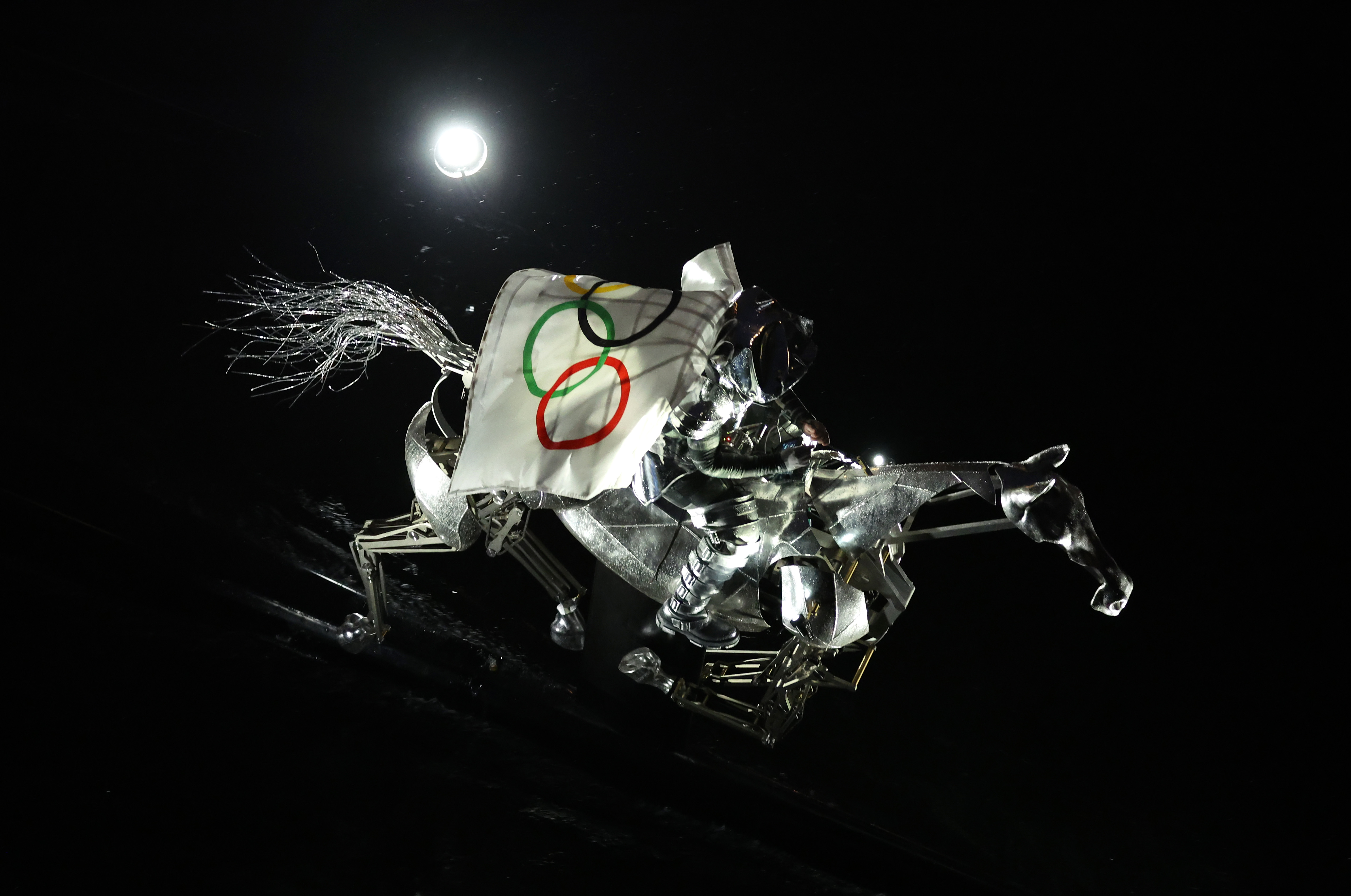
And so, just like the galloping silver horsewoman, a revamped Pegasus crossing Paris, who carried the Olympic flag to its final destination, values of love, inclusion, diversity, sorority and togetherness travelled through the night. 

From the masked torchbearer (an ode to Assassin’s Creed, created by French video game publisher Ubisoft), mezzo-soprano Axelle Saint-Cirel singing La Marseillaise, dressed by Dior, atop the Grand Palais, to the rising statues of historical French women, and athletes Marie-José Pérec and Teddy Riner lightening the Cauldron of the Olympic Games (created by the French designer Mathieu Lehanneur), now flying 30m high above Paris, a “100% electric flame without fuel thanks to EDF, made of water and light”, according to the official Olympic site) to Céline Dion’s return, singing Edith Piaf’s L’Hymne à l’Amour, the evening was eccentric, surprising and formidable. 

Boucheron explained on France Inter: “I don’t know if it’s a historical opening ceremony, I don’t know what one ceremony can do to History, but I know it was important at one point, to portrait our society in a resembling way; and the place where we live; and above all, the place where we’re going, where we would like to go, in a world where we can feel encouraged that yes, indeed, we can live together. For this, we need to put our efforts together, our energy, our past, our traditions, our cultures… And yes, many of us want that.”

Today, France continues to grapple with racism, sexism, antisemitism and traditionalism. The far right is no longer lurking in the background; it is present in the Assembly, inching closer to power, and fuelling its agenda with a dangerous fervour. 

Despite its proclamations, France isn’t always welcoming and inclusive of other cultures, languages and differences. It doesn’t consistently protect its most vulnerable communities nor does it prioritise women’s rights. Resistant to change, France can be messy, chaotic and unruly. It strikes, complains and resists, yet it remains a country of nuances, hope and idealism. 

Here, love can flourish in any form, and maybe the ideals of liberty, equality and togetherness can forever triumph over nationalism and obscurity. DM   

Read more: Olympic Games Paris 2024

Comments

Charlie Victor Jul 29, 2024, 06:12 AM

The alphabet gang try so hard to force acceptance. The bits I saw were poor and not a celebration of anything olympic. So poor (or intentional...) the Olympic flag was hoisted upside down, the internationally recognised symbol of distress. Perhaps they should spent 2 years rehearsing that...

J vN Jul 29, 2024, 08:37 AM

And by pushing their grotesque imagery down everybody else's throats, they are achieving exactly the opposite. The vast majority of sane people have no interest whatsoever in what happens in other people's bedrooms, and to force this upon others, they are alienating normal people.

Andrew C Jul 29, 2024, 10:45 AM

How on earth is what happens in people's bedrooms being forced on you? Your use of the word "normal" shows your belief system. I'm astonished at how easily people are offended and how thin-skinned they are. If you don't like something just ignore it.

Johann Olivier Jul 29, 2024, 03:34 PM

Well said, Andrew. The Grand Irony is that these naysayers underline the importance of the message! Vive la France!

D'Esprit Dan Jul 29, 2024, 03:56 PM

Vive la diversité

Malcolm McManus Jul 29, 2024, 06:48 AM

An epic disaster. Not just the alphabet mafia debacle, but also I believe catering and accommodation for the participants was very substandard. By all accounts this may go down as one of the worst, if not the worst Olympics ever. Christians should boycott it for good reason.

Malcolm McManus Jul 29, 2024, 06:57 AM

"values of love, inclusion, diversity, sorority and togetherness travelled through the night." I strongly doubt this. Probably backed up by the comments that will undoubtedly follow in response to this article. Already its a global topic of heated debate and outrage.

Malcolm McManus Jul 29, 2024, 06:57 AM

"values of love, inclusion, diversity, sorority and togetherness travelled through the night." I strongly doubt this. Probably backed up by the comments that will undoubtedly follow in response to this article. Already its a global topic of heated debate and outrage.

Ed Rybicki Jul 29, 2024, 09:03 AM

I didn’t watch - but having read all of the one-eyed and horrifically biased comments, I think I should! ??

Andrew Mortimer Jul 29, 2024, 10:46 AM

Definitely Ed! It was a little long but that would be my only criticism. it was a triumph and the fact that the bigoted, closed minded so call christians can distinguish between their own religion and greek mythology if hilarious in itself.

Harold Porter Jul 29, 2024, 12:26 PM

In this very article the drag performer, Piche, confirmed that it was an interpretation of Da Vinci's last supper.....just saying....

Rodney Weidemann Jul 30, 2024, 11:31 AM

Piche, a drag performer, said: “Nobody was dressed as Jesus, nobody parodied him, not in their costumes, not in their behaviours.”  Thomas Jolly, creative mind behind the opening said: “It was clear: Dionysus arrives on the table. The idea: to portray a big pagan party linked to the gods of Olympe.”

Wade de Jager de Jager Jul 29, 2024, 04:48 PM

Agree 100% Andrew Mortimer - I'm astonished by the mean spirited, small minded comments on such an amazingly adventurous Olympic Opening Ceremony. Can you imagine what a mammoth task it was to orchestrate so many moving parts. Pity so many couch critics got to watch it from their TV Room cocoons.

Harold Porter Jul 29, 2024, 09:34 AM

I found my Orwell's Dictionary (1984 edition) useful in understanding this article: "Inclusion" - the promotion of a narrow set of ideals glorifying niche sexual acts "Love" - the engaging in the aforementioned sexual acts "Diversity"- strict adherence to a set dogmatic views on the social order

Hendrik Van der Westhuizen Jul 29, 2024, 09:45 AM

One of the best opening ceremonies since the Barcelona games, made we want to revisit Paris again.

Elizabeth Louw Jul 29, 2024, 09:57 AM

Je suis d'accord

Alan Watkins Jul 29, 2024, 10:34 AM

The best ever, by far. I was tired of the humdrum stadium based ceremonies with dancers and fireworks, all trying to supersede the previous humdrum ceremonies. This was different, hugely entertaining. Some over my head and I only got some of the references from the reviews, but c'est magnifique.

joules-airbase-0b Jul 29, 2024, 07:35 PM

Magnifique cr-p.

Charles de Villiers Jul 29, 2024, 12:08 PM

Wonderful, beautiful and whimsical. It's a bit depressing, though, to read the reactionary, bile-filled comments from some of our compatriots. They used to say that one should turn one's watch back 20 years on landing in SA - perhaps that's still the case. The world is moving on, people!

Is there hope South Africa? Jul 29, 2024, 04:21 PM

Before posting, you need to educate yourself on this issue. It's not only South Africans on this platform criticising the opening ceremony. People all over the world (not just Christians) are saying that it mocked Christianity and that the organisers should have exhibited the very tenets of peace, tolerance, inclusivity and respect that they purported to be displaying. Yes, the world is moving on, but it is supposed to be moving on to be tolerant of all and not mock anyone. That is what we are all trying to achieve. Read Elon Musk's comments on this issue. It is indeed necessary to be brave and stand up for what is fair and right.

Biff Trotters Jul 30, 2024, 12:47 AM

"you need to educate yourself on this issue" - Do you wag your index finger when you say that?

Is there hope South Africa? Jul 30, 2024, 08:34 AM

Grow up (and yes, I am wagging my index finger)

Biff Trotters Jul 30, 2024, 02:18 PM

This from one who takes his(?) norms on Christianity from Musk, his self-proclaimed religion being "one of curiosity"? Says Musk "I don’t really worship anything, but I do devote myself to the advancement of humanity by using technology." Same Musk, right?

Is there hope South Africa? Jul 31, 2024, 09:11 AM

Yes, same Musk. And that's precisely the point - even non Christians are saying that the opening ceremony was a mockery.

Rodney Weidemann Jul 30, 2024, 11:34 AM

before posting, educate yourself: The creative mind behind the opening said: “It was clear: Dionysus arrives on the table. The idea: to portray a big pagan party linked to the gods of Olympe.” Also, if you think being the richest man in the world qualifies you be an expert on anything - wake up!

Malcolm McManus Jul 30, 2024, 05:43 AM

The world is moving on. DM did an article on someone defecating on a canvas as part of her arts thesis. Now all that's missing from artistic France is a smurf defecating from the top of the Eiffel tower onto a canvas. Pretty acceptable perhaps in your modern eyes.

aylanadine Jul 29, 2024, 12:48 PM

Let's all laugh at the bigots who got their knickers in a twist over the opening ceremony. HA HA HA! #Love isLove

Rob Martin Jul 29, 2024, 02:44 PM

Completely missed the mark. No relevance to the best sporting event in the world. If anything, it will push the average French voter further to the Right in fear that what they witnessed becomes mainstream. A watershed day for France. Let's see how they react.

D'Esprit Dan Jul 29, 2024, 03:53 PM

All sports opening ceremonies are OTT, with few sticking to the actual sport, but rather giving a flavour of the hosts. Why should Paris be different? I fear the naysayers have missed the mark on this - the point of inclusivity is to, well, include those on the margins. Bravo, Paris, bravo!

Sue Grant-Marshall Jul 29, 2024, 07:05 PM

The opening of the Paris Olympic Games was one of the most spectacular launches of all time - the horsewoman on the silver horse galloping down the Seine was pure magic. Amazing, inspiring, yes...revolutionary...I can't see another country topping this for years to come. Vive la France.

Marc Caldwell Jul 29, 2024, 09:37 PM

This article doesn't even TRY to be objective. It reads like a PR press statement put out by the alphabet committee.

alastairmgf Jul 29, 2024, 10:53 PM

The fact that the Olympic Committee has removed the entire opening ceremony from their website and banned, yes banned, anyone from showing it on social media, on pain of legal action, says it all. A vomit inducing fest of woke garbage, full of virtue signaling. The worst opening ceremony on record.

Steve Davidson Jul 30, 2024, 10:48 AM

The original painting he based it on was about the Greek gods as reported in today's UK Guardian: “The tableau vivant or ‘living painting’ in the opening ceremony of Paris 2024 was of The Feast of the Gods, by Jan van Bijlert from 1635,”

Santie Pretorius Pretorius Jul 30, 2024, 10:58 AM

The intensely emotional debate proves the artistic achievement of the opening ceremony: “In all its often uncomfortable or unusual beauty, art breaks the speed of everythingness to make us stop and contemplate.” Art has through the ages challenged the smug superiority of those who view their way of life as normal and assigning anyone they see as different to live outside society, so as not to offend their ways and disturb their comfort.

Malcolm McManus Jul 30, 2024, 12:33 PM

I agree art has changed through the ages. So much so that crapping on a canvas is considered art. Without even trying, evidently I am artistically gifted the morning after a viciously hot Durban bunny chow. I am canvassing and framing my next post bunny crap in the hope you will buy it. No offense.

Michael Cinna Jul 30, 2024, 11:29 AM

Are we being gaslit into believing that out of the incredible French culture, what we saw was the best it had to offer? Regarding the Christian symbology, I don't have a problem. But is that rule being applied evenly? No, otherwise Charlie Hebdo would still be around.

Julian Hitchcock Aug 1, 2024, 04:37 PM

I commend Emilie on an exceptionally well written and informative article. The opening ceremony was the best three hours of entertainment I have ever seen. The French absolutely nailed it.

gslcelliers Aug 4, 2024, 08:20 AM

I had high expectations- I love the Olympics and the ethos of achievement and striving and the literal love I have for people giving years and their best to this event. The opening ceremony in Paris was to be unique . But it was trite, boring, off focus and shameful. Amateur and woke rubbish. Bored