


Dailymaverick logo

Maverick Citizen

This article is more than a year old

Maverick Citizen

Cold reality – many of us are closer to living on the street than we think

For some of us, there is a safety net when faced with the crisis of lost employment. We can fall back on parents, spouses or friends. Others are not so lucky.
Cold reality – many of us are closer to living on the street than we think Last week, I bought a new bed. It is, hands down, one of the best purchases I’ve made as an adult. Even more so when you consider that up until then, I was still sleeping on the second-hand single bed I bought off one of my honours-year classmates. My first night in this new bed was one of the most comfortable I can remember.  [caption id="attachment_2280574" align="alignleft" width="2560"] Looking down at an encampment on a traffic island alongside Helen Suzman Boulevard in Cape Town, 17 July 2024. This spot along with six other encampments around the CBD area has been designated for eviction at the end of the month after the City of Cape Town succesfully obtained a court order. (Photo: David Harrison)[/caption] [caption id="attachment_2280573" align="alignleft" width="2560"] Part of the homeless encampment on the Foreshore at Foregate Square, with the high rise buildings of the CBD & Nelson Mandela Boulevard bridge towering behind, 16 July 2024. This encampment is one of seven that is to be cleared at the end of the month following the City of Cape Town obtaining an eviction court order. (Photo: David Harrison)[/caption] [caption id="attachment_2280572" align="alignleft" width="2560"] Joseph Mokgeti at the homeless encampment on the Foreshore at Foregate Square, 16 July 2024. This encampment is one of seven that is to be cleared at the end of the month following the City of Cape Town obtaining an eviction court order. (Photo: David Harrison)[/caption] Around the same time as I got the bed, I started working on an article about a recent Western Cape High Court ruling that approved the eviction of unhoused persons from seven sites around Cape Town’s inner city by the end of July. Through interviews with people living in these spots – and the city-funded Safe Space One shelter under the Culemborg Bridge – I began to build a more complete picture of their lives. Our conversations have taken shape against a backdrop of escalating storms and frigid temperatures. I’ve slept terribly ever since, and the new bed hasn’t helped. There are certain mantras of the middle class when it comes to living alongside those who’ve been left without a home. “Don’t give them money, they’ll just use it for drugs and/or alcohol”. “If they really wanted to, they could get out of that situation”. “I went through a difficult time, and look where I am”.

Cold reality

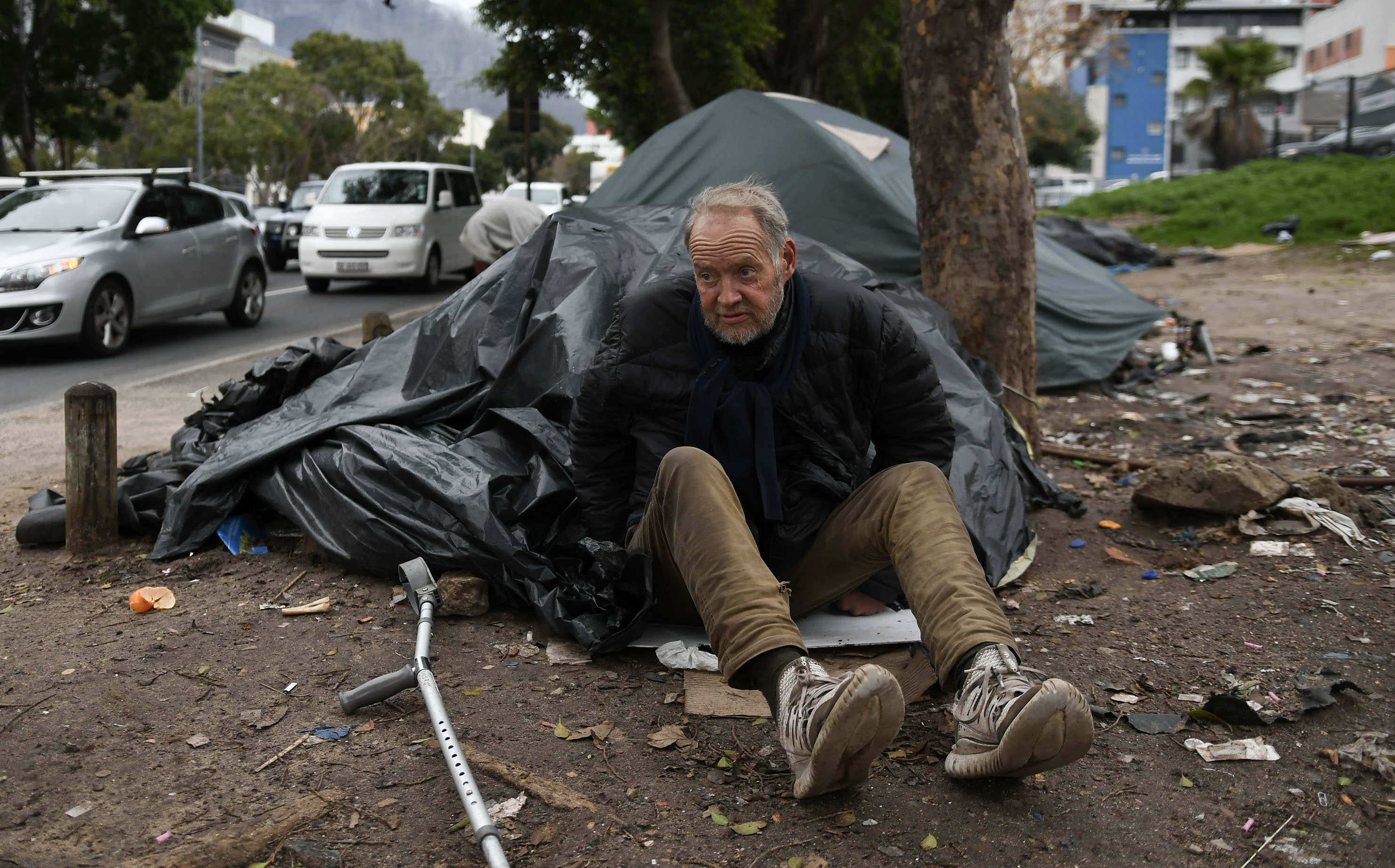
The cold reality is that many of us are closer to living on the street than we think.  One of my conversations during the past week was with Inus Gouws. He’s a 52-year-old man who worked as an IT specialist and data modeller up until the onset of Covid-19. He was laid off – along with seven others – when the pandemic hit. For some of us, there is a safety net when faced with the crisis of lost employment. We can fall back on parents, spouses or friends. For Gouws, he was that safety net. He’d been supporting his parents and his wife’s parents up until that point. There was no one left to catch him when he fell. [caption id="attachment_2280570" align="alignleft" width="2364"] Inus Gouws asking for assistance from passers-by in cars on Strand Street in Cape Town, 17 July 2024. Inus & others in encampments around the CBD will be forced to move at the end of the month when a City of Cape Town eviction court order takes effect. (Photo: David Harrison)[/caption] [caption id="attachment_2280575" align="alignleft" width="2560"] Inus Gouws at his encampment on the corner of Strand & Buitengracht Street in Cape Town, 16 July 2024. Inus & others in encampments around the CBD will be forced to move at the end of the month when a City of Cape Town eviction court order takes effect. (Photo: David Harrison)[/caption] Both Gouws and his wife ended up on the street. In 2023, while walking back to their shelter from a public toilet in the dark, Gouws’ wife was mugged and stabbed to death. Her final moments were spent just off Buitengracht Street, which many of us take to work. Sometime after, Gouws witnessed a robbery on that same street. He went to court to testify. The gang-mates of the man he helped to send to jail hunted him down and tried to break his back. As a result, he spent some 20 weeks in Karl Bremer Hospital, wondering if he’d ever walk again. He has been left disabled, vulnerable… and still on the street. [caption id="attachment_2280569" align="alignleft" width="2560"] Part of the homeless encampment next to the Cape Town Castle with the Grand Parade & City Hall in the background, 17 July 2024. (Photo: David Harrison)[/caption] “There’s a lot of things that I’ve learnt on the street. I never knew of this life. I never thought or dreamt about this life,” he reflected. “If I was a normal member of the public, which I was only a couple years ago – looking at people, driving my car to work – and a homeless guy would come up to me, I myself would put up the window, switch on the radio, not look at them… I always said they had a choice; they made that choice. And now I’m in the same position.” Gouws lives at one of the seven sites that will enforce eviction by the end of this month. His home for the past three years has been the corner of Buitengracht and Strand Street. For him, anything would be better than spending another night at the mercy of criminal and winter elements. The city says it will relocate him and other evictees who are willing to accept alternative accommodation to a yet-to-be-opened shelter called Ebenezer Safe Space Three in Green Point. He believes he’ll get a better life after his eviction, and I hope that’s true. More than 100 unhoused persons will be evicted from the seven sites around Cape Town this month. When the court ruling approving the evictions was handed down, the Socio-Economic Rights Institute of South Africa (Seri) – which represented the evictees in court – initially believed they would be accommodated at the Safe Space One shelter. The city has since said it will offer the evictees places at Ebenezer Safe Space Three. Occupants of Safe Space One have made allegations of poor and undignified conditions at the shelter. Among their claims is that the rudimentary structures – corrugated iron roofs with no walls – don’t provide adequate protection from the elements. Rats are allegedly commonplace there, getting into beds and belongings and biting some residents. The city has stated that sleeping quarters are protected and monthly pest control services are provided at the site, adding that on a scale of dignity and health, there was “no comparison” between what the city was offering at the Safe Spaces and what the occupants endured on the street. Read more: ‘A travesty of human rights’ — Cape Town shelter occupants tell of degrading conditions

Harmful misconceptions

Safe Space One is a free shelter for people who’ve been left without a home. Occupants of the site repeatedly brought up the harmful misconception that homelessness is mainly caused by drug and alcohol use and stressed that the situation was often far more complex. While some unhoused people do struggle with these issues, there are many other factors at play. One Safe Space One resident was an operations director overseas before returning to support his sick mother. Around the same time that she died, the Covid-19 pandemic hit and he’s been struggling to find a job ever since. Another told me that a messy divorce was the catalyst for him living on the street. What he thought would be a short-term situation has now lasted many months. There are residents of Safe Space One who are living with mental health conditions, some of which have been exacerbated by the trauma of spending time on the streets. I was told there are a significant number of elderly people who end up in the shelter, some of whom are suffering from conditions like Alzheimer’s or dementia. They belong in a care facility but – for whatever reason – have been left without the support they need. A big part of the problem is that once people reach the point of living on the street, it becomes very difficult to escape the situation, whether they want to or not. This is in part because of the harmful assumptions that are made about them, but also because of other barriers. Things of value are often stolen; it’s a challenge to meet acceptable standards of appearance for job interviews; and it gets progressively harder to rise above feelings of exhaustion and hopelessness. The longer a person’s on the street, the harder it gets. As one Safe Space One resident put it, “I didn’t plan on getting into this situation but the plan is to not stay in it. However, a lot of people have said to me in the last few months that there comes a point where people cross that line — the point of no return — and they throw in the towel… This becomes the new reality.” The truth is that if I were to lose my job – due to the shrinking media industry, poor decision-making or chance – I’d probably have about three or four months before my savings dried up. My good fortune is that I have a parent who would, begrudgingly but lovingly, allow me to move back in for a while; some good friends who’d let me couch-surf for a few months; contacts in my industry who might give me another opportunity. But not everyone is so lucky. The space separating those with homes from those without is narrow. Narrower than we think. I think it makes us better people to remember that. DM

Last week, I bought a new bed. It is, hands down, one of the best purchases I’ve made as an adult. Even more so when you consider that up until then, I was still sleeping on the second-hand single bed I bought off one of my honours-year classmates. My first night in this new bed was one of the most comfortable I can remember. 

Looking down at an encampment on a traffic island alongside Helen Suzman Boulevard in Cape Town, 17 July 2024. This spot along with six other encampments around the CBD area has been designated for eviction at the end of the month after the City of Cape Town succesfully obtained a court order. (Photo: David Harrison)


Part of the homeless encampment on the Foreshore at Foregate Square, with the high rise buildings of the CBD & Nelson Mandela Boulevard bridge towering behind, 16 July 2024. This encampment is one of seven that is to be cleared at the end of the month following the City of Cape Town obtaining an eviction court order. (Photo: David Harrison)


Joseph Mokgeti at the homeless encampment on the Foreshore at Foregate Square, 16 July 2024. This encampment is one of seven that is to be cleared at the end of the month following the City of Cape Town obtaining an eviction court order. (Photo: David Harrison)


Around the same time as I got the bed, I started working on an article about a recent Western Cape High Court ruling that approved the eviction of unhoused persons from seven sites around Cape Town’s inner city by the end of July. Through interviews with people living in these spots – and the city-funded Safe Space One shelter under the Culemborg Bridge – I began to build a more complete picture of their lives. Our conversations have taken shape against a backdrop of escalating storms and frigid temperatures.

I’ve slept terribly ever since, and the new bed hasn’t helped.

There are certain mantras of the middle class when it comes to living alongside those who’ve been left without a home. “Don’t give them money, they’ll just use it for drugs and/or alcohol”. “If they really wanted to, they could get out of that situation”. “I went through a difficult time, and look where I am”.

Cold reality


The cold reality is that many of us are closer to living on the street than we think. 

One of my conversations during the past week was with Inus Gouws. He’s a 52-year-old man who worked as an IT specialist and data modeller up until the onset of Covid-19. He was laid off – along with seven others – when the pandemic hit.

For some of us, there is a safety net when faced with the crisis of lost employment. We can fall back on parents, spouses or friends. For Gouws, he was that safety net. He’d been supporting his parents and his wife’s parents up until that point. There was no one left to catch him when he fell.

Inus Gouws asking for assistance from passers-by in cars on Strand Street in Cape Town, 17 July 2024. Inus & others in encampments around the CBD will be forced to move at the end of the month when a City of Cape Town eviction court order takes effect. (Photo: David Harrison)


Inus Gouws at his encampment on the corner of Strand & Buitengracht Street in Cape Town, 16 July 2024. Inus & others in encampments around the CBD will be forced to move at the end of the month when a City of Cape Town eviction court order takes effect. (Photo: David Harrison)


Both Gouws and his wife ended up on the street. In 2023, while walking back to their shelter from a public toilet in the dark, Gouws’ wife was mugged and stabbed to death. Her final moments were spent just off Buitengracht Street, which many of us take to work.

Sometime after, Gouws witnessed a robbery on that same street. He went to court to testify. The gang-mates of the man he helped to send to jail hunted him down and tried to break his back. As a result, he spent some 20 weeks in Karl Bremer Hospital, wondering if he’d ever walk again. He has been left disabled, vulnerable… and still on the street.

Part of the homeless encampment next to the Cape Town Castle with the Grand Parade & City Hall in the background, 17 July 2024. (Photo: David Harrison)


“There’s a lot of things that I’ve learnt on the street. I never knew of this life. I never thought or dreamt about this life,” he reflected.

“If I was a normal member of the public, which I was only a couple years ago – looking at people, driving my car to work – and a homeless guy would come up to me, I myself would put up the window, switch on the radio, not look at them… I always said they had a choice; they made that choice. And now I’m in the same position.”

Gouws lives at one of the seven sites that will enforce eviction by the end of this month. His home for the past three years has been the corner of Buitengracht and Strand Street. For him, anything would be better than spending another night at the mercy of criminal and winter elements. The city says it will relocate him and other evictees who are willing to accept alternative accommodation to a yet-to-be-opened shelter called Ebenezer Safe Space Three in Green Point. He believes he’ll get a better life after his eviction, and I hope that’s true.

More than 100 unhoused persons will be evicted from the seven sites around Cape Town this month. When the court ruling approving the evictions was handed down, the Socio-Economic Rights Institute of South Africa (Seri) – which represented the evictees in court – initially believed they would be accommodated at the Safe Space One shelter. The city has since said it will offer the evictees places at Ebenezer Safe Space Three.

Occupants of Safe Space One have made allegations of poor and undignified conditions at the shelter. Among their claims is that the rudimentary structures – corrugated iron roofs with no walls – don’t provide adequate protection from the elements. Rats are allegedly commonplace there, getting into beds and belongings and biting some residents.

The city has stated that sleeping quarters are protected and monthly pest control services are provided at the site, adding that on a scale of dignity and health, there was “no comparison” between what the city was offering at the Safe Spaces and what the occupants endured on the street.

Read more: ‘A travesty of human rights’ — Cape Town shelter occupants tell of degrading conditions

Harmful misconceptions


Safe Space One is a free shelter for people who’ve been left without a home. Occupants of the site repeatedly brought up the harmful misconception that homelessness is mainly caused by drug and alcohol use and stressed that the situation was often far more complex.

While some unhoused people do struggle with these issues, there are many other factors at play. One Safe Space One resident was an operations director overseas before returning to support his sick mother. Around the same time that she died, the Covid-19 pandemic hit and he’s been struggling to find a job ever since. Another told me that a messy divorce was the catalyst for him living on the street. What he thought would be a short-term situation has now lasted many months.

There are residents of Safe Space One who are living with mental health conditions, some of which have been exacerbated by the trauma of spending time on the streets. I was told there are a significant number of elderly people who end up in the shelter, some of whom are suffering from conditions like Alzheimer’s or dementia. They belong in a care facility but – for whatever reason – have been left without the support they need.

A big part of the problem is that once people reach the point of living on the street, it becomes very difficult to escape the situation, whether they want to or not. This is in part because of the harmful assumptions that are made about them, but also because of other barriers. Things of value are often stolen; it’s a challenge to meet acceptable standards of appearance for job interviews; and it gets progressively harder to rise above feelings of exhaustion and hopelessness. The longer a person’s on the street, the harder it gets.

As one Safe Space One resident put it, “I didn’t plan on getting into this situation but the plan is to not stay in it. However, a lot of people have said to me in the last few months that there comes a point where people cross that line — the point of no return — and they throw in the towel… This becomes the new reality.”

The truth is that if I were to lose my job – due to the shrinking media industry, poor decision-making or chance – I’d probably have about three or four months before my savings dried up. My good fortune is that I have a parent who would, begrudgingly but lovingly, allow me to move back in for a while; some good friends who’d let me couch-surf for a few months; contacts in my industry who might give me another opportunity. But not everyone is so lucky.

The space separating those with homes from those without is narrow. Narrower than we think.

I think it makes us better people to remember that. DM

Comments

Andrew C Jul 18, 2024, 07:11 AM

Very sobering. Thank you for this article.

rwcurtis Jul 18, 2024, 07:21 AM

Gouws is a victim of the New South Africa. A sobering and tragic article.

Ann Bown Jul 18, 2024, 09:10 AM

The ‘old’ South Africa had thousands of homeless children and adults…don’t forget that!

Skinyela Jul 18, 2024, 03:16 PM

Maybe Alaric Nitak meant to say that the homeless in the old South Africa were of a particular demographic and it was ok. I don’t know, I am just being devil’s advocate here.

francismnyel Jul 21, 2024, 12:15 PM

He may be saying that, without the, "and it was ok". I would have said the same myself, even though I did see homeless white people in the 80s, without the, "and it was ok".

Skinyela Jul 18, 2024, 03:29 PM

Maybe Alaric Nitak meant to say that the homelessness was acceptable in the old South Africa because the homeless were of a particular demographic. I don’t know, I am just being devil’s advocate here.

Skinyela Jul 18, 2024, 03:29 PM

Maybe Alaric Nitak meant to say that the homelessness was acceptable in the old South Africa because the homeless were of a particular demographic. I don’t know, I am just being devil’s advocate here.

megapode Jul 19, 2024, 10:06 AM

I don't see that at all. And in fact stats repeatedly show that white SAns are least likely to be unemployed. But he was overburdened, supporting three families. We should admire his generosity, but it left him with no buffer when he lost his job.

Shafiq Morton Jul 18, 2024, 08:01 AM

Every normal person is one salary cheque from bankruptcy, three months from losing your car, six months from losing your house and twelve months from losing your dignity completely.

superjase Jul 18, 2024, 09:19 AM

it's a sad fact that "normal" means living in a state of financial risk that would be far, far lower with different lifestyle choices :/ don't get me wrong, poverty (or near-poverty) is real and incredibly difficult to escape from and i have only the hugest compassion for anyone in that situation. i'm talking here about middle-class "normal" people who have options; those who choose a car that takes more years to pay off than a car that suits their needs but isn't as nice, or buy a home that is bigger than they need but requires 20 to 30 years instead of 7 to 10 years to pay off, or who buy a newer, bigger, flashier TV when the old will do. or get a new cellphone on contract every two years instead of using the previous one for longer. this is all of us to sosme degree. prolonged unemployment will in most cases eventually result in financial ruin no matter what choices are made, but whether that ruin comes in a short time or a long time is heavily influenced by our pre-unemployment choices.

loammitruter Jul 18, 2024, 11:30 AM

True.

David van Wyk Jul 18, 2024, 01:49 PM

And once you hit the cliff of unemployment, getting back on your feet is tougher and soon you are destitute with no opportunities.

mike1 Jul 18, 2024, 08:02 AM

Thanks for this article. It hits hard and we need reminding of what so many are facing.

Jennifer D Jul 18, 2024, 08:29 AM

It is truly tragic that government BBBEE regulations have forced many qualified people to leave the country, or to rely on family members for support. It is also tragic that despite having paid hundreds of thousands of rands, during his career, into government tax coffers, his country offers him no social security at all. All those UI payments he made have resulted in nothing for him. This article should focus on the complete lack of social security employees are provided despite paying increasingly high taxes. Interestingly, high paid, useless and clearly entitled government employees have a wonderful pension program - even if they are caught stealing they are kept on the payroll. Why has the government not provided a tax paying citizen who has fallen on hard times, a place to stay? What kind of country is this that takes a huge tax cut from employees and gives nothing back? Society has had to fund these night shelters, Government does nothing. The fact that City of Cape Town chooses to protect its property owning, tax paying citizens from people defecating in their doorway is not the fundamental issue - they are at least keeping their side of the deal. The issue is that even if you contribute tax, there is no differentiation from someone who has never. There are thousands of untaxed people earning a fine living in the informal economy and collecting Unemployment. It is also interesting that the author chooses to single out Cape Town to describe homelessness, when it is certain that Gauteng has many more tent and shack dwellers occupying illegal spaces. I seem to recall red ants tearing down informal settlements in other provinces? Cape Town will be relocating these people to a suitable location. Property rights, thank goodness, are still a thing in Cape Town.

ttshililo2 Jul 18, 2024, 11:37 AM

Aaaah right on cue there goes the jukebox of lies regarding BBBEE.

Janet Sully Jul 18, 2024, 02:57 PM

Tamsin is obviously based in Cape Town and reports on the sad/disturbing side of life in Cape Town. This is not her first article on this kind of topic. Its a pity she does not come up to Jhb to do this kind of reporting. I am sure the situation is the same or perhaps even worse here in Gauteng.

ttshililo2 Jul 18, 2024, 04:24 PM

Aaaah, right on cue there goes the jukebox of lies regarding BBBEE

megapode Jul 19, 2024, 10:13 AM

There's a government pension available. It is not a lot, but it will buy you a room in a Salvation Army hostel. But Mr Gouws doesn't qualify yet. When he's 60 he will, but he will have to take care of the red tape. Other grants may be available, but they will need an ID book, affidavits etc.

Inertia Maharaj Jul 19, 2024, 06:26 PM

You don't have to be a taxpayer to pay tax. Apart from a very limited basket of goods, people in this country pay tax on everything. And as a tax payer, I am more than happy to pay my share to create a social safety net for people who fall on hard times... IF that money was being well spent.

Cally Heal Jul 18, 2024, 08:40 AM

Thankyou for this article. A sad and concerning story. The words of a Joan Baez song "There but for fortune go you or I " come to mind.

Angelame Jul 18, 2024, 08:50 AM

This is a sobering read. Since I've moved to the city I've heard so many of these 'mantras' repeated as a way not to empathise with the homeless population. This article challenges that and tells the tragic truth of individuals who just keep getting kicked while they're down.

Cobuswelgemoed Jul 18, 2024, 08:55 AM

Thank you for reminding me to count my blessings and share them.

gfogell Jul 18, 2024, 09:02 AM

I've sometimes wondered about some of the homeless people that I see at intersections in the city, and I have seen Inus too. A very sobering article that brings home the fragility of what we see as "normal". The state is failing too many people, but with an increasing level of unemployment and shrinking base of taxpayers, the fiscus's resources are being stretched even further. Do we really need such an expensive SANDF that is not fit for purpose? Actually, can its purpose be clearly defined in terms of the essentials? And there are probably many other opportunities to redefine purpose for other areas of government. We have more ministries and a larger civil service than many large countries, with a disproportionately large wage bill. We should be lean and mean, with qualified people aiming to do their best for the country rather than serving time to that nice pension.

Ann Bown Jul 18, 2024, 09:08 AM

Well done…this piece holds up a stained mirror reflecting our lack of humanity, our lack of empathy and lack of will to find solutions to reduce the number of unhomed and vulnerable people. Why can’t we fix this??

ler Jul 18, 2024, 03:55 PM

The answer is simple, pure gluttony in satisfaction and admiration. All we want is people to admire how fortunate we are, and how unfortunate you are. The selfish gene right....

Chris Lee Jul 18, 2024, 09:15 AM

Sobering indeed, and it does prompt the questions, what can be done about it - or who is already doing something about it? Providing safe spaces is clearly important, but what seems to be missing is a clear pathway of assistance to get people back into taking ownership of their own lives and dignity.

bigbad jon Jul 18, 2024, 06:55 PM

I was wondering if the Lions or Rotary couldn't have an arrangement with a B&B where homeless going for a job interview could prepare by having a good wash, even a good snooze and be fit for the interview? The author didn't discuss why Inus was unable to find another job in IT? Normally big demand..

Coff Jul 18, 2024, 10:13 AM

Thank you for the article. I find it scary that far too many folks are so very close to the line separation the fortunate from the less fortunate as described in your article. The number of people at traffic intersections wanting or needing the kind of support or help you describe is increasing. I find this situation rather frustrating and having discussed with colleagues of all races, find I am not alone in wondering what remedies can be found beyond the urgent need for sustained job creation. I still remember in the old (yes apartheid) days when I was a kid, the state used to air clips at the movie houses on simple matters like the now seemingly forgotten road road safety mantra 'keep left, pass right'. Similar on the radio which was a fixture in every home. We seem to have forgotten to care about what goes on in a general sense at the baseline of our society and this speaks very much to the missing values we should hold in common. I really hope that in my frustration at not being able to 'help everyone' at the traffic intersections, I am not alone, at least as my colleagues testify. Simply put, it hurts to see people sitting on the sidewalk where the body language spells hopelessness. So my question, what are we to do? Wait for a government intervention? Build a civic response? I for one would be happy to hand out tokens for example, purchased against a tax incentive, that can be redeemed at a food or clothing bank, or shelter or retraining facility, or psychological counselling, you name it. Such a system however, would require a united effort and willingness on the part of government, business and civic society to build and put such systems in place. Maybe my idea is nonsensical, a non starter? I do think though that more than words are needed. Other countries manage to do great things....come on, we are South Africans, we are unique and should be able to work our way towards remediating this malaise.

Susan Keegan Jul 28, 2024, 06:12 AM

You can buy tokens from U-turn, an organization which has a phenomenal success rate with helping the homeless get off the streets

glmoonie Jul 18, 2024, 10:15 AM

I've just moved to Cape Town and find the level of homelessness totally heartbreaking. Are churches doing their part? I would like to hear about community efforts to help as this is everyone's problem, not just government.

J vN Jul 18, 2024, 05:16 PM

Yeah....Pretoria, Jhb and Durban have no homeless people, it's a Cape Town thing...

Beverley Roos-Muller Jul 18, 2024, 10:22 AM

The homeless are always with us, and fully deserve our compassion, not criticism, whether their plight is from bad luck, or bad choices. Yet the city must also consider the rest of its citizens, including the tourist economy, alongside the accolade that CT is globally rated as one of the most beautiful cities in the world. Accomodating these two issues are not incompatible, but at the moment the resolutions are inadequate, if well-meaning. Many homeless have repeatedly said they hate the constraint, noise and rules of provided shelters. On the other hand, the homeless shack-land next to the Cape Town castle is dreadful - I see it often, when attending daytime CPO rehearsals, and my heart sinks at the dirt, the massive plastic rubbish in the canal (mostly hidden by the reeds), and the visitors who refuse to cross the road to the Castle in fear of this threatening-looking, ugly dump. Perhaps our thinking about urban shelters is just too narrow? Asian temporary workers often rent/use tiny pods just for sleeping, which are recycled during day/night hours, for example. Containers could be used for such forms of accomodation - including ones dedicated for women and children only, for safety reasons. What we've done so far isn't working. There are solutions...we just haven't found the right ones yet. It may mean an entirely new mode of creative thinking. And thanks to all who aid the homeless.

mannian22 Jul 18, 2024, 10:58 AM

Yup think Cape Town has a problem with homeless people? Sadly, it is a problem worldwide in every major town or city. I was in San Francisco recently, and was amazed at the number of people living rough under bridges and flyovers, in one of the richest cities in the world.

superjase Jul 19, 2024, 10:23 AM

SF has a huge affordable housing problem. even well-salaried people often share accommodation with two or three others if they want a commute that is less that 90 minutes in and 90 minutes out. anything closer to work is just priced too high for even professionals to afford to rent, let alone buy.

Mike King Jul 18, 2024, 11:14 AM

Yes a sobering report. The mayor spoke about what the City are doing to help the people that are being evicted. I think a report on that might tell us of a potentially brighter outcome for them.

loammitruter Jul 18, 2024, 11:28 AM

There but for fortune go you or I... We must never ever forget that. Thank you for reminding us, Tamsin.

ugqirha Jul 18, 2024, 11:38 AM

My father would have landed up on the street if not for myself and my late aunt - formerly a policeman in the then Northern Rhodesia - then a solicitor in the UK - returned to South Africa and made some poor decisions and was literally penniless for a few years before his UK and overseas pensions kicked in - there but for fortune ...

adritheonly Jul 18, 2024, 11:38 AM

Perhaps if we reduced our cabinet to a more realistic number and brought those salaries in line with middle class salaries there will be enough money to look after the disabled, elderly and those with addiction problems. Our problem is not that the Emperor has no clothes but is wearing Gucci and earns a sickening amount of money for doing very little.

Jane Crankshaw Jul 18, 2024, 11:45 AM

Too many people, too few jobs and taxpayers! Lack of Community engagement and fragmentation of family values have also exacerbated the problem. We are ALL responsible for this INCLUDING those that are homeless, a lot of whom choose addictions and irresponsibility as a life choice. Just my opinion.

Derek Hill Jul 18, 2024, 12:50 PM

Well written and thought provoking.

Robbed Blind Jul 18, 2024, 02:27 PM

Very heartbreaking stories. However there is another side. CTICC beggars have been offered shelter numerous times and refuse due the drug addiction and the amount of money they can make. Safety concerns and costs are ballooning. Why can I only write 300 characters?

Les The Fox Jul 22, 2024, 10:40 AM

I suspect the number of words we have for comments is dependent on the amount we pay for our subscription!

megapode Jul 18, 2024, 02:34 PM

Poor Mr Gouws willingly looked after his parents and his wife's. One thing those of us with a steady job can do is to start saving now, so as to not burden our children later. Thanks for this article. A sobering piece about the precariousness of life.

Interal Jul 18, 2024, 03:05 PM

What a frightful place South Africa has become; of course it was always frightful for the so called non whites. Eventually most whites will be overcome by the wave that’s coming

Steven D Jul 18, 2024, 03:19 PM

How does one differentiate between those who have made repeated poor choices, some perhaps related to alcohol- and drug-abuse, and those who have become victims, per se, despite having made all the right choices and moves? The inevitable response to this is, "Should it matter?", but it does.

Dave Griffiths Jul 18, 2024, 04:05 PM

Thought-provoking - thank you!

Dave Griffiths Jul 18, 2024, 04:05 PM

Thought-provoking - thank you!

Quentin Campbell Jul 18, 2024, 05:46 PM

Well written article and a lot of the comments about it are mostly good. Just one thing about the comments, the article was written from a Cape town based point of view. But it is not a Cape Town only based situation. It is a very scary reality, because I am one month away from the same situation. I'm going to be frank and I'm not going to moan about my situation. Just speaking my mind. It is in a way self inflicted as I didn't plan better working for myself, and drugs and alcohol are not the problem here. I am a professional on quite a few fields (Like Inus Gouws). I'm also flexible with my experience to adopt other fields. I used to turn a blind eye to the people standing on street corners. But with me, looking at them now, knowing I don't have the money to help them is very sobering. I also used to think that it is all about drugs and alcohol. And the people in the 'know' telling you don't give them money, rather donate to a shelter does not know sh!t (and who does, if you yourself have not been there?). But when you see somebody standing next to your car with signs and holding their hands out, and knowing you don't have the cash to give them... Then you start to realise what your situation is. It hits you like a brick. BTW, I have since sold my car. To get some money. I am still un- employed (18 months). We al hear about the youth looking for work, and the youth empowering programs. All good, But what about the elderly (59 here) who knows what to do and train the youth? Companies turn a blind eye to all that. And that is why Inus stays where he is.

superjase Jul 19, 2024, 10:26 AM

we always keep a box of apples in the car, so we can at least give something at a robot (who keeps cash on them these days?). the joy and gratitude in the eyes of most to whom we give tells me that hunger is real.

Jennifer Hughes Jul 18, 2024, 07:44 PM

An excellent article, thank you.

Common Sense Is not common Jul 18, 2024, 09:14 PM

Wow. This punched me in the gut. I realise there are so many people suffering in this country, but could a Go Fund Me be set up for these people? Then any amount readers could spare could be used to help. It's heartbreaking.

robynheathfiel Jul 18, 2024, 11:57 PM

In Bishopscourt there is a well spoken well educated white guy living in a 2m x 1m guard house. Despite support from many residents, and offers of cash to stay in the local Wynberg shelter at R10 a night, he finds the restrictions of a shelter unpalatable (i.e. no alcohol, no visitors), and spends his cash on cannabis, cigarettes and alcohol. Sometimes there be demons.

David McCormick Jul 19, 2024, 07:12 AM

Mitch passed away about two months ago.

Alan Jeffrey Jul 19, 2024, 05:51 AM

Haven't had time to read all the article but get the gist. Bottom line- 2 main factors. Poverty exists the world over. Secondly, how different this country would have been if Thabo Mbeki had remained in power and not been followed by Zuma. We would indeed have had "A Better Life for all "

Felicity Gallagher Jul 19, 2024, 09:34 AM

Thank you for this article. I am one of many people who donates to shelters, and then doesn't look homeless people in the eye when they beg on the street. This has made me think, and hopefully be a little kinder.

johnlebrasseur Aug 13, 2024, 05:35 PM

Hi Tamsin, Please update us about Inus's progress in his new place. I remember that you may have mentioned two others in your article. I can't find their names right now. If you did please update us about them as well. Please tell them I am praying for them.