



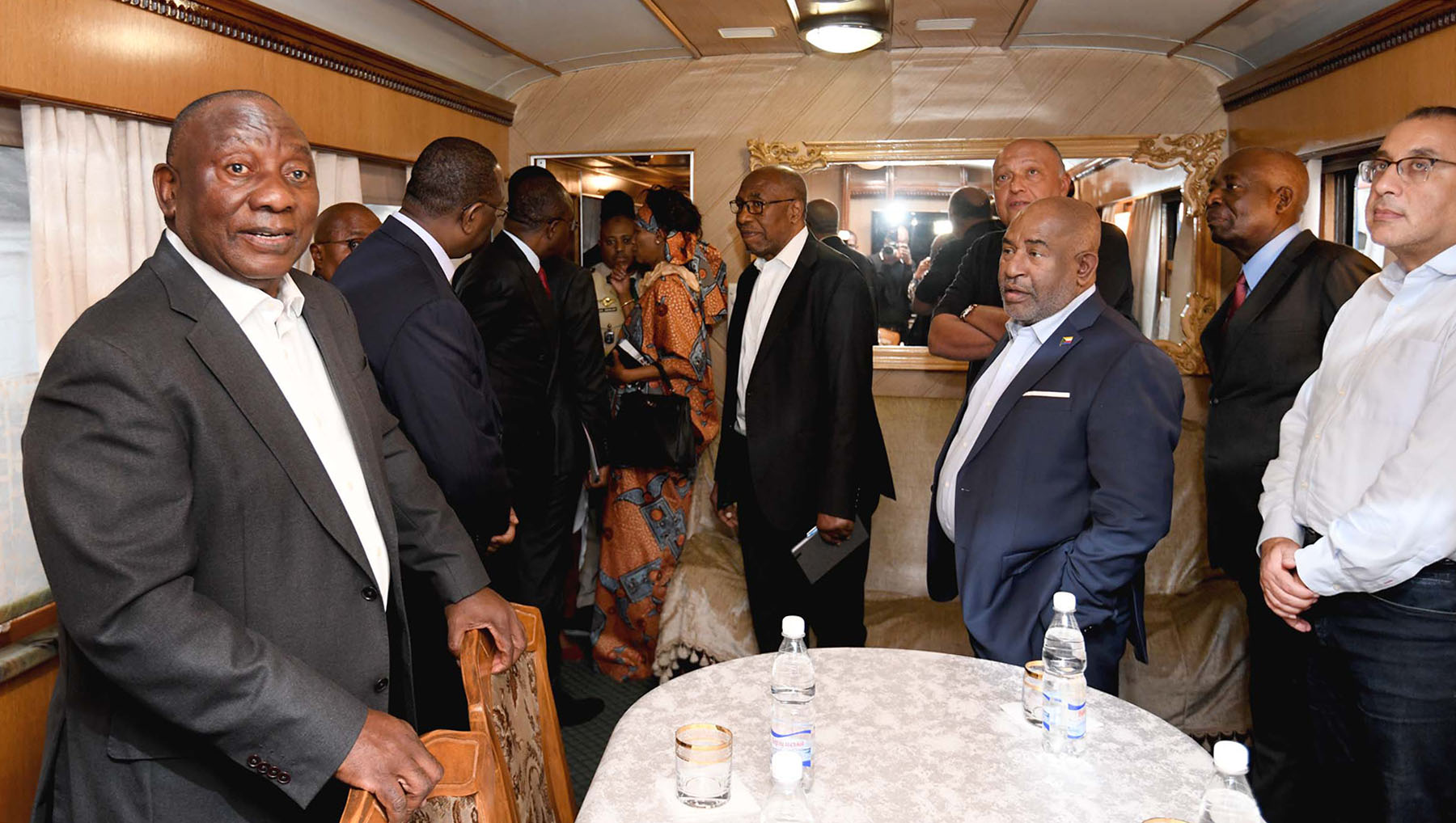

The African peace mission, in which President Cyril Ramaphosa played a leading role, may, in the end, deepen the internal divisions in South Africa over our apparent close relationship with Russia. While this debate has always been about the future direction of our society, and whether we support Russia or Ukraine (and thus the West), it is now likely to include questions about the SA government’s basic competence.
The large number of protection officers, and what the Polish government claims to be a large number of weapons on the support flight to Warsaw, could well lead to bigger questions being asked in the next few weeks. The whole unsavoury incident will amplify debates about Ramaphosa’s strategic judgement, and questions will be asked about whether the President and those around him have by now realised just how little influence they have in Europe.
It is in the elemental toolbox of many politicians around the world to seek to appear next to world leaders on the central stage because it often enhances their prestige back home. But the reverse is true should that brief sojourn in the global spotlight turn into a humiliation — it invariably leads to domestic humiliation too.
Inevitably, Ramaphosa’s opponents are going to use this quixotic mission against him. His government’s competence is already in question after an accusation that they could not even fill out simple paperwork. Others will ask whether his administration understood beforehand that Poland was unlikely to welcome a country seen as supporting Russia, particularly a plane carrying so many weapons, and people allegedly trained to use them.
While some opposition parties are likely to focus on the cost of this failed excursion that went only to Poland and no further, those who oppose our government’s stance on the Russia-Ukraine conflict will ask much deeper questions.
Friendly fire backdrop
Ramaphosa is now likely to have to respond to accusations that this shameful series of events shows that he has absolutely no influence on the global stage. Various people are also likely to ask why, if, as Dirco Minister Naledi Pandor put it, Russia is a “friend” to South Africa, did it launch missiles on Kyiv knowing Ramaphosa was there?
Pandor herself may well want to ponder the question. Does she still believe Russia is a friend, even after providing a friendly fire backdrop to Rampahosa’s few hours in Kyiv?
This argument is likely to be intense. This is almost certainly the first time in the history of South Africa as a nation-state that its leader has been in a city against which missiles have been launched by a “friendly” nation which knew they were there.
The criticism will be appropriately crisp: if your friend launches missiles at you, can you name any enemies who have done the same?
Those who support the West may also wonder, perhaps optimistically, if this incident will have the benefit of changing minds within the government and the ANC. After the last few days’ experiences, even Ramaphosa himself may wonder if, in fact, his government is following the right course.
Certainly, it is clear that Putin is not going to change his course after this visit.
Already, there are signs that Putin is losing support in the ANC. It was the secretary-general, Fikile Mbalula, (who recently spent several days in China), who first said that Putin must “not feel belittled” if he doesn’t come to the BRICS heads of state summit in August.
Now, that Putin has rejected a mission spearheaded by the leader of the ANC, and lobbed missiles at a city knowing he was there, those in the party who support Russia may also want to rethink their stance.
At the same time, Ramaphosa and his allies are likely to argue that, as many neutral commentators in this conflict (should such people still exist) have said, it is always the right time to talk about peace. That Ramaphosa and other African leaders were heroic in going to a country at war to do whatever they could.
As the Sunday Times editor, S’thembiso Msomi, put it on Sunday, “It is said that it took 158 meetings, spanning two years, before parties to the Korean War could reach an armistice.”
Those who take a hard line on supporting Russia are likely to argue that Poland’s actions at the weekend were on behalf of the West. They could argue that the US and other countries want to bleed Russia dry in Ukraine (as hinted last year by US Defense Secretary Lloyd Austin), and thus Poland (a strong ally of Ukraine and a member of Nato) was simply obeying orders by grounding the SAA flight.
But this story could well move in another direction.
One of the strange features in the debate about whether our government’s stance is truly “non-aligned” or supportive of Russia is that it could hinge on whether weapons were indeed loaded on to the Russian ship Lady R in Simon’s Town last year.
At the moment, a three-person panel is investigating this, but the Presidency says the terms of reference, the evidence and the findings will remain secret.
This means that the report is unlikely to have any value whatsoever. Ramaphosa appointed the panel to respond to public claims by the US. But now, if no one knows what findings the panel comes to, it will have no bearing on our relationship with the US. And it will have no impact at all on our domestic debate. Should nothing change substantively, it will be a pointless exercise.
Sniper rifles
One of the consistent features of the reporting on the South African plane that was stranded in Poland is that it was carrying a large number of weapons. As the Sunday Times reported, “Highly placed South African government insiders said the arms included long-range sniper rifles and weapons normally used in serious conflict.”
At this stage, it is difficult to know what these weapons were for. While snipers are a common feature of presidential security in South Africa (they can often be seen around events like the State of the Nation Address, for example) it seems unlikely that either Ukrainian or Russian officials would grant permission for South African snipers to operate on their soil.
It is also difficult to believe that these weapons would be necessary (in the event, it turns out that much more important for the safety of Ramaphosa was a bomb shelter in a nearby hotel).
This may well lead to more questions being asked about the South African National Defence Force and what is really happening inside it.
It is obvious that the debate around Russia and Ukraine in our society is about to enter a new phase with Ramaphosa likely to face criticism of even greater intensity.
But the key question may be in fact whether the events in Poland, Ukraine and Russia over this weekend lead Ramaphosa to change his view. And whether that means our government may be about to change its stance on this conflict. DM