



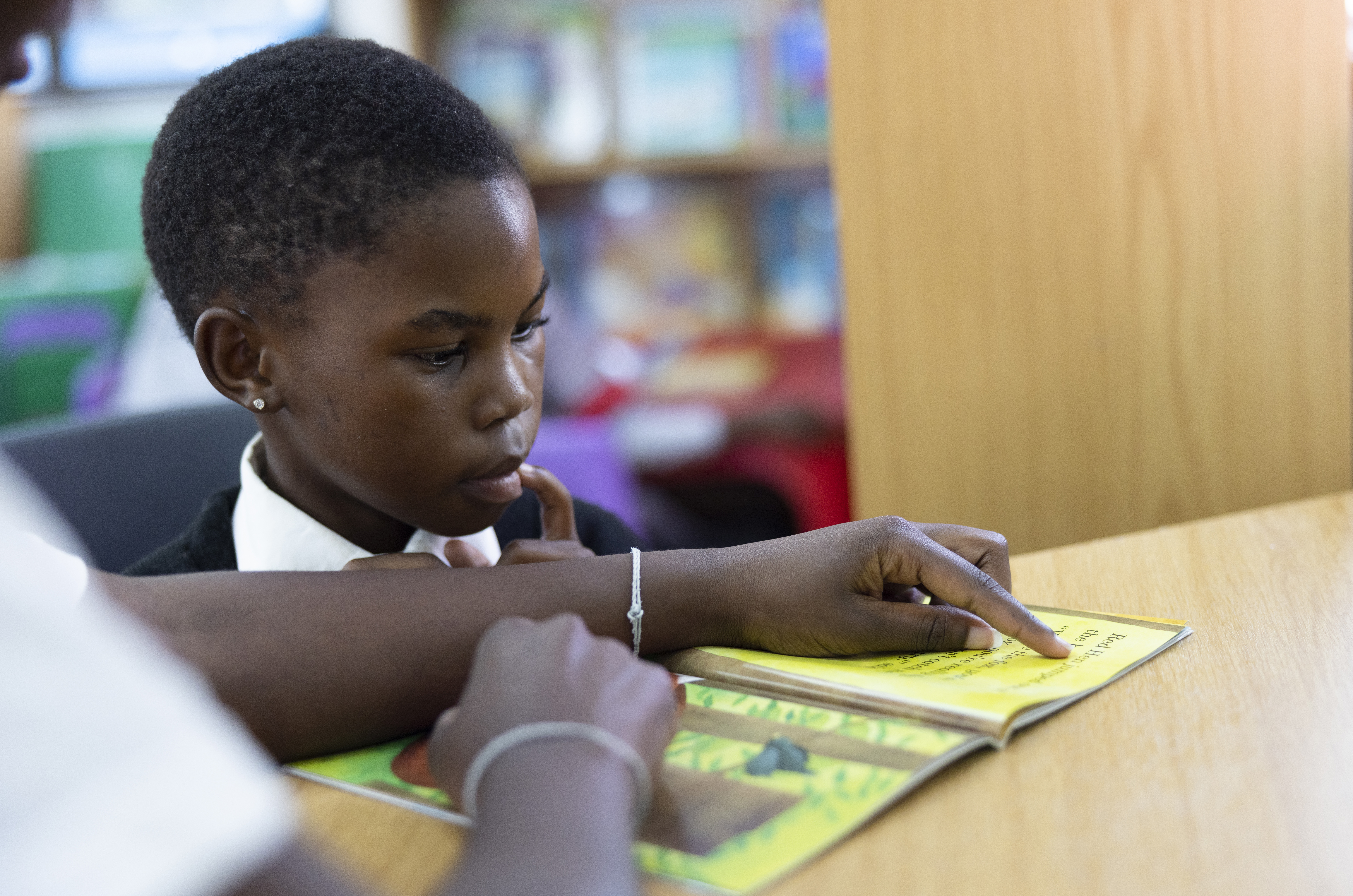

South African education nonprofit help2read is not only seeking to improve reading outcomes in schools, but also involving young adults in their efforts to make a difference. Their approach is chipping away at two major problems facing our society: poor child literacy and high youth unemployment rates.
The nonprofit trains and employs young people from the communities surrounding their partner schools to be English literacy tutors, providing both group and one-on-one support for struggling Foundation Phase learners.
“Covid-19 has played a role in almost creating a lost generation, but there is good news,” said Lynn Cumpsty-Steyn, CEO of help2read.
“Help2read is a tiny NGO – we’ve reached 30,000 plus learners since 2006… We give young people 10 months of employment, we train them to give one-on-one attention to learners, and our assessment is showing that the help2read learners… improve dramatically in the building blocks of reading. So, it can be done.”
 Members of the help2read team at Sivuyiseni Primary School in Khayelitsha, Cape Town. From back left: Yolanda Vokozela, Qawekazi Gcanga, Mziwoxolo Laphi, Yonela Mvandaba, Nondumiso Mzamo, Thembela Khohlakala. From front left: Zizipo Silihasa, Lisa Mbuyazwe, Lazola Ndarala. (Photo: Tamsin Metelerkamp)
The results of the 2021 Progress in International Reading Literacy Study (Pirls), released on 16 May 2023, showed that 81% of Grade 4 learners in South Africa were unable to read for meaning in any language.
Read more in Daily Maverick: International study shows most Grade 4s in South Africa cannot read for meaning
Through Early Grade Reading Assessments (Egra) – standardised tests meant to assess learners’ abilities to perform fundamental pre-reading and reading skills – help2read has been able to track the improved reading outcomes of their learners, according to Cumpsty-Steyn.
The Egra results show that between 2019 and 2022, the average scores for “passage reading” among help2read learners went from 59% to 88%, while average “phonemic awareness” scores went from 67% to 78%. Average “comprehension” scores went from 30% to 42%.
Read more in Daily Maverick: National Reading Plan to be revised as SA grapples with poor early grade learner literacy
The nonprofit is active in a number of communities, including Diepsloot, Gauteng, as well as Khayelitsha, Mitchells Plain and the Cape Winelands in the Western Cape. Their “Literacy Tutor Programme” operates in eight schools, reaching more than 3,000 learners.
The programme is beneficial for the tutors as well as the pupils.
Senior literacy tutor Thembela Khohlakala, a Khayelitsha resident, told Daily Maverick that he joined help2read in 2019, the year after he matriculated. The experience “opened up” his mind, he said, pushing him to think about furthering his own education.
“Now I know what I’m going to do next year… Working in this environment, becoming a literacy tutor [means] I can be a qualified teacher in the coming years. So, that is why I ended up applying for the [teaching] course at Unisa,” he said.
 Thembela Khohlakala, senior literacy tutor at help2read, first started with the nonprofit in 2019 and has since decided to pursue a teaching qualification. (Photo: Tamsin Metelerkamp)
Tutor development
Those applying to be tutors at help2read must have a matric certificate, with decent outcomes for language, according to Cumpsty-Steyn. Most tutors are between 19 and 26.
Training for tutors involves personal development and financial literacy programmes, as well as some career guidance, she said.
“The [school] teachers assign the learners to the tutors. They each work with 10 learners, and they then negotiate their times with the teachers,” explained Cumpsty-Steyn. The tutors work with pupils in grades R to 4, with children in the lower grades participating in “reading clubs” rather than one-on-one sessions.
Daily Maverick visited Sivuyiseni Primary School, a quintile 3 school in Khayelitsha, where Khohlakala and his team work. A room at the school has been set aside for their use, the walls covered in colourful, handmade posters showing phonics sounds and parts of speech.
 Lazola Ndarala, a tutor at help2read, says working at the nonprofit has taught her how to work patiently with children. (Photo: Tamsin Metelerkamp)
Lazola Ndarala, a tutor who joined help2read last year, said her team faced many challenges at Sivuyiseni, including that many of the learners were shy and unsure of their abilities.
“You are trying… to also build their self-esteem,” she said. “Just to give back to the community is so nice, because you are staying in this community, and now you are trying to enhance the English.”
Being a help2read tutor teaches patience and understanding, according to Lisa Mbuyawze, another tutor at Sivuyiseni. Through interactions with the children, she learns more about their backgrounds and the obstacles they face.
 Lisa Mbuyazwe, a tutor at help2read, says some children are shy when it comes to reading aloud, so lessons are about building their confidence as well as their skills. (Photo: Tamsin Metelerkamp)
“Each and every term, we take the report and see the progress when it comes to English and other subjects. There was a lot of progress last year when it came to English because I understood that [the learners] did not fail because they didn’t know [the answer to] the question, but because they didn’t understand. Now, they read it [with] understanding, and it became better,” she said.
Lukhanyo Betana, an English and social sciences teacher at Sivuyiseni, said he had seen a significant improvement in learners’ reading outcomes since help2read started offering their literacy tutor programme at the school 18 months ago.
“I could see that they built some confidence in [the learners]... They were able to read,” he said. “There is a change that is happening within the school.”
The disruptions of the pandemic affected literacy skills at Sivuyiseni, he continued. Many pupils were further disadvantaged due to the lack of a “culture of reading” in their homes.
“In the classrooms… I think it is our responsibility as well to constantly remind learners of the importance of reading, the importance of books, because our learners go back to the home environment [and] the culture of reading is not there,” he said.
“If we do not instil it here in school, it’s not going to happen.” DM