




Riah Phiyega feels hard done by. According to weekend reports citing unnamed sources, Phiyega wrote to President Jacob Zuma that she inherited a militarised South African Police Service (SAPS) in 2012 and was only in charge for two months before the Marikana massacre. “We have picked up some of the areas where we strongly disagree with the content of the report, such as the insinuation that management went to work that day with murderous intent. But this is a discussion for another day,” the national police commissioner said in a recent statement.
Last week, her deputies and provincial commissioners said they fully support her and were concerned about the “prevailing unfair and largely negative attitude towards the national commissioner of the SAPS”.
In a way, they are right. There were 740 police officers deployed in Marikana. Phiyega was not in command of operations; she didn't fire the bullets, hunt down the survivors at scene two, manhandle the dead bodies, or deny the injured medical services. But that doesn't mean she should keep her job.
In June, Zuma wrote to Phiyega asking for her response on the commission's recommendation that an inquiry be held into her fitness to hold office and whether she is guilty of misconduct in attempting to mislead the commission.
The Marikana report was scathing: “The leadership of the police, on the highest level, appears to have taken the decision not to give the true version of how it came about that the 'tactical option' was implemented on the afternoon of August 16 and to conceal the fact that the plan to be implemented was hastily put together without POP inputs or evaluation. In order to give effect to this, the decision at the NMF (National Management Forum) was not disclosed to the commission. An inaccurate set of minutes for the 06:30 meeting was prepared and a number of SAPS witnesses testified before the commission in support of the incorrect version. There is at least a prima facie case that the national commissioner and the provincial commissioner for the North West Province, who knew the true facts, approved Exhibit L, (an) SAPS presentation which contained the incorrect facts.”
That's the key allegation – Phiyega supported a police lie, that the decision to disperse and disarm the strikers was taken on August 16 when in fact it was taken on the evening of August 15 by Phiyega and the provincial commissioners who are now publicly supporting her.
The Marikana report puts it succinctly but fails to capture how implausible Phiyega's testimony to the commission was. Chairman Ian Farlam last year quizzed her on the “secret” meeting, which only emerged after a tip-off to evidence leaders. Phiyega stonewalled him. She couldn't remember the details of what was discussed because she doesn't have a “photographic memory” and could not recall “pedantic details”. Farlam responded: “The fact that the proposal was endorsed by the meeting, the fact that the people there all agreed to make resources available as required, surely means that they cannot evade responsibility and say: 'We knew about the plan. Sure go ahead. And if it goes wrong or is managed badly or defective planning that's nothing to do with us.' Surely there comes a time when responsibility must rest with those people in that meeting as well.”
The plan did go wrong. Despite a lack of intelligence on the ground, the risk of danger, police intervention days earlier that saw the deaths of two officers and three protesters, and an operation designed for early morning rather than afternoon, the SAPS went “tactical” on August 16.
Phiyega and others in the meeting weren't found responsible for the massacre, but if the recorded transcript of the NMF meeting did not go “missing” the commission could have provided more detail on the motivations for arbitrarily deciding August 16 was “D-Day” and the level of interrogation, or lack of it, of the operational plan. The lie Phiyega endorsed, that the decision to confront the strikers was made on August 16, shielded the SAPS top brass from responsibility. Because the SAPS withheld details of that evidence the relatives of the 34 people killed know almost nothing about a crucial moment directly linked to the death of their loved ones.
Phiyega also faced other accusations. The commission found her comments on August 17 that Marikana represented the “best of responsible policing” might have been due to a lack of information and attempts to boost police morale. But it said they were “singularly inappropriate” and “set out what was from then on to be the official police line: that no blame at all attached to the police for what happened because they had been responsible in doing what they did. This was calculated to effect a closing of the ranks, encouraging those who had participated in the operation to withhold contrary information from the commission and indeed to deny that mistakes had been made and things had been done that could not be described as 'the best of possible policing'.”
The commission agreed with evidence leaders that Phiyega did not dispute North West Police Commission Lieutenant Zukiswa Mbombo's testimony that they discussed the possibility of Julius Malema coming to Marikana and resolving the situation, which evidence leaders said meant the were police taking political factors into account in police operations.
Phiyega's strategy throughout the commission was to never make a definitive statement, refer specific questions to her juniors, and try never to agree with the cross-examiner. Simply, she was an uncooperative witness. Her dodging left questions unanswered and the commission's report said she was unhelpful in determining what role then police minister Nathi Mthethwa played in Marikana.
Phiyega was also found by the commission to have deliberately misled the public about the details of the killings. In an explanation to the president after the massacre, she clearly said there were two killing sites, scene one and two. On August 17 the explanation was modified for a press conference, creating the impression there was only one shooting incident. Scene two was later dubbed the “killing koppie” and the commission said it could not make specific findings on the 17 deaths there, which require further investigation.
The police commissioner didn't do herself any justice during the inquiry. In 2013, Phiyega's statement that she had seen nothing to question her belief that police acted in self-defence was questioned with a statement from an officer alleging execution-style killings of the wounded. She admitted she met the officer and heard his views. It led director of the Centre for Applied Legal Studies Bonita Meyersfeld to say: “At best, the national commissioner was dishonest in saying that she had received no information to cause her to question the truth of her press statement that the police had acted only in self-defence. At worst, the fact that the police have never mentioned this evidence is indicative of a deliberate cover-up.”
After the commission, it doesn't seem she has learnt her lesson. Days after the report was released, SAPS expert witness Cees de Rover, who questioned much of what the police claimed when under cross-examination, said he received an SMS from the top cop: “You seriously misrepresented SAPS in the Marikana commission. You shall never be able to assist this service. We are disappointed by the subjective approach you adopted and the clear focus on your self-enlightened interests a real pity indeed General Phiyega.”
As the top cop, not only should Phiyega take responsibility for what happened under her leadership but she must answer the accusations against her, particularly the prima facie evidence that she endorsed a lie. Her performance at the commission did not help exonerate the SAPS and rather than prove the broader claims against her, such as acting in a plot of murder to support politicians and profit, were just allegations, Phiyega was stubbornly unwilling to cooperate with the inquiry. Her removal can only help the SAPS.
Yet the recent statement from SAPS provincial commanders is true – Marikana is not just about her. Phiyega is not suitable to be the country's top cop. But others must also face the blame. Since the report's release, nothing has been said about the investigations into its recommendation to investigate charges against all of those possibly responsible for unlawful killings in that bloody week in Marikana.
For all these reasons, Phiyega should do the honourable thing, as late as it may be, and resign. After the rupture that was Marikana, SAPS, and South Africa, needs to heal. That much-needed process is now almost three years overdue. DM
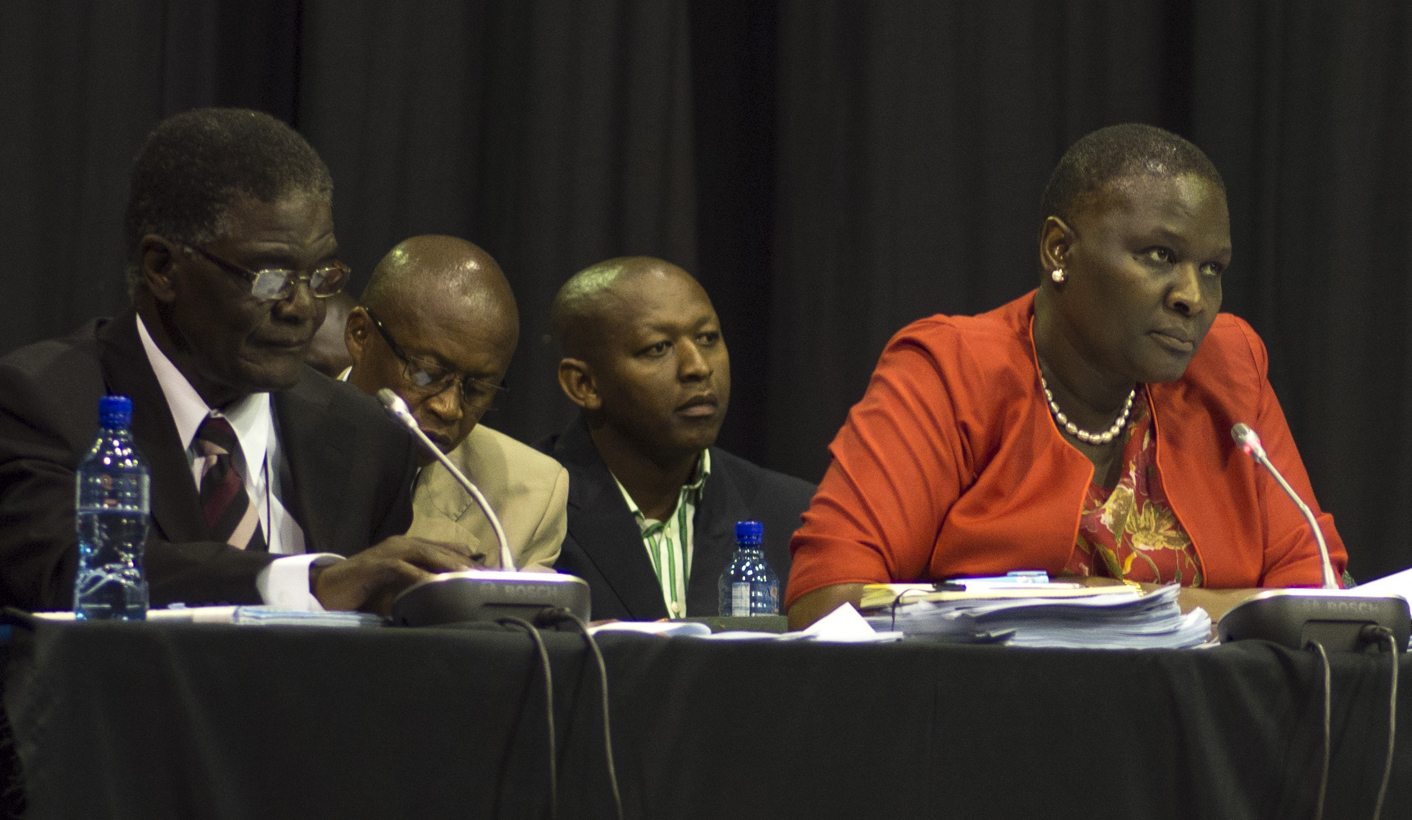
Photo: Rustenburg, North West, South Africa. 2013, April 5.The Farlam Commission into the Marikana Massacre sitting in Rustenburg, with Police Commissioner Riah Phiyega being questioned. (Greg Marinovich)
Read more:
- Marikana report: Key findings and recommendations in Daily Maverick